
What is a remote employee of record and when do businesses use one?

At a glance
- A remote employee of record is a full-time offshore worker employed through a third-party EOR that handles payroll, tax, and legal compliance in the destination country on the client’s behalf.
- The EOR model lets businesses hire genuine employees in foreign markets without registering a local legal entity, cutting months from a cross-border hiring timeline.
- Unlike a contractor arrangement, a remote employee of record has full employment rights in their home country, while the client retains day-to-day direction over the work.
- Remote Employee specializes in this model, placing dedicated offshore staff from the Philippines with a 97% staff retention rate and no requirement for clients to establish a foreign subsidiary.
Most businesses understand what it means to hire an employee. Fewer understand what it means to hire one across borders without triggering a local registration obligation, payroll tax exposure, or labor law liability in a market they have never operated in.
When a company wants to bring on a full-time offshore worker without setting up a local entity, a remote employee of record arrangement closes that gap.
A third-party employer of record (EOR) becomes the legal employer in the destination country, handling employment contracts, payroll, statutory benefits, and compliance. The client retains full control over day-to-day work.
This article explains what that model is, how it works in practice, and when it makes more sense than a contractor arrangement or a fully owned foreign subsidiary.
What an employer of record is and what “remote employee of record” means
An employer of record is a third-party company that employs workers on behalf of another business. The EOR holds the employment contract, runs payroll, makes statutory contributions, and manages compliance with local labor law in the worker’s home country.
The term “remote employee of record” describes the worker in this structure: a full-time employee whose legal employer is the EOR, not the client. The client directs all the work. The EOR handles everything on the employment side.
This differs from an outsourced staff arrangement. A remote employee of record works exclusively for the client and integrates directly into their operations. The EOR’s role is purely administrative and legal, making global employment accessible without the cost and delay of establishing a foreign entity.
How the remote employee of record model works in practice
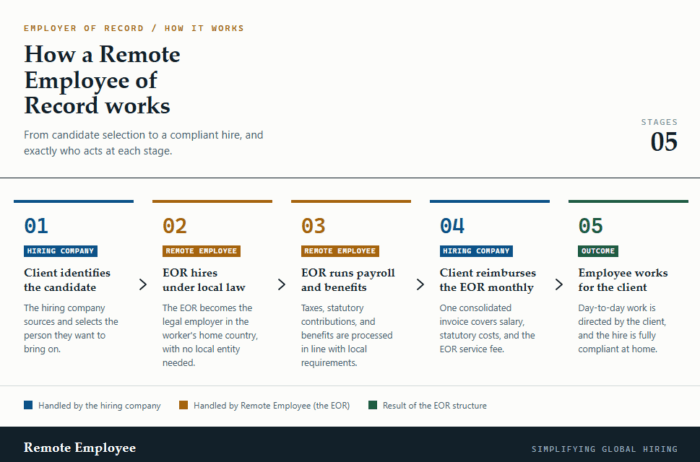
Five stages take a hire from candidate selection to active employment, with responsibilities clearly split between the client and the EOR.
- The client identifies the candidate — through the EOR’s talent network or their own sourcing process.
- The EOR employs the worker locally — issuing an employment contract under local labor law, with the worker’s statutory benefits fully compliant for their home country.
- The EOR manages payroll and statutory contributions — including income tax withholding, social security equivalents, and any mandated employer contributions.
- The client reimburses the EOR — covering the worker’s salary, employer costs, and the EOR’s service fee, billed monthly.
- The worker integrates with the client’s team — attending meetings, working set hours, and reporting directly into the client’s management structure.
The worker sits on the EOR’s legal books, not the client’s. Operationally, they function as a full team member.
Remote employee of record vs contractor: Where the distinction matters
The EOR model and the contractor model look similar on the surface: a worker in another country doing work for a client. The legal and operational reality differs significantly.
| Dimension | Remote employee of record | Contractor |
|---|---|---|
| Employment status | Full employee in home country | Self-employed, independent |
| Client control | Full behavioral and operational control | Limited — contractor sets their own methods |
| Tax obligations | EOR withholds and remits | Contractor manages own taxes |
| Benefits | Full statutory benefits in home country | None from client or EOR |
| IP ownership | Clear client ownership via employment contract | Requires separate IP assignment clause |
| Exclusivity | Works exclusively for the client | May serve multiple clients simultaneously |
For roles requiring full-time commitment, IP ownership, and direct behavioral control, the EOR model is the legally appropriate structure. Misclassifying a full-time offshore worker as a contractor creates compliance exposure in most jurisdictions.
According to Atlas research cited by Select Software Reviews, 86% of HR leaders identify international compliance with local labor laws as their top workforce challenge when hiring across borders, which explains why misclassification carries serious legal and financial consequences.
When a remote employee of record arrangement makes sense
The model fits specific scenarios where speed, compliance, and operational simplicity matter more than building local infrastructure.
- Entering a new country for the first time — The EOR removes the need to register a local entity, which typically takes three to six months and significant legal overhead.
- Hiring a small number of offshore workers — When volume does not justify a full foreign subsidiary, the EOR provides a compliant, lower-overhead alternative.
- Navigating complex local labor law — Markets with strict employment protections or mandatory benefits require specialist knowledge; the EOR already has it.
- Moving quickly on a hire — EOR timelines run days to weeks, compared to months for entity setup in most jurisdictions.
- Reducing administrative burden — Businesses that want the commitment level of a full-time employee without the payroll infrastructure of a foreign subsidiary benefit from the clean separation the EOR provides.
The employer of record market reached roughly USD 5.2 billion in 2024 and is projected to nearly double by 2034, reflecting how quickly cross-border hiring through compliant employer of record services has shifted from a specialist approach to standard business practice.
Hire your remote employee of record with Remote Employee
Remote Employee helps businesses hire full-time dedicated offshore staff from the Philippines without registering a local legal entity. Their managed model covers employment contracts, HR compliance, payroll, and statutory benefits, so clients retain full direction over the work without the administrative complexity of global employment.
“We don’t just provide staff; we build partnerships. Our goal is to act as an extension of our clients’ businesses, so we aim to make certain they achieve their objectives without compromising quality.” – Ruffy Galang, CEO and Co-founder, Remote Employee
- 97% staff retention rate across roles spanning accounting, IT, healthcare administration, customer service, software development, and creative functions
- Fully managed compliance covering Philippine labor law, statutory benefits, and payroll tax obligations
- Dedicated offshore staff integrated directly into the client’s team — not a shared or pooled resource model
- No local entity requirement for clients, with onboarding timelines measured in weeks rather than months
For businesses that want the commitment of a full-time employee without the infrastructure of a foreign subsidiary, get in touch with Remote Employee to explore your offshore staffing options.
Frequently asked questions
Common questions about the remote employee of record model and how it compares to other offshore hiring structures.
What is the difference between an employer of record and a PEO?
A PEO co-employs workers alongside the client, which requires the client to have an existing legal presence in the destination country. An EOR is the sole legal employer, so no local entity is needed on the client’s side. EOR is the standard structure for international hiring where the client has no established in-country presence.
Does the remote employee know they are employed through an EOR?
Yes. The employment contract is between the worker and the EOR, and this is disclosed from the outset.
In practice, the worker experiences their relationship with the client as their primary employer. The EOR operates in the background as the legal and administrative layer.
Is a remote employee of record the same as an outsourced employee?
Not exactly. An outsourced employee typically works for a third-party provider that serves multiple clients, sharing management and infrastructure.
A remote employee of record works exclusively for the client business, with the EOR handling only the employment and payroll layer. The client relationship is direct and full-time.
When should a business use a remote employee of record instead of opening a local entity?
Businesses should consider an Employer of Record when hiring employees in a new country without the time, cost, and legal requirements of establishing a local entity. An EOR enables faster hiring while managing payroll, compliance, and employment obligations on the company’s behalf.
Key takeaways
- A remote employee of record is a full-time offshore worker employed through a third-party EOR that handles legal compliance and payroll in the destination country.
- The EOR model allows businesses to hire genuine employees without registering a local entity, cutting setup timelines from months to weeks.
- The model differs from contractor engagement: the remote employee of record has employment rights and statutory benefits, and the client retains full behavioral control.
- Remote Employee provides this model for offshore hiring from the Philippines, with fully managed compliance and a 97% staff retention rate.






 Independent





