
Remote customer support and how it benefits companies and customers


Remote work is now normal for many teams. In fact, companies can deliver the same quality of service from home. This includes customer support. So what exactly is remote customer support, and how do you adjust to it?
What is remote customer support and why does it matter?
Remote customer support is help given to customers by phone, chat, or the internet, so agents solve issues from anywhere while businesses cut costs and stay flexible.
- Agents answer questions by phone, live chat, email, and screen sharing.
- Customers get faster replies without travel or long waits.
- Companies save on office space and hire talent from anywhere.
In the 456th Outsource Accelerator podcast, Alex Holmes of Influx.com stresses the value of clear roles and a systemized setup. So teams avoid mix-ups and coordination gaps.
He says “I think it comes down to defining which roles have really defined scope where the coordination problems are at a minimum… I think most customer service roles are really well defined.”
“[W]e find the most successful clients and the most successful managers inside our company are really good at systemizing things…”
What is remote customer support?
As the name suggests, remote customer support is help given by phone or the internet. So agents assist customers without meeting them in person. Today, businesses answer questions and concerns remotely. As a result, both sides save time, travel, and money.
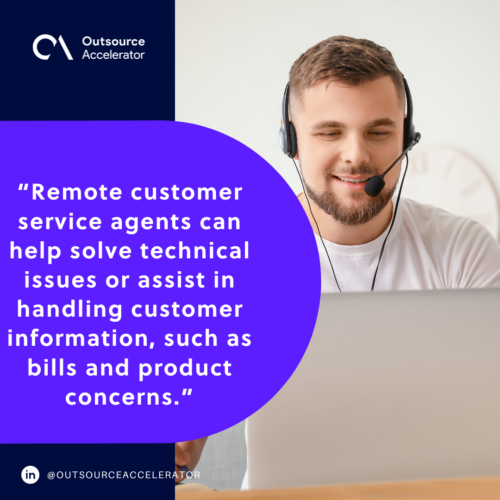
Customer needs vary by product or service. For example, remote agents can fix tech issues or handle bills and product concerns. Strong customer service skills make all of this easier.
Difference between on-site and remote customer support?
The main difference is simple. On-site support needs face-to-face contact, while remote support does not. Traditional service means in-person meet-ups between the customer and business. However, that path costs more time and energy for both sides. So remote support removes much of that hassle.
Benefits of remote customer support
Remote customer support brings many perks. In fact, it helps both the customer and the agent.
Immediate response
The best part is speed. Customers get answers right away. As a result, they feel heard, and loyalty grows. So no one waits long for help.
Increased efficiency
Faster replies also mean faster fixes. So agents can move to the next case sooner. As a result, more customers get help each day. Plus, there is no travel time or cost to slow things down.
Holmes says working with team members worldwide is mostly about efficiency, stating “[I]t’s really a matter of efficiencies. So if the more operational a job is, the more defined a job is, the more it’s fine to work from home.”
Flexibility
Agents can work their preferred hours from home. For example, one agent takes a morning shift before another takes over. So companies can keep 24/7 customer support service by hiring across time zones. As a result, staff gain freedom and a better work-life balance.
On the podcast, Holmes talks about the comfort that home work brings to people in busy cities. He stated “[A] really big value add for them is to be able to work from home 100% of the time, especially in countries or cities like Jakarta or Nairobi, you know, lots of traffic.”
“[T]hey just don’t want to commute two hours each way, each day. And so working from home, they’re very, very happy and empowered.”
Lower costs
On-site support carries many costs. For example, transport, office space, and utilities add up fast. However, remote work removes most of that spend. So your company can save funds for other needs.
Hire talent from anywhere
One of the biggest perks is reach. There are no location limits. So companies can hire skilled people from anywhere in the world. As a result, talent and diversity both grow. This is also why many firms are now outsourcing their customer service. It also helps with hours, since 24/7 support needs people across time zones.

Kinds of remote customer support
Remote support is not just phone calls all day. In fact, customers can reach agents in many ways.
Cobrowsing
Cobrowsing lets an agent view the customer’s screen to fix issues. Since the two cannot meet in person, this is the next best thing. So the agent sees the problem firsthand and troubleshoots it directly. As a result, it cuts miscommunication. For high-value clients, it also supports a more high-touch customer service approach.
Live chat
With live chat, customers send concerns and get quick replies. People want fast answers, so live chat fits well. It also allows one-on-one help, which feels personal. As a result, customers feel happy and stay loyal. Today, many teams pick from a range of chat tools for customer support to make this smooth.
Is remote customer support the new normal?
Remote work is slowly becoming the norm across business, including support. Gone are the days when staff were tied to call centers and offices. So working remotely keeps agents productive while it protects balance and flexibility.
Remote support is also easier, more personal, and more convenient. As a result, it saves both the customer and the agent time and money. The latest customer service statistics point the same way. So the shift looks set to stay.
Remote customer support: FAQs
What does remote customer support mean?
It means agents help customers by phone, chat, or the internet. So they solve issues from anywhere, without meeting in person.
What tools do remote support agents use?
Agents use live chat, email, and phone systems. For example, they also use cobrowsing and CRM tools. So they can view screens and track customer details with ease.
Is remote customer support as good as on-site support?
Yes, often it is better. Remote support gives faster replies and lower costs. Still, it needs clear roles and good systems to run well.
How do companies keep remote support quality high?
First, they set clear roles and goals. Next, they use strong tools and steady feedback. As a result, teams stay aligned and service stays consistent.
Can remote support run 24/7?
Yes, and this is a key perk. By hiring across time zones, companies cover every hour. So customers get help day or night.






 Independent






