
Reduce labor costs with Emapta’s outsourcing solutions


How can outsourcing help you reduce labor costs?
Outsourcing helps you reduce labor costs by moving tasks to skilled professionals in regions with lower wages, so you cut salary, benefits, and overhead without losing quality.
- Offshore wages are lower, so payroll costs drop.
- You skip the cost of benefits, training, and office space.
- You can scale the team up or down as workloads change.
Time changes things. You can probably learn from your elders that running a business in the old days did not cost this much.
Today, finding ways to reduce labor costs while keeping operations efficient is a must. As the global economy grows more connected, one solution has risen to the top: outsourcing. The wider benefits of outsourcing go well beyond price.
Handing specific tasks to outside providers offers real savings without hurting quality. Outsourcing also spans many industries, from creative design to IT services.
Leading providers like Emapta offer a range of outsourcing solutions built for the global market. So this article compares in house hiring with outsourcing. It also shows how Emapta can help you reduce labor costs.
In-house or outsourcing?
The choice to build an in house team or outsource often leaves companies at a crossroads. So it helps to weigh the pros and cons of each path.
Cost efficiency
Hiring in house is not the way to go if you want to reduce labor costs. It brings expenses like salaries, benefits, training, and office space. These costs can be large and hard to predict over time.
Outsourcing usually offers a cheaper path. For example, you can find professionals in regions with lower wages, such as the Philippines. As a result, you reduce labor costs. Many firms start by outsourcing to the Philippines for this reason.
Scalability and flexibility
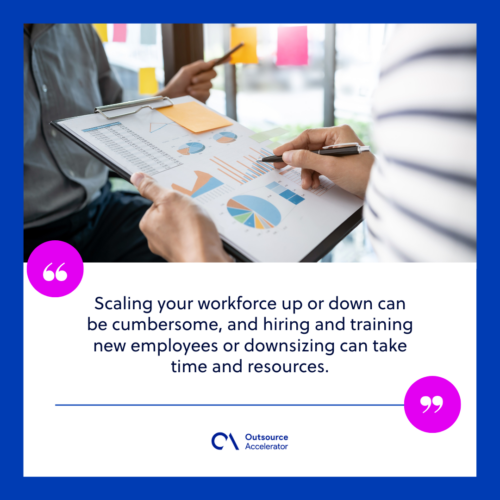
Scaling your workforce up or down can be slow. After all, hiring, training, or downsizing takes time and money.
Outsourcing offers strong scalability instead. So you can adjust your team to meet changing workloads fast. A staff augmentation model makes this even easier, with no in house recruiting overhead.
Quality and control
With internal staff, you have direct control. That makes communication and oversight easier. However, keeping quality steady can be hard without the right expertise.
With outsourcing, you may have less direct control. Still, reputable partners follow strict quality standards. Clear communication and regular updates keep you informed and in charge of your projects.
Security and confidentiality
With in house staff, you have more control over data security. Even so, the risk of internal breaches remains.
Reputable outsourcing firms also put security first. For example, they often use strong measures like data encryption and access controls.
Time to market
Building your own team takes time. As a result, project starts and product launches can slip.
Outsourcing lets you onboard skilled people quickly instead. So you cut time to market and sharpen your edge.
Neither path fits every case. In fact, it depends on your business needs, goals, and resources.
Many successful businesses strike a balance between the two. For example, they keep in house talent for core work and outsource the non core tasks.
Recruiting an internal team is the traditional choice. Still, if you are unsure whether outsourcing can reduce labor costs, consider this illustration.
Comparing labor costs then and now
To give you a clear picture, here is a contrast between the wages of an IT specialist in the past and more recently. The landscape of IT labor costs has shifted hard over the years. As a result, businesses must adapt and rethink how they hire.
Labor costs in 2018
The IT job market back in 2018 was notably different. Talented professionals were already in high demand. So their pay reflected it.
Salaries were competitive. Companies also offered strong benefits to keep top talent.
Consider a mid level IT professional. Let us call him Eddie. With only a few years of developer experience, Eddie could earn an average of $86,750 to $146,000. That number climbed higher, from $170,000 to over $199,000, if he specialized in areas like applications and mobile.
If you hired Eddie in house, you also had to add benefits. For example, health insurance, retirement contributions, and bonuses. At an estimated $21,726 per employee, this added a lot to annual labor costs.
Labor costs in 2023
Fast forward a few years, and several factors had reshaped the landscape:
- Rising labor costs. IT salaries surged, often outpacing inflation. So a mid level developer like Eddie could now demand $97,600 to $155,000.
- Benefits and perks. Competition also drove more generous benefits, an average of $11.86 per hour.
- Remote work. The shift to remote work added new costs too, like pay for IT staff working at home.
These rising costs bring both chances and challenges. Investing in top IT talent matters more than ever. However, the higher expenses can strain budgets, especially for smaller firms. For many of them, outsourcing for small business has become a practical answer. These pressures have only continued in the years since.

How partnering with Emapta helps reduce labor costs
Outsourcing stands out as a strong way to reduce labor costs. It offers several ways to save while keeping quality high. So outsourcing brings these advantages:
- Lower wage rates in offshore locations
- No need for employee benefits
- No training costs
- Reduced overhead costs
Need a trusted outsourcing firm? Emapta has you covered.
Access lower cost resources while reaching premium talent. Emapta opens a deep pool of skilled teams to keep your performance at its peak and reduce labor costs.
Build an offshore team with Emapta today.
Frequently asked questions about reducing labor costs
A few questions come up often once teams weigh outsourcing to reduce labor costs.
How much can outsourcing cut labor costs?
Savings vary by role and location. Still, many firms cut labor costs by moving work to regions with lower wages. On top of that, they save on benefits, training, and office space.
Does outsourcing lower quality when you reduce labor costs?
Not with the right partner. Reputable firms follow strict quality standards and clear reporting. As a result, you can reduce labor costs and still keep strong output.
What tasks are easiest to outsource first?
Start with non core tasks that have a clear scope. For example, IT support, design, and back office work are common first steps. Then expand once you trust the partnership.
Is outsourcing only for large companies?
No. Small and mid sized firms often gain the most. After all, outsourcing gives them access to skills and savings they could not build in house.






 Independent






