
Pick and pack: Optimizing order fulfillment


What is pick and pack in order fulfillment?
Pick and pack is the process of selecting ordered items from inventory and packing them for shipping, so e-commerce orders go out fast and accurately.
- It covers picking items, packing them safely, and prepping them for dispatch.
- It drives delivery speed and order accuracy.
- It lowers costs when you organize inventory and routes well.
The success of any e-commerce business relies on fast, accurate delivery. So, the pick and pack process plays a central role.
An order fulfillment process is not complete without the pick and pack phase. In fact, data from APS Fulfillment, Inc. shows that order picking takes about 55% of total labor.
In short, the method makes sure products are chosen from inventory, packed safely, and shipped on time.
This article explains pick and pack, its benefits, and its process. In addition, we will explore strategies you can use to optimize this key part of daily operations.
What is pick and pack?
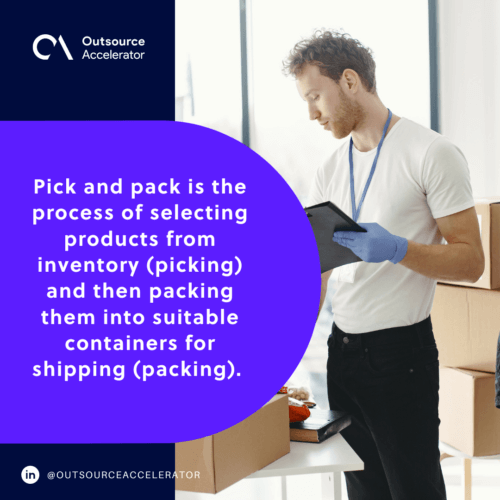
In short, pick and pack is the process of selecting products from inventory, then packing them into the right containers for shipping.
This step happens after you receive an order. However, it involves several stages to run smoothly.
Strong pick and pack practices are vital for customer satisfaction. For example, they shape delivery speed and order accuracy. Many online sellers hand this phase to outsourced fulfillment services as they grow.
How the pick and pack process works
The pick and pack process has several key stages. So, each step adds to the speed and accuracy of order fulfillment.
Order receiving and processing
The first step is to receive incoming orders. This happens through online platforms or other channels. Next, the orders are processed, verified, and entered into the system.
Inventory management
Before picking and packing can start, you need a well-organized inventory system.
Efficient inventory management keeps products ready and easy to find. As a result, it cuts the time needed to pick.
Order picking
Order picking is the core stage. So, workers physically choose products from inventory based on each order.
Order packing
Once picked, the products must be packed well to prevent damage in transit. So, proper packaging helps items reach customers in good condition.
Order shipping
The final step is to ship the packed orders using chosen carriers. This stage needs tight coordination so orders go out on time. Smooth links with e-commerce logistics keep dispatch on track.
Benefits of the pick and pack process
Overall, an efficient pick and pack process brings many gains. Here is why it is vital for e-commerce businesses:
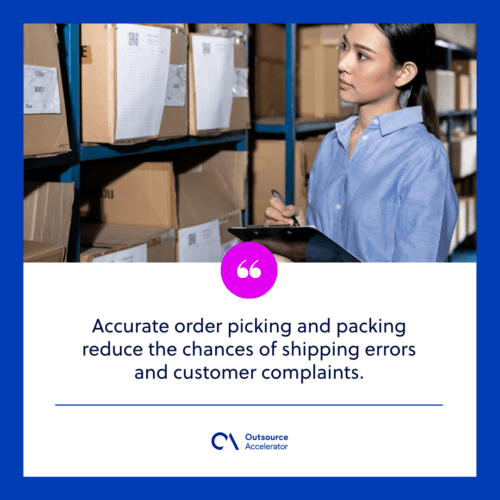
- Improved order accuracy. Accurate picking and packing cut shipping errors and complaints.
- Faster delivery times. A streamlined process lets you fulfill orders quickly. So, faster delivery lifts customer satisfaction.
- Reduced costs. Optimizing the process lowers labor costs and waste. In turn, you use resources better.
- Enhanced inventory control. Good inventory management gives you better control of stock. As a result, it lowers the risk of stockouts or overstock.
- Better customer satisfaction. Accurate, prompt delivery improves the customer experience. So, it builds brand loyalty and spurs positive reviews.
Picking and packing techniques
Organizations can use several picking and packing techniques. However, the right method depends on your products, order volume, and warehouse layout.
Here are four common ways to pick and pack.
Piece picking
In short, piece picking means selecting one item at a time for a specific order. So, it suits businesses with many products and lower order volumes.
Batch picking
Batch picking means selecting several orders at once. As a result, it cuts total effort and travel time in the warehouse. This method helps firms with many small orders.
Zone picking
Zone picking splits the warehouse into zones. So, a picker works a set section to fulfill orders. Next, the orders from all zones are combined for packing and shipping.
Wave picking
Wave picking blends batch picking and zone picking. In this method, workers in each zone select items in batches. So, it saves time and boosts efficiency.
How to optimize pick and pack strategies
To get the most from the pick and pack process, businesses can use the following strategies. Many also weigh outsourced logistics services to scale without heavy overhead.
Analyze and organize inventory
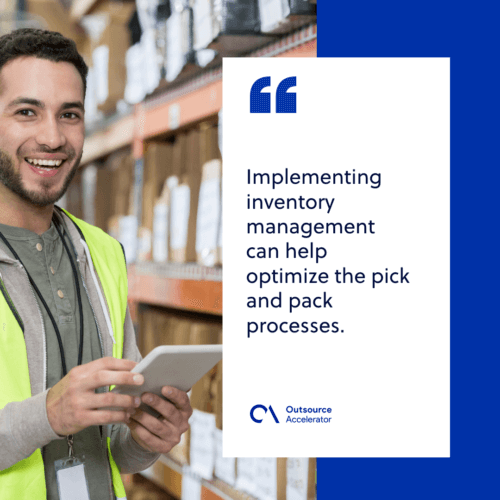
Strong inventory management helps optimize pick and pack. Here are some best practices for organizing inventory:
- Inventory segmentation. This sorts inventory by size, weight, popularity, or other factors.
- ABC analysis. This ranks inventory by its value to the business.
- FIFO and LIFO strategies. These techniques weigh expiration dates and storage needs.
Efficient warehouse layout and design
Also, a well-designed layout can greatly improve pick and pack. Here are some ways to arrange a warehouse well:
- Utilizing vertical space. Install pallet racks and shelving to boost storage without a bigger footprint.
- Minimizing travel time. Place products so pickers walk shorter distances.
- Ergonomic considerations for workers. Design safe, comfortable stations to ease strain and lift output.
Implementing technology solutions
Several tools can greatly improve pick and pack. Here are some warehouse automation solutions that can help:
- Order management system (OMS). This software automates order processing, tracking, and fulfillment.
- Warehouse management system (WMS). Use a WMS to optimize inventory placement, streamline routes, and manage priorities.
- Barcode and RFID technology. Use scanners or RFID tags to speed up picking and reduce errors.
Workforce training and development
Finally, proper training is critical to better pick and pack. So, some strategies you can adopt include:
- Proper order picking techniques. Train staff in standard methods to cut errors and lift speed.
- Safe and effective packing practices. Provide standard tools and guidelines. In addition, teach staff secure methods to prevent damage.
- Cross-training for versatility. Train staff to handle many tasks. As a result, you can assign them to any stage with ease.
Together, these steps turn pick and pack into a real advantage. For broader context, see how to grow through outsourced ecommerce support.
Frequently asked questions
What is the difference between pick and pack and order fulfillment?
In short, order fulfillment is the full journey from order to delivery. Pick and pack is the middle part, where you select and package items. So, pick and pack sits inside the larger fulfillment process.
When should I outsource pick and pack?
Outsourcing helps when order volume outgrows your space or staff. For example, a third-party provider brings warehouses, systems, and trained teams. As a result, you scale without large upfront costs.
Which pick and pack method is best for a small store?
Piece picking usually fits small stores with varied products and low volume. As orders grow, batch or zone picking can save time. Test a method against your real order patterns.
How does technology improve pick and pack accuracy?
For example, an OMS and WMS guide pickers and track stock in real time. Barcode and RFID scans confirm the right item each time. Together, these tools cut errors and speed up dispatch.
How can I reduce pick and pack costs?
First, organize inventory so popular items sit close to packing. Next, shorten picker travel with a smart layout. In addition, cross-train staff so no stage becomes a bottleneck.






 Independent






