
How Pennsylvania health systems can reduce authorization follow-up backlogs

- Prior authorization backlogs in Pennsylvania health systems aren’t a policy problem. They’re an operational one. When follow-up calls aren’t happening at volume, denials stack up, cash flow slows, and clinical staff absorb administrative load that shouldn’t be theirs.
- The AMA’s 2025 physician survey found that 95% of physicians say prior authorization delays patient access to care, and 92% say it negatively impacts patient outcomes. Pennsylvania health systems running understaffed follow-up processes are contributing to that outcome, not exempt from it.
- Dedicated authorization follow-up teams, operating separately from billing and coding, can work payer queues daily, track pending requests by aging, and escalate denials on a defined timeline. Structuring the function this way cuts turnaround time and recovers authorizations that would otherwise expire.
- ContactPoint 360 supports healthcare providers with HIPAA-compliant authorization follow-up, medical billing, and revenue cycle operations, with 98% CSAT and Agentic AI-assisted workflows across multiple delivery locations.
Most authorization backlogs don’t start with a denial. They start with a pending request that nobody called about this week.
The authorization was submitted, it entered a payer queue, and it is sitting there while the clinical team assumes it is being handled. By the time someone checks, the case has aged past the point where follow-up is simple.
Pennsylvania health systems serving dense commercial payer markets face this problem at scale. The payer mix includes major carriers with distinct authorization portals, timelines, and escalation paths.
Following up on a pending authorization isn’t one call. It is a specific process that requires knowing which payers respond to portal inquiries, which require phone escalation, and which have informal override paths for urgent cases.
Prior authorization follow-up is a call center outsourcing function operating under healthcare compliance rules. The agents, the payer knowledge, the daily follow-up cadence, and the volume capacity are what transfer to an external team.
What stays with the health system is accountability for outcomes and every clinical decision that follows authorization.
The scale of the prior authorization burden in US health systems
Pennsylvania health systems operate inside a national prior authorization landscape that has been worsening annually.
The numbers explain why follow-up backlogs compound so quickly.
According to MGMA’s Annual Regulatory Burden Report, 92% of medical group practices have hired or reassigned staff solely to handle the growing volume of PA requests. 60% of those practices need at least three employees involved per request. 35% spend more than 35 minutes on each authorization on average.
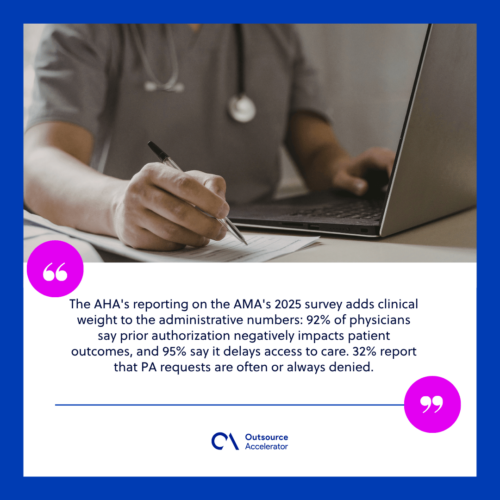
The AHA’s reporting on the AMA’s 2025 survey adds clinical weight to the administrative numbers: 92% of physicians say prior authorization negatively impacts patient outcomes, and 95% say it delays access to care. 32% report that PA requests are often or always denied.
Health systems running follow-up processes through general billing staff (rather than dedicated authorization teams) absorb these numbers across every person doing two jobs instead of one.
Pro Tip: Before assessing your authorization backlog, run a 30-day aging report on all pending PAs by payer and service type. Most health systems find that 20 to 30% of pending authorizations are over 14 days old. That cohort represents your most urgent follow-up target: not because they’re the most recent, but because they’re closest to expiring.
Why manual authorization follow-up doesn’t scale in Pennsylvania
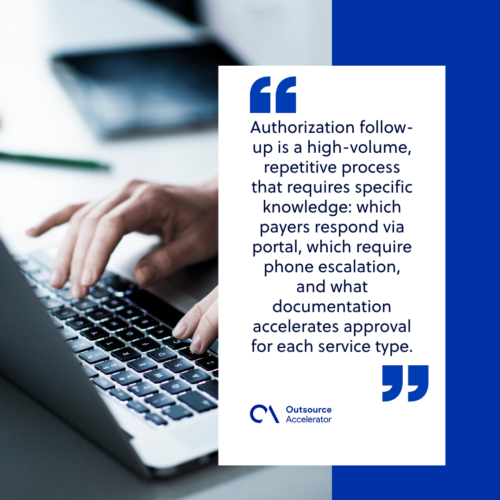
Authorization follow-up is a high-volume, repetitive process that requires specific knowledge: which payers respond via portal, which require phone escalation, and what documentation accelerates approval for each service type.
When that work sits with general billing staff, it competes with claims submission, remittance posting, and denial management. Authorization follow-up is always the task that gets deferred, because its consequences are less visible until a case is denied for failure to respond.
Pennsylvania’s payer mix compounds the issue. Health systems serving both commercial and Medicare Advantage members face different authorization requirements across multiple carriers.
Each carrier has distinct portal interfaces, documentation standards, and turnaround commitments.
Managing that volume effectively requires staff who work authorization follow-up as their primary function, not as one task among many. Structuring it as a dedicated business process outsourcing function, with defined SLAs, daily volume targets, and escalation paths by payer, is what separates health systems that manage their authorization pipeline from those that manage by exception.
| Follow-up model | Who handles it | Typical outcome |
|---|---|---|
| Ad hoc (general billing team) | Billing staff fitting follow-up between submissions and posting | Follow-up happens on high-dollar cases; lower-acuity cases age out or expire |
| Dedicated internal team | Specialist authorization staff focused exclusively on follow-up | Higher coverage but constrained by internal headcount and hiring pace |
| Outsourced follow-up team | Dedicated BPO agents with healthcare-specific authorization training | Full-queue coverage, consistent daily follow-up cadence, scalable volume |
Pro Tip: When evaluating an outsourced authorization follow-up team, ask specifically how they handle payer-specific escalation paths. Generic BPO teams follow a single script. Healthcare-specialized teams know which Pennsylvania Medicaid managed care carriers respond to peer-to-peer requests, and which commercial payers have a dedicated provider line for urgent authorizations. That institutional knowledge is the difference between a call that resolves an authorization and one that creates another pending entry.
How ContactPoint 360 supports healthcare authorization workflows
ContactPoint 360 delivers healthcare BPO services including prior authorization follow-up, medical billing, claims processing, and insurance verification for health systems and physician groups.
Founded in 2007 with delivery locations across North America, South America, Europe, and Asia, ContactPoint 360 operates HIPAA-compliant healthcare workflows with 98% CSAT and 91% first-contact resolution across its client base.
- Prior authorization follow-up: dedicated authorization teams working payer queues daily, tracking pending requests by aging, and escalating denials before cases expire; faster turnaround time and reduced claim denials as measurable outcomes
- Medical billing and coding: end-to-end billing support including claim submission, denial management, and electronic remittance advice processing aligned to health system-specific payer contracts
- Insurance verification: pre-service eligibility and benefit verification reducing authorization surprises and front-end revenue leakage before services are delivered
- Revenue cycle management: accounts receivable follow-up, root-cause denial analysis, and rectified document resubmission to recover revenue that would otherwise be written off
- Agentic AI integration: AI-assisted workflow execution that supports patient experience, appointment booking, and data processing, with human oversight on all compliance-sensitive authorization tasks
- HIPAA-compliant delivery: 100% HIPAA compliance across all healthcare services, with BAA execution, access controls, and audit documentation built into the engagement model
Pennsylvania health systems ready to address authorization follow-up backlogs can connect with ContactPoint 360 to scope a dedicated authorization team and set a target turnaround benchmark.






 Independent





