
The OT/IT Convergence talent gap: Why energy companies struggle to hire


This article is a submission by Fast Dolphin, a nearshore IT and engineering staffing firm with over 20 years of experience placing bilingual and multilingual tech talent across the Americas. Fast Dolphin serves clients across the U.S., Canada, Mexico, Brazil, and Colombia, offering temporary, contract-to-hire, direct hire, and dedicated development team staffing solutions.
A capital project at a mid-size utility or oil and gas operator rarely stalls because the budget got cut. More often it stalls because a single requisition, someone who can run plant control systems and also speak the language of enterprise IT, has been open for months while the rest of the project waits.
The plant still runs on a mix of decades-old control systems and newer IT infrastructure, and the people who can safely connect the two are in short supply everywhere at once.
That’s the real shape of the operational technology, or OT, and information technology (IT) convergence talent gap.
It isn’t one shortage so much as five pressures landing on the same technology budget at the same time:
- Industrial control specialists who are hard to find at any price
- SAP and enterprise resource planning (ERP) talent priced above what most programs budgeted for
- Critical infrastructure cybersecurity roles that sit open for quarters
- Capital projects scaling faster than domestic hiring can keep up with
- Engineering-firm rate cards that price OT/IT consultants out of reach for a multi-year build
None of these show up in isolation, and none of them get solved by posting the same job description on the same job boards and waiting longer.
Key takeaways
- Supervisory control and data acquisition, or SCADA, and industrial control systems (ICS) specialists are scarce enough that domestic-only searches routinely extend project timelines by months.
- SAP IS-Oil and SAP PM talent for energy operations command a premium most IT budgets weren’t built to absorb.
- Cybersecurity roles for operational technology and critical infrastructure are among the hardest positions in the entire energy sector to fill.
- Grid and capital-project investment is scaling faster than the domestic labor market can supply the IT and Engineering talent to support it.
- Large engineering firms often price OT/IT consultants above what an internal IT budget can sustain, which is pushing energy companies toward nearshore staffing models instead.
Why OT/IT convergence is straining energy company staffing right now
Those two worlds, the physical control layer that keeps turbines, pumps, and substations running and the enterprise IT layer that runs everything else a company depends on, used to develop on entirely separate tracks inside an energy company.
That separation is disappearing. Energy companies are connecting SCADA and other ICS systems to cloud platforms, ERP software, and remote monitoring tools, because that’s what modernization and cost control require.
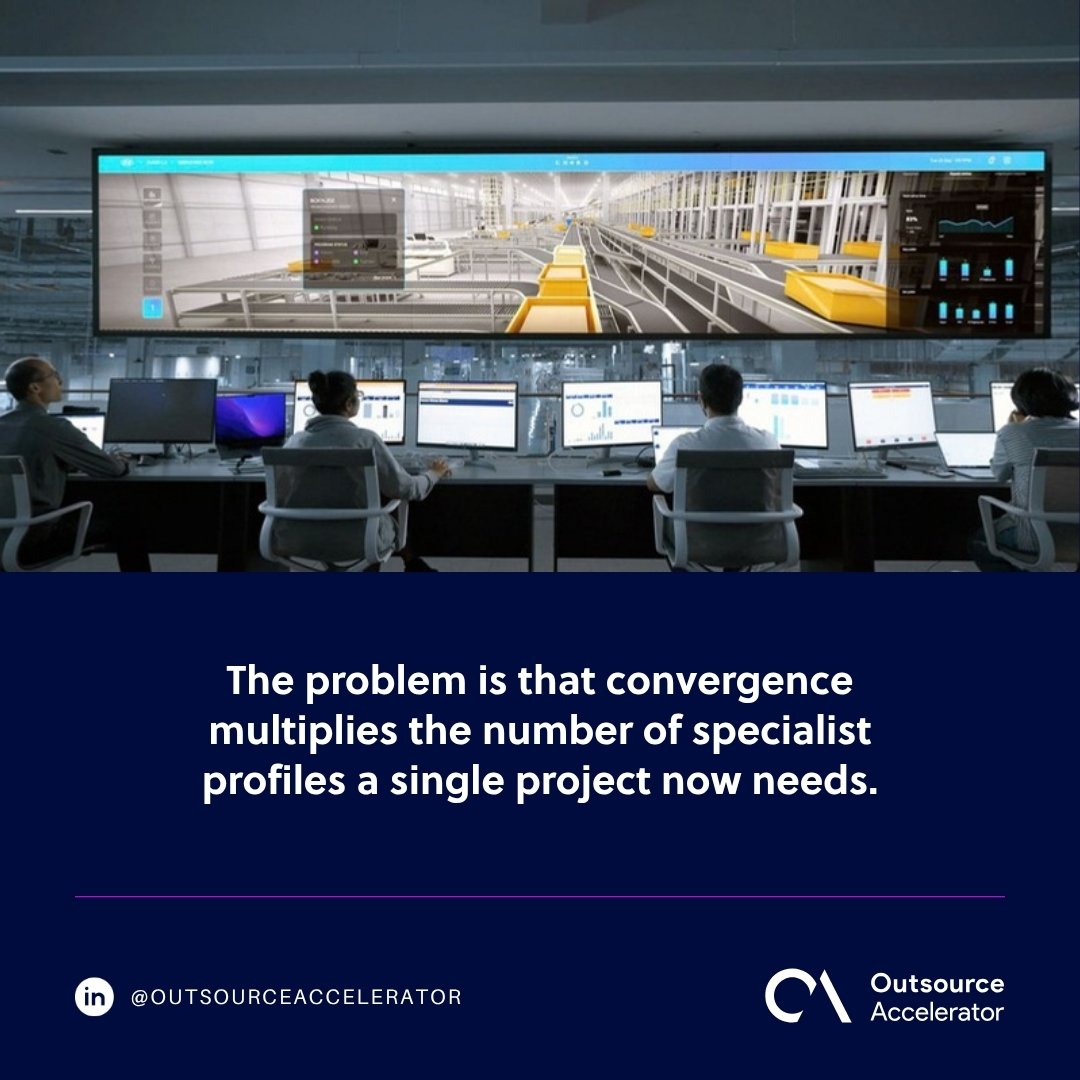
The problem is that convergence multiplies the number of specialist profiles a single project now needs. A go-live that once needed a controls engineer and an IT administrator now needs both of those people to understand each other’s systems well enough to secure and integrate them, and that combination is rare precisely because OT and IT trained separately for decades.
Energy companies already running digital transformation initiatives are feeling this most acutely, since every new integration point is another place where a scarce specialist has to sign off before the project can move.
Energy facilities also carry a wrinkle most other industries don’t. Much of the physical equipment on a plant floor or substation was installed to run for thirty or forty years, long before anyone planned for it to report into a cloud dashboard.
Retrofitting that equipment with modern monitoring and remote access means every integration point has to satisfy an operations team focused on uptime and safety and a security team focused on exposure at the same time, and a specialist who can sit in both conversations is rarer than either team alone would suggest.
SCADA and industrial control specialists are too scarce for a domestic-only search
The pay data alone tells you how tight this market is.
A SCADA engineer earns a median of $123,110 a year, with the middle range of the market running from roughly $106,623 to $142,222 depending on experience and location, and someone focused specifically on ICS and SCADA security engineering commands even more, averaging about $152,773 a year, with some postings reaching $205,000.
Those numbers reflect a pool of people who can safely bridge legacy control systems and modern IT without taking a plant offline, which is a narrow skill set by design and not something a general IT hiring pipeline produces in volume.
Put side by side with the SAP IS-Oil pay data further down, the pattern holds across every specialist role this convergence touches: each one clears six figures on its own, well before a company adds the cost of the search itself.
Part of the scarcity is structural rather than cyclical. Most SCADA and ICS engineers build that expertise over years on a specific plant floor or utility network rather than in a classroom, and there’s no fast way to manufacture more of that experience when three other capital projects in the same region are competing for the same small group of people.
A domestic-only search for these roles doesn’t just cost more, it takes longer, and on a project with a fixed go-live date, every extra week a requisition sits open is a week the rest of the build is waiting on it.
That’s the same reasoning that leads energy companies to look outside the US labor market for mechanical, electrical, and automation engineers, since the underlying scarcity is the same whether the role sits on the OT side or the IT side of the convergence.
SAP IS-Oil, SAP PM, and ERP talent costs more than most budgets were built to absorb
The cost pressure isn’t limited to controls engineers. SAP IS-Oil consultants, who handle the industry-specific SAP module for upstream and downstream oil and gas operations, average $88,333 a year nationally, and pay climbs sharply in the hubs where this specialization concentrates, with San Jose running close to $174,000, nearly double the national average.
SAP PM, the plant maintenance module that most energy operators depend on to schedule and track equipment upkeep, draws from the same thin pool of specialists who understand both SAP’s configuration logic and the physical maintenance workflows it’s tracking.
Neither of these is a role a generalist ERP consultant can step into without a real ramp-up period.
General SAP consultants are far more plentiful, but IS-Oil’s data model, built around upstream production volumes, downstream refining, and joint-venture accounting that most other industries never touch, means a standard SAP hire typically needs months to get productive on a live energy environment, time few capital projects can spare.
That scarcity is exactly why energy and manufacturing operators researching SAP and ERP implementation talent keep running into the same wall: the people who can do this work well are already committed to another program.
Critical infrastructure cybersecurity is its own staffing problem
Layer cybersecurity on top of that and the staffing problem gets harder, not easier.
The National Governors Association’s energy workforce brief, citing the International Energy Agency, puts the global shortage of qualified cybersecurity professionals at roughly 3.4 million people, and found that only 20% of electric utility companies feel confident they have the cybersecurity talent they actually need.
That same research notes energy-sector cybersecurity salaries tend to lag what finance and insurance pay for comparable skills, which makes it harder still for utilities and energy operators to compete for the talent that exists.
The stakes for getting this wrong keep climbing too: Dragos’s most recent OT cybersecurity review found ransomware activity against industrial organizations up more than 87% year over year, with a quarter of those incidents causing a full operational shutdown at the affected site.
A security engineer for an OT or ICS environment isn’t a nice-to-have hire at this point. Unlike a breach in a typical corporate network, a successful attack on an OT or ICS environment can mean a physical outage, a safety incident, or in the worst case a facility offline for the public it serves, which is exactly why the ransomware figures above carry more weight here than they would in a standard IT security review.
Companies that have already had to build a cybersecurity team from Latin America for other parts of the business are increasingly applying that same approach to critical infrastructure roles specifically.
Capital projects are outpacing what domestic hiring can support
None of this is happening against a backdrop of flat spending. Investor-owned electric utilities are projected to invest more than $1.1 trillion in grid infrastructure between 2025 and 2029, according to the Edison Electric Institute’s 2024 financial review, after already spending close to $208 billion in 2024 alone, the highest annual total the industry has recorded.
That pace of investment is colliding with a labor market that’s already stretched thin: ManpowerGroup’s 2025 talent shortage survey found 74% of energy and utilities employers report difficulty finding skilled talent, up six points from the year before.
Greenfield builds and brownfield modernizations both need large temporary IT and Engineering teams to hit their milestones, and that’s a scale problem a handful of direct hires can’t solve on their own, no matter how good the offer is.
A single greenfield build, a new substation, a refinery expansion, or a grid modernization program, can call for dozens of IT and Engineering specialists on-site or in support roles for a year or more, then wind back down once the project reaches steady state.
That’s a staffing curve most internal HR teams aren’t built to manage even once, let alone across several capital programs running at the same time.
Why large engineering firms price OT/IT consultants above the IT budget
The last pressure point is the one energy technology leaders feel every time a proposal comes back from a systems integrator or a large engineering firm.
Those firms carry overhead that a smaller, focused staffing partner doesn’t, and their rate cards for OT/IT convergence consultants are built around that overhead, not around what an internal IT budget can actually sustain across a multi-year program.
A rate card built for a large, full-service engineering firm has to cover project management layers, proposal overhead, and margin stacked on margin before a single OT/IT specialist ever starts billable work, and none of that overhead makes the specialist any more qualified.
It’s the same math that shows up in any comparison of US and nearshore development team costs: the specialist skill is real, and the price for it through a traditional systems integrator reflects far more than the specialist’s own time.
What this means for energy technology leaders
Put together, these five pressures compound rather than sit side by side.
A scarce SCADA hire takes longer to find, which delays a capital project that’s already running against a tight budget, which puts more pressure on the SAP and cybersecurity roles that were supposed to come online at the same milestone.
Solving one pressure at a time, the way most domestic hiring plans are built to do, doesn’t keep pace with a problem that’s structural across all five at once.
Every quarter a company treats these as five separate hiring problems is a quarter where a scarce SCADA hire, a stalled SAP rollout, and an open cybersecurity requisition all sit on the same project plan, each one waiting on the others to move first.
The fix isn’t hiring harder in the same labor market. It’s rethinking where the specialized talent gets sourced from in the first place.
How nearshore staffing closes the OT/IT convergence gap
This is where nearshore IT and engineering staffing for energy earns its place in the conversation, built around exactly these kinds of specialist gaps. For SCADA and industrial control roles, the fix is a vetted nearshore talent pool that’s already been screened for the specific combination of controls and IT literacy this work requires, so a search doesn’t start from zero.
For SAP IS-Oil, SAP PM, and broader ERP cost pressure, nearshore rates run well below what the same specialization costs through a US-based hire or a large systems integrator, without asking a company to compromise on the skill itself.
For OT and ICS cybersecurity, the same nearshore sourcing model that already works for general security roles extends naturally to critical infrastructure, putting security-aware engineers on a project without the multi-quarter search utilities are used to.
And for the sheer scale that a greenfield or brownfield capital project demands, a nearshore partner can stand up a large temporary team fast enough to match the project’s own timeline rather than the timeline of a domestic hiring pipeline.
In practice, that mostly runs through temporary IT and engineering staffing, which puts vetted specialists directly under your team’s direction at nearshore rates rather than bundling in the project-management layers and overhead a traditional engineering-firm engagement carries, and is built for exactly this kind of project-scale, time-bound need, with contract-to-hire available within that same engagement when a company wants to try a specialist on a project before making a longer commitment.
Once a program stabilizes and a particular SCADA lead or SAP specialist has proven out on the project, direct hire IT and engineering staffing is there for converting that person into a permanent member of the team.






 Independent





