
A practical guide to nearshore HR services

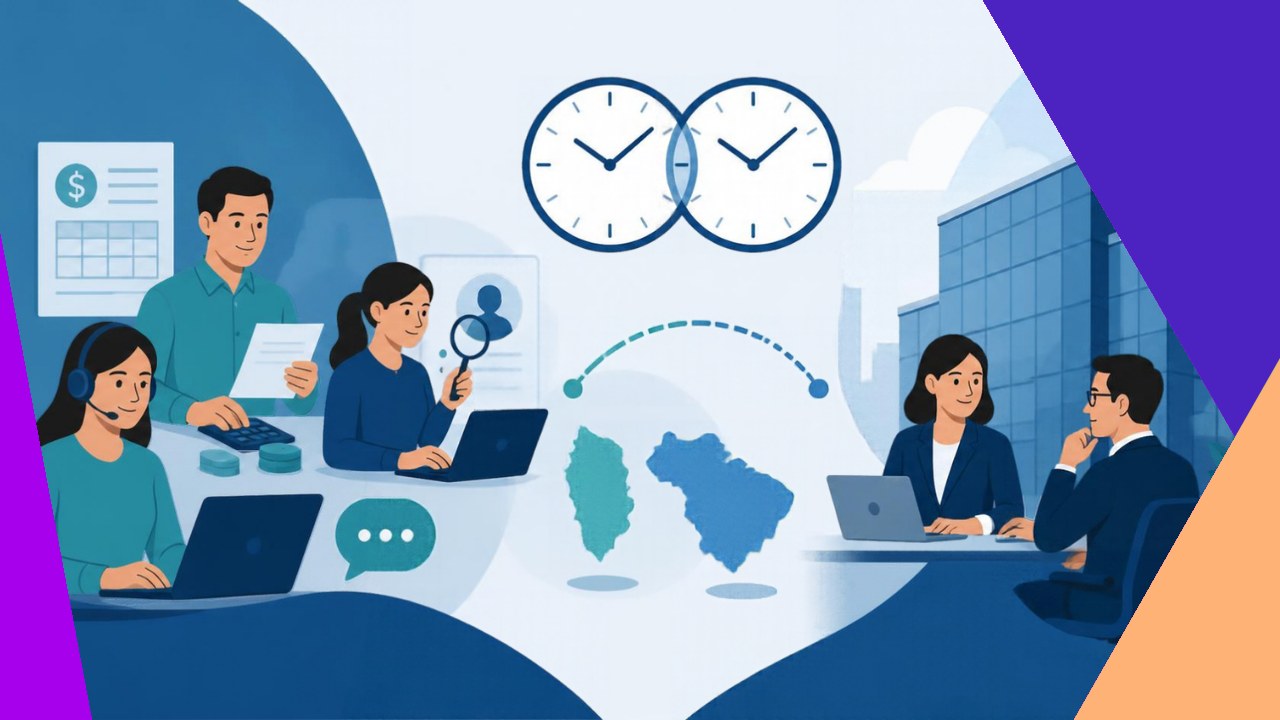
- Nearshore HR services place payroll, recruiting, help desk, and benefits work in a nearby country that shares your business hours.
- The main draws are overlapping work hours, closer cultural fit, and lower labor cost than hiring the same roles at home.
- Pick a region for its time zone, talent pool, and compliance record, then vet a partner on security, references, and service levels.
Nearshore HR services let a growing company run core people tasks from a nearby, time-zone-aligned country instead of its own office or a far-off one. In practice, that means payroll administration, recruiting support, an HR help desk, and benefits administration handled by a team you can reach during your own workday. The appeal is simple. You keep most of the cost savings of outsourcing while losing far fewer hours to time-zone gaps.
For HR and operations leaders, the choice often comes down to overlap. A team eight or ten hours ahead can stall a hiring decision until the next morning. A nearshore team two or three hours away usually answers the same day. This guide covers what nearshore HR includes, why it works, and how to choose a region and a partner.
What nearshore HR services cover
Nearshore HR is not one service. It is a bundle of tasks you can assign in whole or in part. Nearshore work sits within the broader practice of moving HR tasks to an outside provider, only closer to home. Most providers handle four areas well.
Payroll administration
Nearshore teams run payroll cycles, process changes, and keep records clean. They calculate hours, deductions, and leave, then flag anything unusual before it reaches an employee’s paycheck. Your HR lead still approves the final run.
Recruiting support
Recruiting is labor heavy, so it moves well to a nearshore team. They source candidates, screen resumes, schedule interviews, and run reference checks. The U.S. Bureau of Labor Statistics notes that “employment of human resources specialists is projected to grow 6 percent from 2025 to 2035,” which keeps experienced recruiters hard to hire at home.
HR help desk
An HR help desk fields everyday employee questions about pay, leave, and policy. Because a nearshore team shares your hours, workers get answers during their own day. That speed is a big reason companies choose nearshore over offshore for this task.
Benefits administration
Benefits work is detailed and deadline driven. Nearshore teams handle enrollment, track eligibility, answer plan questions, and reconcile carrier records. As a result, your internal staff can focus on plan design and vendor choices. Teams that employ workers in several countries can extend this into people support across multiple locations.
Why companies choose nearshore for HR
Overlapping work hours
Time-zone overlap is the headline benefit. When your partner works roughly the same hours, you can solve a payroll error or an onboarding snag in real time. Meetings fit the normal day. Handoffs do not sit overnight in someone’s inbox.
Closer cultural fit
Nearby regions often share language strength, holidays, and business norms with their northern neighbors. That closeness smooths candidate calls and employee conversations. It also cuts the friction that can creep into email when two teams read tone differently.
Lower cost than hiring at home
Cost still matters. In the United States, employer costs for employee compensation averaged “$49.46 per hour worked in June 2026,” per the Bureau of Labor Statistics. Nearshore talent in Latin America often costs well below that for comparable HR work, yet it stays easier to coordinate than an offshore team. In short, you trade a slice of the deepest savings for better daily access.
How to choose a nearshore region
Region matters as much as the provider. Weigh three things: the time-zone gap, the local talent pool, and the compliance record. A country one or two hours off your clock, with strong HR and English skills, beats the cheapest option on paper.
| Region | Overlap with U.S. hours | Common strengths |
|---|---|---|
| Mexico | Full to near full | Large talent pool, bilingual staff, close culture |
| Colombia | Full | Strong recruiting and support talent, neutral accent |
| Costa Rica | Full | Stable labor law, high education levels |
| Argentina | One to two hours ahead | Deep professional talent, strong English |
How to choose a nearshore HR partner
Once you have a region, vet providers in order. These five steps keep the search focused.
1. Match the scope to your gap
List the exact tasks you want to move, whether that is payroll only or a full help desk. A provider that specializes in your gap beats a generalist. This early clarity also makes pricing easier to compare.
2. Check data security
HR data is sensitive, so confirm how a partner stores and protects it. Ask about access controls, encryption, and recognized certifications. Get the answers in writing before you share a single record.
3. Review references and tenure
Ask for clients of similar size and stage. A short call with two references tells you more than any sales deck. Staff turnover at the provider matters too, because constant churn means constant retraining.
4. Set clear service levels
Define response times, accuracy targets, and reporting up front. Write them into the contract as service levels you can measure. Clear metrics prevent slow drift once the work begins.
5. Start with a pilot
Run one process, such as a single payroll cycle, before you hand over more. A pilot shows how the team communicates and fixes mistakes. If it goes well, expand in stages.
Frequently asked questions
Is nearshore HR the same as offshore HR?
No. Offshore usually means a distant country many time zones away, often in Asia. Nearshore means a nearby country in a similar time zone. Offshore can cost less per hour, but nearshore wins on overlap and on travel time when you need to visit the team.
How long does it take to set up nearshore HR services?
Most simple handoffs, like a single payroll process, go live in four to eight weeks. A full help desk with trained agents can take a quarter. The timeline depends on how clean your current process documents are.
Can small companies use nearshore HR services?
Yes. Many providers offer shared teams where several clients draw on the same agents. This lets a company of 30 or 40 people buy a few hours of help desk or payroll support without funding a full role.
Who stays responsible for HR compliance?
Your company does. A nearshore partner processes and advises, but legal responsibility for correct pay and lawful policy stays with you. Keep final approval on payroll runs and policy changes in house.






 Independent





