
LatAm tech talent: the complete guide

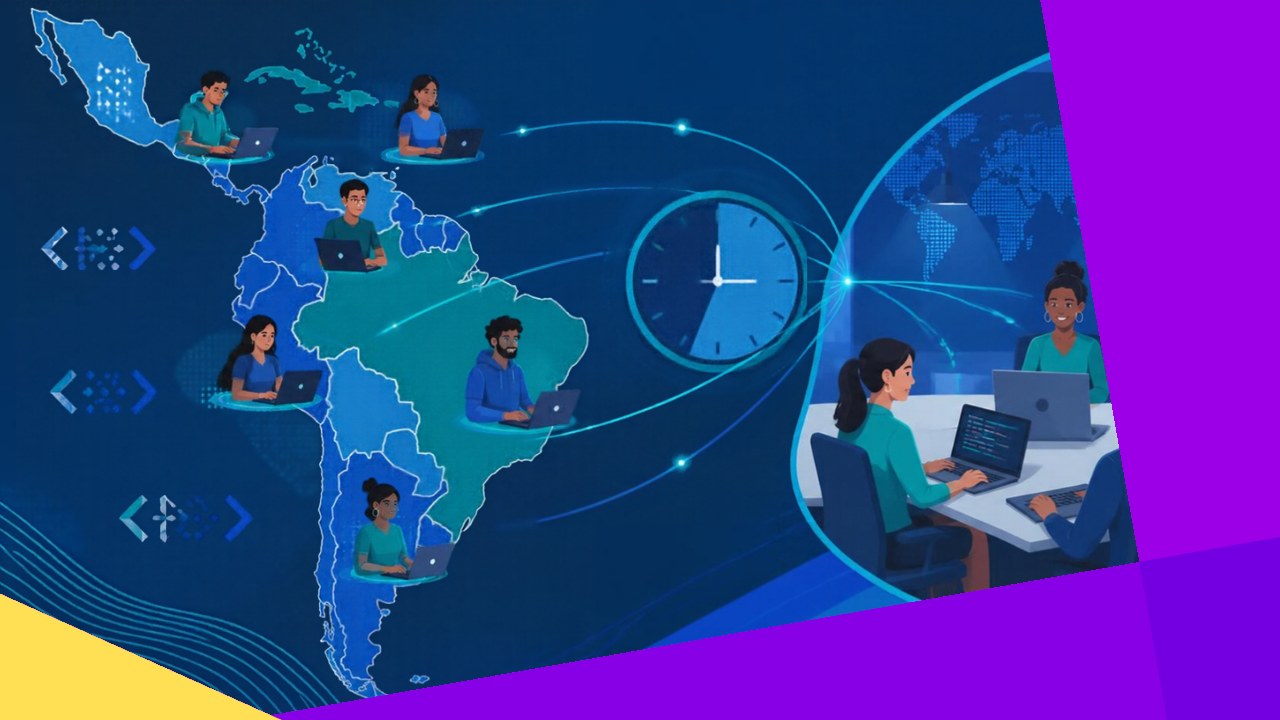
- Latin America gives US companies near-total work-hour overlap, strong English, and engineering salaries well below domestic rates.
- Brazil, Mexico, Colombia, and Argentina anchor the region’s deepest talent pools, each with its own cost and skill profile.
- You can hire through an employer of record, a staffing partner, or your own local entity, depending on how many people you need and how fast.
Finding senior engineers at home has become slow and costly. So more US teams are looking south instead. LatAm tech talent offers a rare mix: working hours that line up with North America, solid English, and pay far below Silicon Valley rates. For a growing company, that combination can decide whether a roadmap ships on time.
This guide walks through why the region works, which countries lead, what roles you can fill, what you should budget, and the three main ways to hire. The aim is a clear starting point, not a pitch for any single destination.
Why companies tap Latin America
The appeal comes down to four practical advantages. Together they explain why nearshore hiring has grown so quickly.
Time zones that actually overlap
Most Latin American countries sit within one to three hours of US business hours. That means live standups, pair programming, and same-day answers. Unlike a team twelve hours away, your engineers are online when you are. Problems get solved during the workday, not overnight.
Lower cost without a time gap
Salaries in the region typically run a fraction of US levels for comparable skills. You cut payroll without pushing collaboration into odd hours. For many firms, that balance beats both expensive local hiring and hard-to-reach offshore teams.
English and cultural fit
English proficiency is strong in major tech hubs, especially among developers who work with international clients. Business culture also tends to mirror US norms around deadlines and direct feedback. Onboarding feels familiar, so ramp-up is faster.
Deep and growing engineering pools
The region trains large numbers of developers each year. Brazil alone ranked among the top 10 countries in the 2024 Stack Overflow Developer Survey, which drew responses from coders in 185 countries. Universities and coding bootcamps keep feeding the pipeline, so supply is steady.
The key countries
No single country fits every team. Each market trades off scale, cost, and specialty. The table below sketches the main hubs, and you can go deeper when two of the region’s markets go head to head.
| Country | Strengths | Best for |
|---|---|---|
| Brazil | Largest talent pool, strong product and data skills | Scaling teams, specialized roles |
| Mexico | Closest to the US, large workforce, USMCA ties | On-site visits, fast coordination |
| Colombia | Neutral English accent, competitive cost, growing hubs | Cost-sensitive teams, support roles |
| Argentina | High English levels, strong engineering culture | Senior and complex technical work |
Smaller markets like Uruguay, Costa Rica, and Chile also punch above their weight. They offer stable economies and skilled, if smaller, talent pools.
Common roles and skills
You can fill almost any modern software role from the region. Full-stack, front-end, and back-end developers are the most common hires. Demand is also strong for cloud and DevOps engineers, QA testers, data engineers, and mobile developers.
On the skills side, you will find deep benches in JavaScript, Python, Java, and .NET. React, Node, and AWS appear in most job postings. Beyond coding, many candidates bring product sense and client-facing experience, which helps on distributed teams.
What LatAm tech talent costs
Costs vary by country, seniority, and skill, but the gap with US pay is wide. The US Bureau of Labor Statistics reports that “the median annual wage for software developers was $135,980 in May 2025.” Comparable nearshore engineers often cost far less in total, even after you add partner fees or benefits.
Remember that the headline rate is not your full cost. Factor in recruiting, local taxes, equipment, and management time. A lower salary still usually nets real savings, but budget for the extras so there are no surprises.
How to hire: three routes
The right model depends on your headcount, timeline, and appetite for admin work.
Employer of record (EOR)
An EOR hires the worker on your behalf in their country. It handles payroll, taxes, and compliance, while you direct the day-to-day work. This route suits teams adding a few people quickly, without opening a legal entity. You trade a per-employee fee for speed and low risk.
Staffing or outsourcing partner
A staffing or offshore partner sources, vets, and often employs the talent for you. It works well when you need to fill several roles fast or lack local recruiting reach. The partner carries much of the hiring and retention burden, though you give up some direct control.
Build your own entity
Setting up a local entity gives you the most control and the lowest per-head cost at scale. It also brings the most paperwork, from registration to ongoing tax filings. This path makes sense once you plan to hire dozens of people in one country for the long term.
Frequently asked questions
Is a time-zone match really worth it?
For collaborative work, yes. Research on distributed teams links overlapping hours to faster code review cycles and fewer handoff errors. Asynchronous work can function, but it adds a day or more to every back-and-forth. Nearshore overlap removes that lag for product and engineering teams that iterate daily.
Do I need to speak Spanish or Portuguese?
No. Technical work in the region’s export hubs runs in English, and contracts are usually written in English too. A few Spanish phrases build goodwill, but they are not a requirement. Focus your vetting on communication clarity rather than accent.
How long does nearshore hiring take?
Through an EOR or staffing partner, you can often make an offer within two to four weeks. Building your own entity takes months, since registration and banking setup are slow. Match the model to your timeline: use a partner for urgent roles and an entity for a long horizon.
What about data security and IP protection?
Put IP assignment and confidentiality terms in every contract, and confirm they hold up under local law. Many countries have modernized their data rules, and trade agreements add further protection in markets like Mexico. Ask any partner how they handle device management and access controls before you sign.






 Independent





