
IT service delivery models: the pros and cons

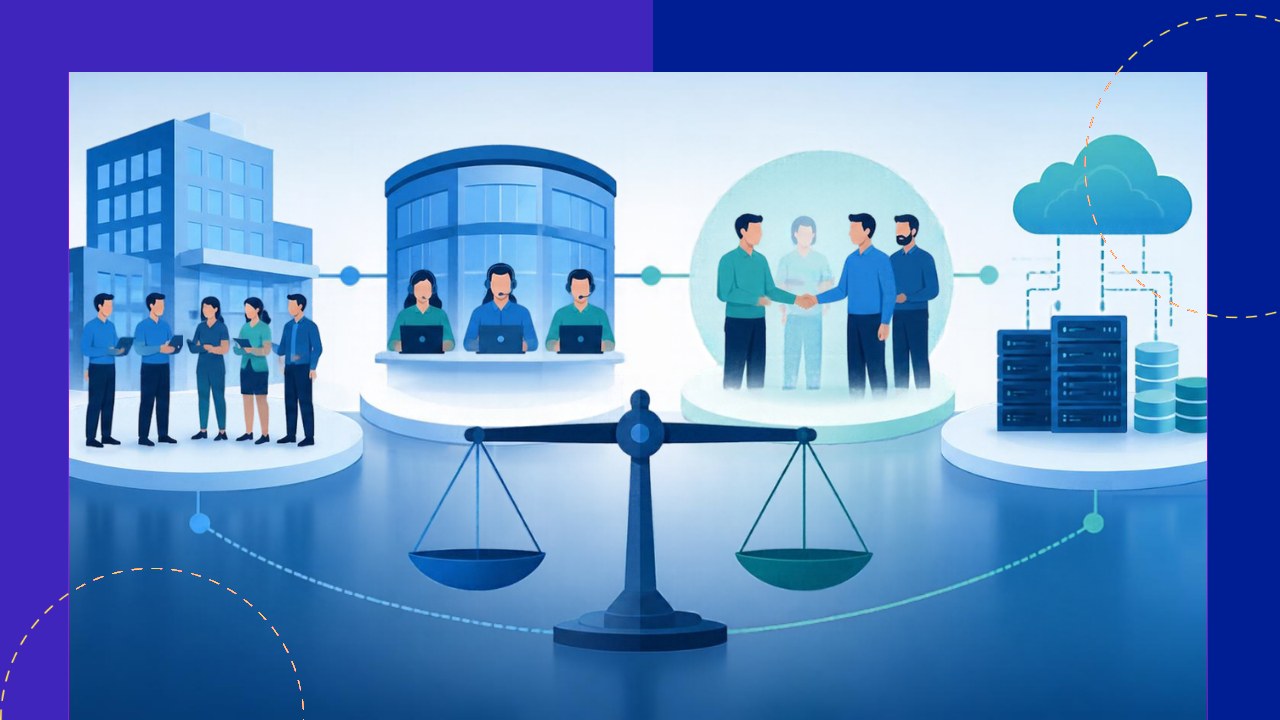
- IT service delivery models decide who owns your technology work: your own staff, a provider, or a blend of both.
- The main options are in-house, fully managed services, staff augmentation, project-based outsourcing, hybrid, and cloud or as-a-service.
- No model wins outright, so match each one to your budget, your risk, and the speed you need.
Every company runs on technology, yet few agree on who should run that technology. IT service delivery models describe how your organization sources, staffs, and manages its IT work. The model you pick shapes your costs, your response times, and how fast you can grow.
Some teams keep everything in-house for control. Others hand the whole stack to a provider. Many land somewhere in between. This guide compares the six main models, with the pros and cons of each, so you can choose with your eyes open.
Your model also sets the tone for quality, because it decides how service management practices get run and measured day to day.
In-house IT
With an in-house model, you employ your own IT staff. They sit inside the business and answer only to you.
The upside is control. Your team knows your systems, your people, and your priorities, so response can be fast and knowledge stays in the building. The downside is cost and coverage. Salaries, tools, and training add up, and a small team cannot watch systems around the clock. Demand for skilled staff also stays fierce. The U.S. Bureau of Labor Statistics projects about 280,000 IT openings a year, which keeps hiring slow and pay high.
Fully managed services
Here a provider runs an agreed set of services for a fixed monthly fee. This is the classic managed services partner arrangement, and it often covers monitoring, help desk, and security.
The pros are predictable cost, broad coverage, and access to a deep bench of skills. You also get round-the-clock support without hiring for it. The cons are less direct control and reliance on the provider’s priorities. Weak service level agreements can leave gaps. If you are weighing an internal team against an outside provider, who owns the risk during an outage often matters more than the headline price.
Staff augmentation
Staff augmentation adds outside specialists to your team for a set period. They work under your direction but stay on the provider’s payroll.
The benefit is flexibility. You scale up for a project or a skills gap, then scale back down when it ends. You also keep control of the work and the tools. The drawback is that you still manage these people day to day. Onboarding takes time, and hard-won knowledge can walk out the door once the contract closes.
Project-based outsourcing
With project-based or outsourced delivery, a provider owns a defined piece of work from start to finish. Think of a system migration, an app build, or a one-off rollout.
The pros are clear scope, a fixed outcome, and no long-term staffing. You pay for a result, not a seat. The cons show up when scope shifts. Change requests can raise the bill, and the provider may move on once the project ends, taking valuable context with it.
Hybrid delivery
A hybrid model blends internal staff with outside help. Your team handles strategy and core systems, while a provider covers monitoring, after-hours support, or specialist tasks.
The upside is balance. You keep control where it counts and buy scale where you lack it, so many larger firms settle here. The downside is complexity. Someone must manage the handoffs between the two sides, or work quietly falls through the gap.
Cloud and as-a-service
In a cloud or as-a-service model, you rent computing over the internet instead of owning it. NIST, which sets the standard definition of cloud computing, describes three service models: software, platform, and infrastructure as a service.
The pros are speed and elasticity. You scale on demand and skip big hardware costs. The cons are ongoing fees that can creep upward, plus shared responsibility for security. The provider secures the platform, but your data and your access controls stay your job.
Comparing the models at a glance
| Model | Best for | Main trade-off |
|---|---|---|
| In-house | Control and deep system knowledge | High cost, limited coverage |
| Fully managed | Predictable cost, full coverage | Less direct control |
| Staff augmentation | Short-term skills and scale | You still manage the people |
| Project-based | Defined, one-off work | Scope changes raise cost |
| Hybrid | Balance of control and scale | Handoffs add complexity |
| Cloud / as-a-service | Speed and elastic scaling | Creeping fees, shared security |
How to choose the right model
Start with your size and your risk. Small teams often lean on managed services or cloud, because they cannot staff every skill in-house. Larger firms tend toward hybrid, keeping core work inside and buying the rest.
Then weigh three factors. How much control do you need? How steady is your workload? And how fast must you move? Steady, sensitive work suits in-house or hybrid. Spiky or specialist work suits augmentation or project delivery. Most companies mix several models over time, and that is perfectly normal.
Frequently asked questions
Can a company use more than one delivery model at once?
Yes, and most do. A firm might run core apps in-house, rent email and storage from the cloud, and bring in augmented staff for a busy quarter. The trick is to document where each model’s responsibility starts and stops, so nothing slips through the cracks.
How do service level agreements fit into these models?
An SLA sets the promised response time and uptime for any outsourced work. It matters most in managed services and project delivery, where an outside team owns the outcome. Review the penalties and reporting before you sign, not after a system goes down.
Which model is cheapest?
No single model wins on price. In-house looks cheap until you add after-hours cover and turnover. Cloud looks cheap until usage climbs. Compare the full cost over three years, including tools, downtime, and the staff time needed to manage each option.
Does moving to a provider mean losing control?
Not if you keep ownership of strategy and data. Treat the provider as an extension of your team, hold regular reviews, and keep the key decision rights in-house. Strong governance lets you gain scale without handing over the steering wheel.






 Independent





