
Why should insurance agencies work with outsourcing partners for back-office support?
This article is a submission by Fusion Business Solution (P) Ltd.-FBSPL. Fusion Business Solution (P) Ltd. (FBSPL) is a Udaipur, India-based company providing Business Process Outsourcing, management, consulting, and IT services, with operations in New York, USA.
When routine insurance tasks start consuming entire workdays, outsourcing partners offer steady support, experienced teams, and reliable capacity for changing workloads.
Insurance agencies run on routine work that never seems to slow down. Policies move in, endorsements need checking, claims appear without warning, and paperwork keeps filling the queue.
Teams handle it, but the load builds up quietly. Many agencies start to feel that the day disappears into administrative tasks instead of client-facing priorities.
This is where outsourcing partners begin to matter, especially those trained in insurance back-office support.
Outsourcing insurance operations is no longer treated as a shortcut. Agencies use it because it makes the daily workflow steadier. Tasks get handled on time, and the internal team is not constantly trying to catch up.
The idea is simple: move the repeatable work to a professional outsourcing team, so the agency can focus on what clients actually notice.
8 Key benefits of outsourcing for business growth
Some agencies first try to manage everything in-house. Hiring more people feels like the natural step until they face long training cycles, unexpected attrition, or a heavy renewal season.
Insurance outsourcing services end up offering something agencies rarely have enough of: predictable support.
Below are practical benefits, not theoretical ones.
1. Fewer errors in daily work
Insurance tasks depend on accurate entries, complete documents, and consistent formatting. Small mistakes can cause delays that disrupt the entire file.
A professional outsourcing team repeats these tasks every day for multiple agencies, so their rhythm becomes sharper over time.

Because of this, insurance BPO teams tend to:
- Notice gaps quickly
- Follow checklists with discipline
- Maintain cleaner documentation
Agencies often see fewer corrections and less backtracking. This steady accuracy becomes one of the strongest benefits of outsourcing.
2. No constant hiring and training pressure
Insurance roles require patience and knowledge that develops slowly. When employees leave, the agency must start again; postings, interviews, onboarding, and the long process of getting someone comfortable with the work. Professional outsourcing partners already have trained people ready.
This removes a large operational burden and saves internal teams from constant re-training cycles.
The agency does not need to expand its in-house team every time the workload grows. The outsourcing partner adjusts the capacity instead.
3. Ability to handle busy seasons without stress
Most agencies have phases where everything peaks at once. Renewal periods can stretch the staff. Carrier changes may add unexpected tasks. Even a small surge becomes overwhelming when the existing team is fully booked.
Insurance agency back-office support offered by outsourcing partners can expand temporarily during these heavy periods. When the work slows down, the support levels can return to normal.
This flexibility prevents the team from burning out during peak seasons.
4. More time for clients and advisory work
When the internal team is stuck with checking forms, entering data, or tracking documents, they naturally have less time for clients. Calls get shorter. Follow-ups get delayed.
With outsourcing insurance tasks, the internal staff can focus on:
- Helping clients understand coverage
- Improving retention
- Resolving issues that need judgment
- Engaging in renewal discussions
Clients feel the difference quickly because they receive more attention.
5. Controlled costs without reducing quality
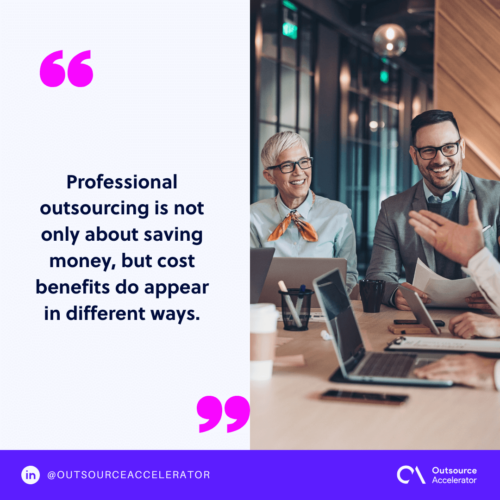
Professional outsourcing is not only about saving money, but cost benefits do appear in different ways. Agencies avoid:
- Hiring additional staff for repetitive tasks
- Paying overtime during busy weeks
- Purchasing extra systems or licenses
- Spending on training for routine roles
Capacity becomes something the agency adjusts rather than something it struggles to maintain.
6. Better processes through structured workflows
Insurance BPO providers often bring ready workflows, tracking tools, and review steps. These may be more organized than what smaller agencies use internally. Over time, the agency gains:
- Clearer workflows
- Standardized file handling
- Stronger audit readiness
This structured approach improves the day-to-day rhythm of operations.
7. A calmer work environment
When queues shrink and tasks move at a steady pace, the mood inside the agency changes.
Teams feel less rushed. Managers do not need to monitor every small detail. There is more space to plan or resolve client issues properly. This relief becomes visible across the organization.
Outsourcing partners provide the stability that helps create this calmer environment.
8. Reduced compliance and documentation risks
Insurance compliance depends heavily on accurate records and well-checked documents. Outsourcing partners follow strict guidelines and work with standardized formats.
This lowers the risk of:
- Missing required documents
- Incorrect entries
- Inconsistent records
Audit preparation also becomes easier because the files are already organized.
How outsourcing becomes the turning point
Insurance agencies often face rising workloads while trying to maintain consistent service quality. Outsourcing partners offer trained teams who handle insurance back office support with steady accuracy and organized workflows. This allows internal teams to focus on clients, advisory work, and long-term growth instead of routine administration.
Professional outsourcing also helps agencies manage costs, reduce hiring pressure, and stay prepared for busy seasons.
As agencies shift more administrative tasks to insurance BPO partners, they usually notice smoother operations, fewer delays, and a more balanced work environment.
Outsourcing insurance work becomes a practical advantage that supports both day-to-day operations and long-term agency stability, especially when agencies enter their holiday season checklist phase.






 Independent





