
5 Notable advantages of in-kind benefits


What are in-kind benefits?
In-kind benefits are non-cash perks an employer gives staff, such as housing, healthcare, and transport.
They add value on top of salary and help attract and keep talent. In short, in-kind benefits:
- Come as goods or services, not cash
- Carry a money value that may be taxed
- Support employee well-being and loyalty
Employees often receive non-cash incentives that boost their well-being. Some staff treat these perks as a bonus on top of a good salary.
Other staff receive key services like healthcare and insurance. These are things they could not easily pay for from taxable income alone.
These perks are called in-kind benefits. They are a core part of employee remuneration. As a result, they help firms keep staff and recruit top talent.
In-kind benefits defined
In-kind benefits, also called perks or fringe benefits, are non-cash rewards from an employer.
They have a money value even though they are not paid in cash. Depending on the country, the tax may fall on the employer, the employee, or both.
They may be taxable, but they are not part of the employee’s salary. Instead, firms plan allowances for these perks in their wider pay strategy.
In-kind benefits may also give access to needed resources or services. For example, this can include company cars or transport costs.
Such perks are given at the company’s discretion and policy. They can also form part of collective bargaining agreements for unionized teams. A clear compensation management plan keeps them fair and consistent.
Examples of in-kind benefits
In-kind benefits help staff do their jobs or feel more secure.
Here are some common perks that employers can provide.
Accommodation and relocation
Housing costs can be high. So some companies offer these accommodation perks:
- Housing unit
- Apartment
- Bunkhouse
- Other forms of living quarters
Meanwhile, relocation benefits help staff move when their job needs it.
In most cases, the employer pays these costs on top of salary. Otherwise, the perk lowers the tax bracket, so staff keep more of their wages.

Medical benefits
One of the most common in-kind benefits is health care. Many workers rely on it to protect their own and their family’s well-being.
Both small firms and large firms offer medical perks to keep a healthy workplace. This usually comes in the form of:
- Health insurance
- Sick leave credits
- Pension contributions
- Other perks
Medical benefits cut the cost of routine care. For example, they help with checkups, wellness visits, prenatal care, and emergencies.
Many staff could not pay for needed care without this perk.
Car or transportation allowance
Not every company offers this, but a car allowance is a common perk.
In this setup, staff get money instead of a company car. It comes on top of the fixed salary and helps cover transport costs.
Meanwhile, executives and senior staff may use or receive a company car for official meetings.
A car allowance is often stated in the contract. In some cases, it is taxed just like a normal salary.
Educational assistance
An education allowance is one of the best perks a company can give. It is highly sought after, especially by younger staff.
An educational benefit supports skill growth. For example, it can help staff finish a degree or repay student loans.
Some firms also cover education costs for staff who support their children or siblings.
Any education program usually aims to attract top people. In addition, it lifts the overall skill of the business.
Food and entertainment expenses
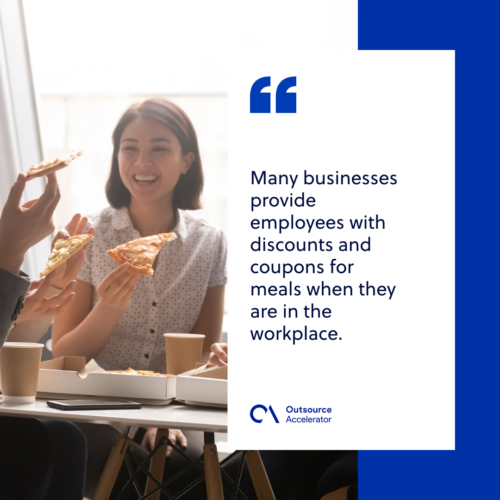
Many businesses provide staff with meal discounts and coupons at work.
Some even offer free tickets to movies and other fun activities. This perk falls under meal and entertainment allowances.
Employers should also plan for staff meal and entertainment spending. These perks attract young talent, who often pick firms that offer them.
This perk also shows that the employer cares about staff welfare. As a result, staff who feel cared for are more likely to stay.
5 advantages of in-kind benefits
Offering in-kind benefits brings real gains. These perks help staff spend less on needs like housing, transport, meals, and healthcare.
They also give access to benefits that taxable income often cannot cover.
In-kind benefits offer the following advantages.
Great recruitment strategy
Perks are now a key factor in hiring. For example, the Harvard Business Review reports that 80% of workers would rather have more perks than a pay raise.
So it helps to lead with perks when you hire. This is a real advantage when you court top C-suite talent.
The first few hires can make or break a young company. As a result, generous in-kind benefits are a strong tool to win great candidates.
Improve employee retention
Some in-kind benefits build trust and loyalty. For example, pensions, stock options, and healthcare all encourage staff to stay. A strong benefits mix is a proven fix for common employee retention problems.
Many people will not say it, but these perks ease day-to-day worries.
If their retirement is secure, staff worry less about savings. When their travel is covered, they think less about leaving.
Remember that not every employee is the same. So always lead with empathy.
Boost employee morale
Picture a worker who gets free transport to work. They do their job well, then enjoy a free lunch, so their costs drop.
A strong private insurance plan does the same. As a result, staff no longer set aside cash for emergencies.
With such perks, staff can drop small worries. So they focus more on their career goals. Broader employee wellness programs reinforce this effect.
Promote employee mental well-being
Good mental health is more than being happy and productive. It also means clear thinking, enough sleep, and healthy relationships.
Poor mental health at work raises absence and lowers output. As a result, the whole organization feels it.
Johnson and Johnson was a pioneer here. Its staff and their families are covered by the company’s mental healthcare program. It also trains more than 1,000 workers to give mental health first aid.
Tax benefits
Some non-cash perks are not taxed. In some countries, the law makes it simpler to grant benefits. As a result, many in-kind benefits fall outside an employee’s taxable income.
Providing in-kind benefits is all worth it
A solid benefits package is a smart way to keep staff. It lifts morale, output, and loyalty. So it helps people work at ease.
Offering in-kind benefits helps you attract and keep the best workers. As a result, it supports growth and a stronger skill base. It also pairs well with a good employee benefit insurance plan.
As the old saying goes, take care of your employees, and they will take care of your business.
Frequently asked questions about in-kind benefits
What are in-kind benefits?
They are non-cash perks an employer gives to staff. Common examples include housing, healthcare, cars, and meals.
Are in-kind benefits taxable?
It depends on the country and the perk. Some are taxed like salary, while others are tax free.
What is the difference between in-kind benefits and salary?
Salary is paid in cash, while in-kind benefits are goods or services. Both have value, but they are treated differently for tax.
Why do companies offer in-kind benefits?
They use them to attract talent and keep staff. In addition, the perks boost morale and support well-being.
What are common examples of in-kind benefits?
Housing, healthcare, transport, education, and meal perks are all common. Many firms mix several to build a strong package.
Key takeaways
- In-kind benefits are non-cash perks that add value on top of salary.
- Common examples include housing, healthcare, transport, and education.
- They help firms attract talent, keep staff, and boost morale.
- Tax treatment varies by country, so check the local rules.






 Independent





