
Human-in-the-Loop: Where staff and AI team up

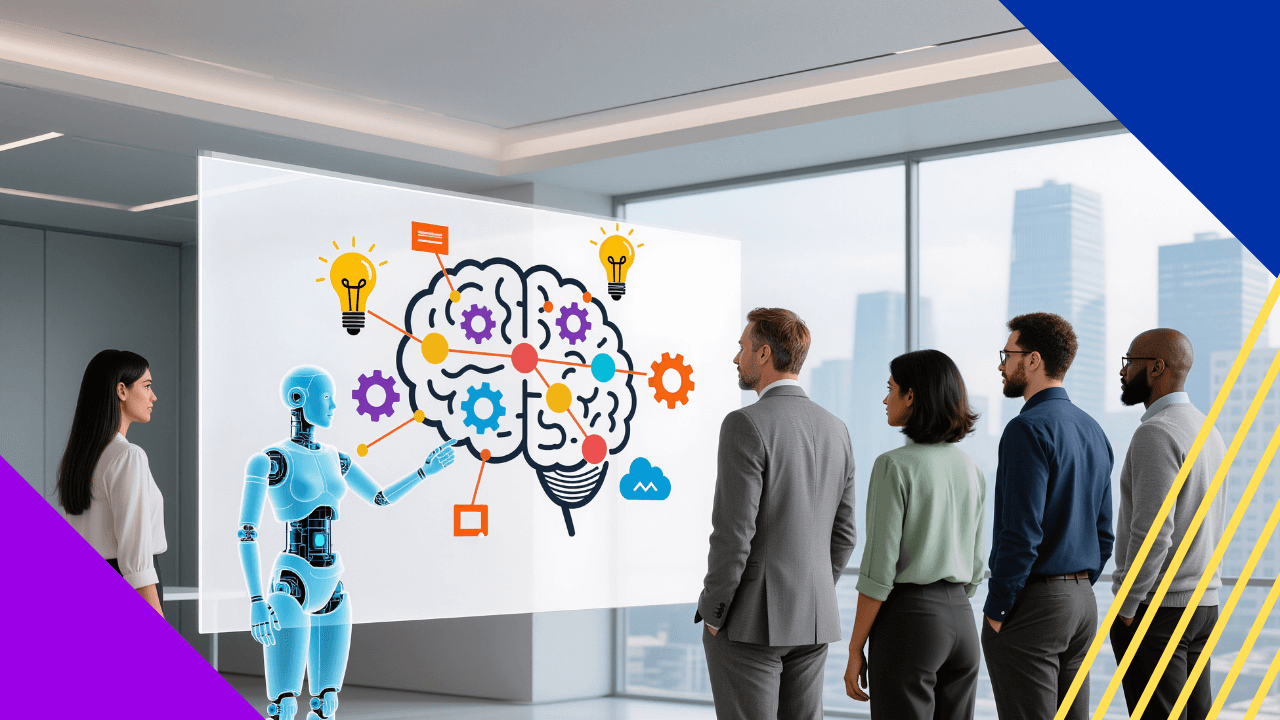
Businesses have widely adopted and started integrating artificial intelligence into many of their daily operations. In fact, a recent AWS report found that 52% of UK businesses now use AI, up from 39% just a year ago, with 92% of adopters reporting revenue growth.
Rapid improvements in machine learning models, natural language processing, and predictive analytics demonstrate that AI is continuously evolving, offering smarter automation and deeper insights.
This article explores how combining human judgment with advanced algorithms yields more effective outcomes. It covers what “human-in-the-loop” means, why staff participation matters, and how organisations can apply this approach to balance efficiency, accuracy, and ethics.
What is human-in-the-loop?
Human-in-the-loop (HITL) is a framework in which humans play an active role in guiding, monitoring, or refining the actions of an automated system.
In artificial intelligence, HITL places human expertise within the AI workflow to handle tasks that require context, judgment, or ethical reasoning.
While machine learning models excel at processing large volumes of data, they often encounter challenges when facing edge cases, biases, or incomplete inputs.
Human participation helps address these limitations by adding clarity and critical thinking where algorithms may fall short. This interaction strengthens the accuracy, reliability, and adaptability of AI systems.
HITL works as a feedback loop: humans review, intervene, or correct AI outputs, and the system learns from that input over time. This partnership supports a balance between the speed of automation and the thoughtful decision-making of human intelligence.
HITL is especially valuable in industries where safety, fairness, and accountability are non-negotiable.
How does human-in-the-loop work?
Human-in-the-loop integrates human judgment into different stages of an AI system’s development and operation. This interaction allows artificial intelligence models to learn more effectively, adapt to real-world variability, and reduce the risk of errors.
HITL can occur before, during, or after model training, forming a continuous feedback loop that improves accuracy, transparency, and usability:
Supervised Learning: Building the foundation
Supervised learning depends heavily on human-labeled data. Data scientists manually annotate examples (e.g., categorizing emails as “spam” or “not spam” or identifying objects in images) to create structured datasets.
These labeled examples help machine learning models learn correct associations. In this stage, human involvement is not optional; it is fundamental. The quality of labeled data directly impacts the model’s performance in real-world scenarios.
Reinforcement learning from human feedback (RLHF): Optimizing complex behavior
RLHF is often used when traditional training methods fall short. Humans score or rank different outputs generated by the AI, helping to train a reward model that guides the learning process.
This method is especially useful for complex tasks like dialogue generation or ethical decision-making, where the correct outcome isn’t always clearly defined.
Human feedback helps refine behavior and align the model with desired outcomes.
Active learning: Focusing human effort where it counts
In active learning, the AI model identifies data points it struggles to classify confidently. Instead of having humans label everything, the system requests human input only for the most challenging cases.
This targeted approach enhances learning efficiency and reduces the time and effort required to achieve high accuracy.
HITL strengthens AI performance by combining computational speed with human judgment, making systems more adaptable, explainable, and useful in real-world settings.
Primary benefits of human-in-the-loop to organizations
Organizations integrating artificial intelligence into their operations face a growing need for precision, responsibility, and adaptability. HITL adds human oversight to AI systems, strengthening their reliability and aligning their performance with real-world needs.
This collaborative approach delivers multiple benefits that extend beyond technical improvement:
Improved accuracy and reliability
AI systems often struggle with edge cases or incomplete data. HITL allows humans to step in, correct errors, and guide the model through uncertain outputs.
Subject matter experts can detect patterns or anomalies that AI might miss, adding contextual knowledge that improves long-term performance. Over time, this feedback loop helps models evolve and perform more consistently under varied conditions.
Ethical oversight and accountability
Automated systems can unintentionally produce biased or unfair results. Human-in-the-loop workflows give organizations the ability to pause, adjust, or override decisions when ethical concerns arise.
This level of control is especially important in high-stakes sectors such as hiring, lending, and healthcare. HITL supports clearer accountability. Organizations are able to document decisions, track interventions, and meet compliance requirements, including regulations like the EU AI Act.
Greater transparency and explainability
Black-box models can leave stakeholders in the dark. HITL improves transparency by embedding human checks throughout the AI pipeline.
When humans participate in decision-making, they leave a record of actions and reasoning. This helps organizations explain how and why decisions were made, which is essential in regulated industries or customer-facing applications.
Reduced risk and developer burden
HITL reduces the likelihood of harmful or costly mistakes, particularly in applications where accuracy is critical. It also eases the pressure on developers to build perfect models upfront, allowing for continuous improvement through structured human feedback.
Together, these advantages make HITL an excellent tool for safer and accountable AI adoption.
Human-in-the-loop FAQs
Human-in-the-loop (HITL) raises important questions as more organizations adopt AI-assisted workflows:
Is HITL only useful during training?
No. While HITL plays a key role during model training, it also supports real-time monitoring in production environments. Humans can intervene during deployment when the system encounters unfamiliar or high-risk scenarios.
Does HITL slow down automation?
Not necessarily. HITL can actually accelerate development cycles by identifying issues early and minimizing rework. Strategic human input helps models learn more efficiently and reduces the likelihood of costly errors in the future.
Can HITL be scaled across large datasets?
Yes. Many organizations use a tiered HITL system, combining automation for routine tasks and human review for edge cases. This hybrid model strikes a balance between scalability and precision.
As AI adoption grows, understanding HITL helps teams build systems that are not only fast and efficient but also accountable and aligned with business goals.






 Independent





