
How generative AI reduces operational costs across enterprises


- Generative AI helps enterprises reduce operational costs by automating repetitive tasks, improving workflows, and enhancing cross-departmental decision-making.
- Practical use cases such as AI chatbots, AI agents, and workflow automation deliver measurable efficiency gains in customer service, operations, and back-office functions.
- A strategic, full-cycle approach to generative AI development enables organizations to achieve sustainable savings and long-term competitive growth.
Operational expenses often grow unnoticed as teams rely on a patchwork of disconnected systems, legacy platforms, and manual workflows.
Departments adopt their own tools to solve immediate challenges. Over time, this fragmented environment increases licensing fees, maintenance costs, and integration complexity.
Outdated technologies limit visibility into performance metrics, making it harder for leadership to control budgets and optimize resources.
These inefficiencies affect productivity, slow decision-making, and reduce overall competitiveness. Things move fast these days, and if you don’t update how you operate, you’ll eventually find that more agile players have completely taken over.
This article explores how generative AI reduces operational costs. We’ll highlight practical use cases and strategic opportunities for enterprises aiming to streamline operations and improve financial performance.
What is generative AI development?
Generative AI development focuses on building intelligent systems that create new content, including text, images, code, audio, and synthetic data.
Traditional artificial intelligence typically analyzes data, identifies patterns, and makes predictions or classifications. Generative AI goes a step further. It produces original outputs that resemble human-created work based on learned patterns.
Businesses use conventional AI to forecast demand, detect fraud, or optimize logistics. Generative AI supports content creation, automated reporting, virtual assistants, software prototyping, and knowledge management.
This creative capability unlocks new efficiencies across departments, which explains its rapid market growth. According to Statista, generative AI revenue reached $63 billion in 2025 alone.
The rise of agentic AI systems, developed by companies such as Google, OpenAI, Microsoft, and France’s Mistral, signals even greater expansion. Analysts expect this market to grow considerably between 2025 and 2030 as enterprises adopt more autonomous AI-driven tools.
How generative AI development works
Generative AI development typically involves selecting suitable models, customizing them for specific business tasks, integrating them into enterprise systems, and continuously refining performance:
Foundation models
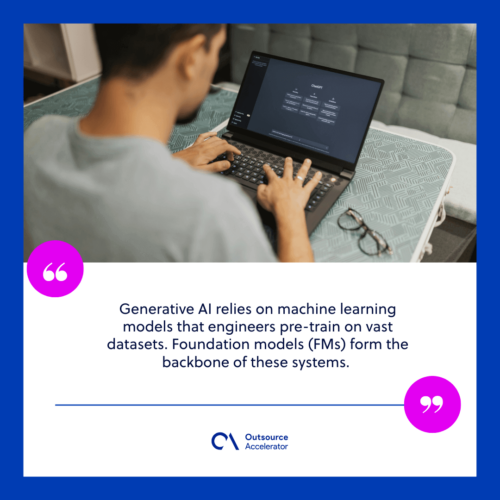
Generative AI relies on machine learning models that engineers pre-train on vast datasets. Foundation models (FMs) form the backbone of these systems.
Developers train FMs on broad, largely unlabeled data so they can perform diverse tasks. These models learn patterns and relationships, then predict the next element in a sequence.
Large language models (LLMs)
In image generation, a model refines details to produce a clearer result. In text generation, the model predicts the next word based on context and probabilities. Large language models (LLMs), such as OpenAI’s GPT models, represent a specialized class of FMs.
LLMs handle tasks like summarization, classification, conversation, and information extraction. Their billions of parameters allow them to interpret complex prompts and generate meaningful outputs across many business scenarios.
How generative AI reduces operational costs: Top 3 use cases
Rising operational expenses often stem from repetitive tasks, fragmented communication, and slow processes.
| Use case | How businesses use it | Cost reduction impact |
| AI chatbot development | Automates customer support, FAQs, appointment booking, and internal helpdesk tasks | Lowers staffing costs and improves service efficiency |
| AI agent development | Executes multi-step tasks, updates systems, generates reports, and supports decision-making | Cuts process overhead and increases productivity |
| Workflow automation | Processes documents, extracts data, routes approvals, and drafts responses | Shortens cycle times and reduces operational waste |
A reputable generative AI company addresses these inefficiencies head-on. Organizations that apply it strategically reduce manual effort, shorten turnaround times, and allocate talent to higher-value work:
1. AI chatbot development
AI chatbots powered by generative models handle customer inquiries, internal helpdesk requests, and routine service interactions in real time. Companies deploy them across websites, mobile apps, and messaging platforms to provide instant, accurate responses.
Support teams benefit from reduced ticket volumes and faster resolution times. Chatbots manage FAQs, order tracking, appointment scheduling, and basic troubleshooting without human intervention.
Lower staffing pressure and improved response speed translate into measurable cost savings and higher customer satisfaction.
2. AI agent development
AI agents take automation further. These systems complete multi-step tasks, make context-aware decisions, and interact with enterprise software independently. An AI agent can:
- Generate reports
- Update CRM records
- Analyze contracts
- Coordinate supply chain actions
Operations, finance, and HR departments use AI agents to reduce administrative overhead and eliminate bottlenecks. Technology providers such as Google, OpenAI, and Microsoft actively invest in agentic AI, which signals long-term enterprise adoption.
3. Workflow automation
Generative AI enhances workflow automation by interpreting unstructured data such as emails, documents, and voice transcripts. It extracts key information, drafts responses, and routes tasks automatically.
Industries that involve claims processing and compliance reporting can rely heavily on this capability. Teams spend less time on manual coordination and more time on strategic initiatives, which directly reduces operational costs.
Partner with Itransition for full-cycle generative AI development
Itransition helps enterprises turn generative AI into measurable business value. Its experts design, develop, integrate, and optimize AI-powered solutions tailored to each organization’s goals and infrastructure.
Connect with Itransition today and gain strategic guidance and hands-on technical expertise at every stage!
Frequently Asked Questions (FAQs)
This section addresses common concerns enterprises have when evaluating generative AI for cost optimization:
How long does it take to implement generative AI in an enterprise environment?
Implementation timelines vary based on project scope, data readiness, and system complexity. A focused pilot can take a few months, while a large-scale enterprise deployment may require phased integration across departments.
Does generative AI require large volumes of proprietary data?
Generative models come pre-trained on extensive datasets. Companies can fine-tune them using internal data to improve relevance and accuracy.
How can companies measure ROI from generative AI?
Organizations track metrics such as reduced labor hours, faster turnaround times, lower error rates, and improved customer satisfaction to evaluate financial impact.
Key takeaways
Generative AI helps enterprises reduce operational expenses by automating repetitive tasks, optimizing workflows, and augmenting team productivity. Organizations that adopt a strategic, full-cycle development approach gain measurable cost savings and long-term competitive advantage.






 Independent





