
How to improve healthcare operational efficiency

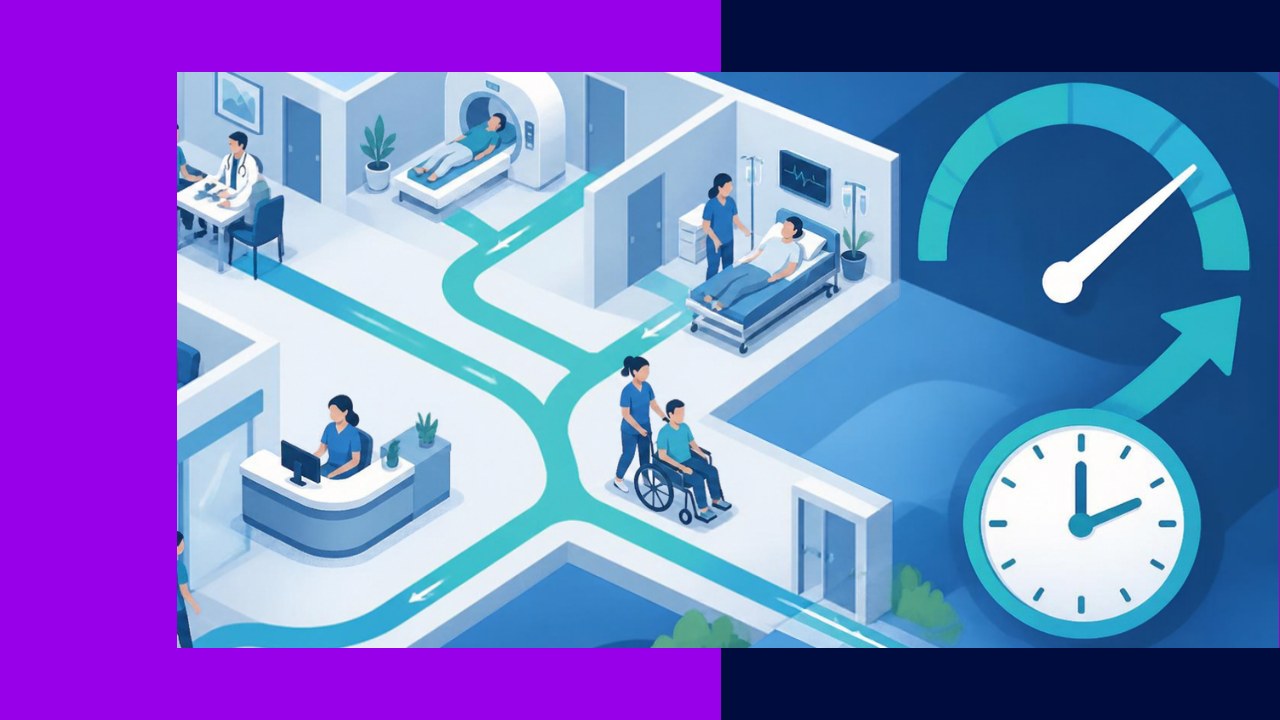
- Healthcare operational efficiency is about throughput: moving more patients through your capacity safely, without adding beds or staff.
- Start by mapping patient flow to find the single bottleneck, then match staffing and scheduling to real demand patterns.
- Track throughput metrics such as cycle time and time in the emergency department, and offload admin work so clinicians treat patients.
Healthcare operational efficiency measures how well a clinic or hospital converts its fixed capacity, meaning its rooms, equipment, and staff hours, into completed patient visits. When efficiency is low, patients wait, staff scramble, and the schedule runs late by mid-morning. The frustrating part is that the building and the payroll rarely change. The throughput does.
This guide stays in one lane: throughput and capacity. That means patient flow, scheduling, staffing efficiency, wait times, and capacity planning. It is different from cost reduction, which targets the money you spend, and from workflow optimization, which redesigns the steps and technology behind each task. Those are related levers, and they help, but here the focus is moving more patients through the space you already have.
The good news is that most bottlenecks are visible once you look for them. Below are six practical steps, in order, to raise throughput without cutting corners on care.
How to improve healthcare operational efficiency
1. Map patient flow and find the one bottleneck
Walk the patient journey from arrival to discharge and time each stage. Note where people sit and wait: check-in, rooming, provider, labs, checkout. In most practices, one stage holds up the rest. A clinic can add front-desk staff all day, but if there are only two exam rooms, rooming is the real constraint. Fix the tightest point first, then re-time the flow. Chasing every delay at once wastes effort and rarely moves the needle.
2. Match staffing to demand, not to the calendar
Demand is not flat. Mondays surge, Friday afternoons thin out, and the hour after lunch often stalls. Pull three months of visit data and chart arrivals by day and hour. Then stagger start times, breaks, and float staff so coverage tracks the peaks. This is staffing efficiency: the same headcount, placed where the patients actually are. It beats uniform shifts that leave you overstaffed at 8 a.m. and underwater at 11.
3. Smooth the schedule and shrink no-shows
A packed schedule is not an efficient one if it clumps arrivals or leaves gaps. Space appointment types by their true length, so a complex visit does not blow up the next three slots. Use wave or modified-wave scheduling to absorb variation. Then attack no-shows directly. Reminder texts, easy rescheduling, and a short waitlist to backfill cancellations all recover capacity you have already paid for.
4. Measure throughput with the right numbers
You cannot improve what you do not time. Track cycle time (arrival to departure), room turnover, and provider idle time between patients. Hospitals with emergency departments watch a well-known federal metric here. The Centers for Medicare and Medicaid Services publicly reports the “Median Time from Emergency Department Arrival to Emergency Department Departure”, a direct read on flow. Pick two or three metrics, post them where staff can see them, and review weekly. Numbers on a wall change behavior faster than a memo.
5. Free clinical staff from administrative load
Clinicians lose hours to scheduling, intake, insurance checks, and records. Every hour spent on paperwork is an hour not spent on a patient, which directly caps throughput. This matters more as staffing tightens. The Bureau of Labor Statistics projects that healthcare employment will “grow much faster than the average for all occupations”, with roughly 1.9 million openings each year. Since you cannot hire your way out, protect the clinical hours you have. Many practices do this by delegating non-clinical tasks to a specialized partner, or by using offshore administrative teams to absorb overflow during busy stretches.
6. Plan capacity ahead of demand
Capacity planning is the forward-looking half of efficiency. Forecast volume from seasonal trends, referral patterns, and local growth. Then decide in advance how you will flex: extended hours, shared rooms, group visits, or telehealth for routine follow-ups. Telehealth, for example, frees a physical room entirely. Planning three to six months out beats reacting to a waiting room that is already full.
Common bottlenecks and the fix
The table below maps frequent flow problems to the step that resolves them.
| Bottleneck | Symptom | First fix |
|---|---|---|
| Rooming | Patients wait after check-in | Add or reassign rooms; standardize rooming |
| Provider time | Schedule runs late by mid-morning | Right-size slots by visit type |
| No-shows | Gaps beside full days | Reminders plus a backfill waitlist |
| Admin overload | Clinicians doing paperwork | Offload non-clinical tasks |
Work these steps in sequence and the gains compound. Better flow shortens waits, shorter waits lift patient satisfaction, and satisfied patients keep their appointments. That, in turn, protects the capacity you planned for.
Frequently asked questions
How is operational efficiency different from cost reduction?
Efficiency raises output from your current capacity, while cost reduction lowers the money you spend. They often move together, but not always. Cutting staff to save money can shrink throughput and lengthen waits. The sharper question is output per dollar, not spend alone. A clinic that sees 20 percent more patients on the same payroll has improved efficiency even if total costs held flat.
What is a realistic first metric to start tracking?
Cycle time is the best starting point for most outpatient settings. Record the timestamp at arrival and at departure for a two-week sample, then find the median. It exposes hidden waits without new software. Once you have a baseline, set a modest target, such as trimming the median by 10 minutes, and re-measure monthly to confirm the change is real.
Can small practices improve throughput without new technology?
Yes. The highest-yield moves are operational, not technical. Staggering shifts, right-sizing appointment slots, and standardizing how staff room a patient cost nothing but attention. Technology helps later, once you know where the constraint sits. Buying a tool before you find the bottleneck often automates the wrong step and hides the real problem.
Does adding staff always increase capacity?
No, and this trips up many managers. Extra staff only help at the constraint. Hiring a second receptionist does nothing if exam rooms are the limit; the patients simply wait in a different chair. Identify the true bottleneck first, then decide whether people, space, or scheduling is the lever that actually lifts your ceiling.






 Independent





