
Grow your website conversion rate with funnel analysis


What is funnel analysis and how does it grow conversions?
Funnel analysis maps each step a visitor takes on your site, then shows where people drop off, so you can fix those gaps and lift your conversion rate.
- It tracks how visitors move from first visit to final purchase.
- It reveals the exact stage where potential customers leave.
- It guides changes that boost conversions and customer retention.
Visitors flow through your website every day. Most marketers want to know what share of them moves to the next step. Funnel analysis answers that question. It measures the conversion rate across the whole funnel using a funnel report. As a result, you can see how many visitors turn into buyers.
Read on to learn why funnel analysis matters. You will also see how it lifts your overall user experience and your conversion rate. For more context, it pairs well with a clear view of the digital customer journey.
What is funnel analysis?
Funnel analysis is used to study website traffic[1] and understand user behavior. It also helps you calculate conversion rates. Usually, product managers use it to map the step-by-step path of users. That path can run through a website, social media pages, or a mobile app.
This set of steps is called a funnel. The name fits because the shape narrows toward the end, just like a physical funnel. In short, the number of visitors at the top is larger than the number at the bottom. Funnel analysis also helps you spot the barriers that make a customer leave before they convert.
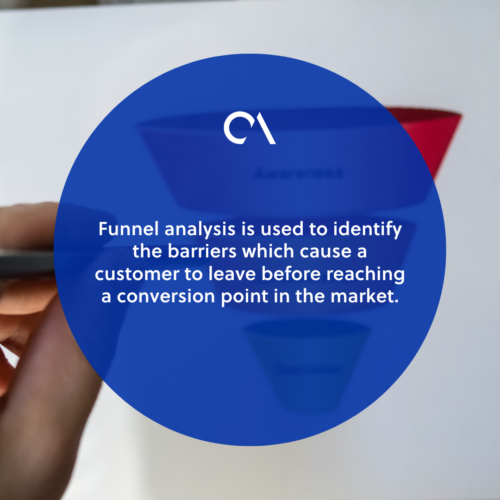
Importance of funnel analysis
The importance of funnel analysis sits in one place: it tracks user behavior. It reveals what customers want and what brings them to your site. A company runs many digital touchpoints, such as websites, email, apps, and dashboards. So funnel analysis helps streamline all of them for a better user experience.
However, funnel analysis is not just for sales and marketing. It also helps you grow customer retention[2] by improving campaigns based on funnel reports. For deeper demand work, it also supports your customer acquisition strategies.
Two main benefits of funnel analysis
Funnel analysis offers many ways to pull insights from your data and website traffic. Here are the two main benefits.
Identifies where high-quality visitors come from
Funnel analysis shows where your high-converting traffic comes from. It does this through analytics tools such as Google Analytics. As a result, you gain deeper insight and can run more advanced funnel analysis. Pairing it with broader web analytics makes those findings even clearer.
Helps find traffic
Funnel analysis helps you find website traffic through a funnel visualization tool. A funnel visualization tool shows the drop-off rate and conversion rate of your main pages. So the whole process makes one thing clear: it shows where and when visitors leave your site.
Types of funnel analysis
With funnel analysis, you can study and improve your marketing funnel. This helps you judge how well your campaigns and retention efforts work. You can apply this method to several parts of your business. Below are some common types of funnel analysis.
Onboarding funnel analysis
This type helps new users get started with your software. It offers guides, walkthroughs, and trials. Onboarding funnels often include a free trial. The main goal is simple: turn a free trial user into a paying customer.
Sales funnel analysis
A sales funnel analysis has stages. Each stage offers specific information, content, or answers. As a result, prospects move closer to a purchase. A clear sales pipeline process keeps those stages on track. It involves the following stages:
- Research and preparation. Getting to know the target customers.
- Brand awareness. Introducing the product or service through advertising, guest posting, podcasts, or sponsored social posts.
- Interest and evaluation. Building relationships with new leads to learn their goals.
- Desire. Showing prospects what life looks like once they become your customers.
- Action. Giving users materials that help them get familiar with the software.
- Re-engagement. Re-engaging current users to lift their experience and prompt more purchases.
Marketing funnel analysis
From a strategic view, a marketing funnel is a powerful analytics tool. It helps businesses understand the customer journey. It also shows how the number of users changes as they pass through each stage. In other words, a marketing funnel analysis measures a brand’s success across the buyer’s path. Many teams pair it with digital marketing support to act on the results.
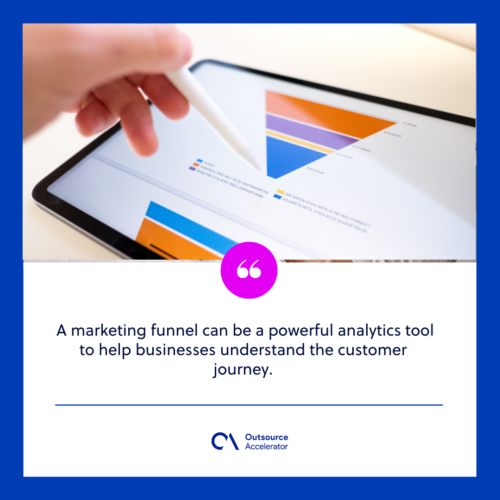
Amp up your website conversion rate using funnel analysis
Funnels are great tools for customer insight and better conversions. Once you know the basics, you get a clearer sense of each user stage. You can also use funnel analysis alongside cohort analysis. Together, they help you dig into why users do not convert.
Finding out why some customers do not convert gives you useful insight. As a result, you learn how to improve the experience and who to target next. Funnel analysis can report where your most frequent visitors leave. It can also show which pages have the best click-through rates.
Article references
[2] Grow customer retention: Arslan, I Kahraman, “The importance of creating customer loyalty in achieving sustainable competitive advantage.” Eurasian Journal of Business Management; Istanbul, 2020 Vol. 8 (1), doi: 10.15604/ejbm.2020.08.01.002
Frequently asked questions about funnel analysis
What is the difference between a funnel and funnel analysis?
A funnel is the path a user takes toward a goal, such as a purchase. Funnel analysis is the study of that path. So the funnel is the map, and the analysis is how you read it.
Which tools are best for funnel analysis?
Google Analytics is a common starting point. Many teams also use product analytics and funnel visualization tools. The best choice depends on your site, your budget, and the stages you want to track.
How often should you run funnel analysis?
Review your funnel at least once a month. Check it more often after a big campaign or a site change. Regular checks help you catch new drop-off points early.
Can funnel analysis improve customer retention?
Yes. It shows where current users disengage, not just where new buyers drop off. As a result, you can fix weak steps and keep more customers. For deeper context, review these customer retention trends.
Who should own funnel analysis in a company?
Product managers and marketers often lead it. Still, sales and support teams add useful context. Many firms also hand the day-to-day work to an outsourced marketing team.






 Independent






