
5 specialist finance roles US insurers now outsource instead of hiring


At a glance
- US insurers face a structural talent shortage in actuarial support, statutory reporting, and underwriting analysis: roles that take months to fill and carry high retention risk.
- Insurance BPO has expanded well beyond call centers. The global market grew from $7.7 billion in 2025 to $8.1 billion in 2026 and is projected to reach $10.6 billion by 2034, with carriers increasingly sending specialist work offshore alongside customer service.
- The five roles moving offshore are actuarial support, statutory reporting, underwriting support, claims finance and reconciliation, and premium and commission accounting, each with defined workflows that offshore teams handle reliably under in-house oversight.
- Afrishore BPO provides finance and accounting outsourcing from South Africa, including AP/AR, bookkeeping, and month-end close, plus actuarial analyst capacity through its Afrishore Quant division.
Most insurance carriers treat outsourcing as a customer service tool: call centers, first notice of loss, basic claims intake. Finance stays in-house by default.
That default is shifting. Tight talent markets and expanding compliance requirements are pushing US insurers to move functions they previously considered too technical or too sensitive for offshore delivery.
The shift is concentrated in five specific finance roles: not the full function, but defined layers within it. Understanding which roles are moving, and what makes them viable candidates, is where an insurance outsourcing evaluation should begin.
Why insurance finance is harder to staff than most carriers expect
The talent problem is structural, not cyclical. Actuaries require years of credentialing through the SOA or CAS, with each exam adding months to the pipeline.
Statutory reporting professionals need jurisdiction-specific knowledge of NAIC requirements that vary state by state. Underwriting support analysts need both financial modeling skills and insurance domain experience, a combination that does not come from a generalist finance background.
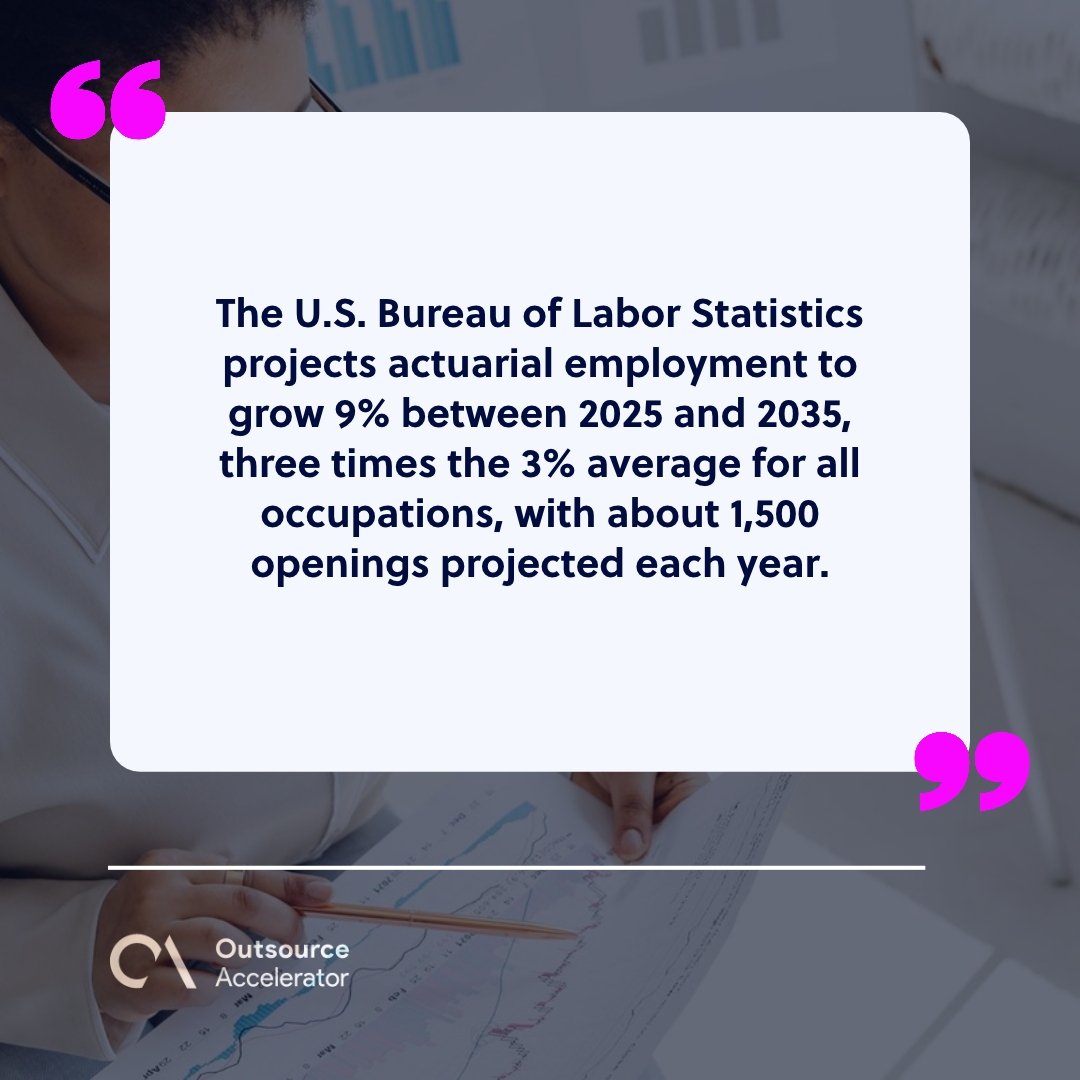
The U.S. Bureau of Labor Statistics projects actuarial employment to grow 9% between 2025 and 2035, three times the 3% average for all occupations, with about 1,500 openings projected each year. Many of those openings come from replacing actuaries who retire or leave the occupation, not from new roles.
Replacement cost when a specialist leaves runs high. The institutional knowledge embedded in these positions is rarely documented well enough to survive the transition.
The result is that many carriers are either permanently understaffed in these functions, paying above-market salaries to retain talent, or both.
Offshore delivery solves the capacity problem without solving it by hiring. The same logic that has driven adoption of accounting outsourcing in other industries now applies to the F&A layer inside insurance carriers.
Pro Tip: Before scoping an offshore finance engagement, map each role’s compliance dependencies. Statutory reporting and actuarial support carry direct regulatory exposure: these require vendors with insurance-sector specialization, not general F&A providers.
The 5 finance roles US insurers now outsource
Not every insurance finance function is equally suited for offshore delivery. The five roles below share a common characteristic: defined inputs, documented methodologies, and measurable outputs that make quality management straightforward from a distance.
1. Actuarial support
Reserve calculations, loss development modeling, and pricing analysis follow defined actuarial methods. The work requires technical precision, but much of the production work is methodical rather than judgment-heavy.
Carriers structure these engagements with in-house actuaries setting the methodology and signing off outputs, while offshore actuarial analysts execute the data processing and modeling runs.
2. Statutory and regulatory reporting
NAIC filings, state financial statements, and reinsurance reporting are high-stakes, repetitive, and jurisdiction-specific. Specialist teams that work exclusively on statutory reporting can build faster turnaround and fewer errors than in-house generalists who rotate across functions.
The key requirement is jurisdiction-specific training and in-house sign-off, not geographic proximity.
3. Underwriting support
The underwriting decision itself requires a licensed professional with accountability for risk. The data layer beneath it does not.
Risk scoring validation, document intake, portfolio data analysis, and application completeness checks are volume tasks. Offshore teams handle them at lower cost per transaction without touching the underwriter’s judgment.
4. Claims finance and reconciliation
Accounts payable for claims, payment reconciliation, and vendor invoice processing generate significant transaction volume in mid-to-large carriers. The reconciliation cycle produces predictable, documentable workflow.
Offshore delivery reduces cost per transaction while maintaining the audit trails that claims finance requires.

5. Premium and commission accounting
Premium accounting, commission calculations, and the month-end close that depends on them have well-defined workflows and clear performance benchmarks.
They are also the layer most carriers already understand from general finance outsourcing, which makes them a natural place to build confidence before expanding scope to more specialized insurance work.
Pro Tip: Claims reconciliation and premium accounting are the lowest-risk entry points for insurers new to offshore finance delivery. Both have clearly defined inputs and outputs and existing quality benchmarks. Most carriers pilot with one of these before expanding scope to statutory reporting or actuarial support.
What insurance finance outsourcing requires that standard F&A does not
Standard accounts payable and financial reporting outsourcing is well understood. Insurance finance adds two complications carriers need to account for before selecting a provider.
Regulatory jurisdiction complexity
A carrier operating across multiple states faces varying NAIC requirements, filing calendars, and format specifications. An offshore team handling statutory reporting needs jurisdiction-specific training and ongoing tracking of regulatory changes, not just general accounting expertise.
Audit and examination readiness
Insurance carriers face periodic state examinations. Any finance function handled offshore must meet the documentation standards an examiner would expect: clear process trails, version control, and data accessible to examiners on request.
Carriers that establish these standards from the start avoid remediation work later.
According to IMARC Group, the global insurance BPO market grew from $7.7 billion in 2025 to $8.1 billion in 2026 and is projected to reach $10.6 billion by 2034, a CAGR of 3.42%.
The growth reflects both rising demand for cost-variable delivery models and the increasing capability of offshore teams equipped to handle compliance-sensitive work.
| Role | Offshore-ready? | Key requirement |
|---|---|---|
| Actuarial support | Yes, with in-house oversight | SOA/CAS methodology familiarity, in-house sign-off |
| Statutory reporting | Yes, with in-house sign-off | Jurisdiction-specific NAIC expertise |
| Underwriting support | Yes | Defined workflow, data access |
| Claims finance and reconciliation | Yes | Claims system integration, audit trails |
| Premium and commission accounting | Yes | Documented close process, clear benchmarks |
| Core underwriting decisions | No | Licensed judgment, regulatory accountability |
Pro Tip: Treat the offshore finance team as an extension of your department, not a vendor at arm’s length. Shared documentation systems, direct access to the same source data in-house teams use, and regular review cycles are what separate compliant offshore finance delivery from the arrangements that create examination problems.
How Afrishore BPO supports US insurance carriers
Afrishore BPO delivers financial services outsourcing from South Africa, giving regulated businesses dedicated finance capacity without the hiring timelines and retention costs of building in-house.
Afrishore BPO’s capabilities relevant to insurance carriers include:
- Accounts payable and accounts receivable processing, including vendor invoice handling and payment reconciliation
- Bookkeeping and month-end close support with documented process trails
- Payroll support for finance and operations teams
- Actuarial analyst capacity through Afrishore Quant, its actuarial division, available as staff augmentation or managed services under your in-house actuaries’ methodology and sign-off
- Insurance operations support, including insurance claims outsourcing alongside the finance layer
US insurance carriers that need finance capacity without long hiring timelines can connect with Afrishore BPO to assess which finance functions are ready for offshore delivery.






 Independent






