
The best EOR to simplify hiring employees in Spain


What is the best way to hire employees in Spain without setting up a company?
The best way to hire employees in Spain without a local entity is to use an employer of record (EOR), which legally employs your staff through its own Spanish company while you manage their daily work.
- An EOR handles the Spanish contract, payroll, taxes, and statutory benefits for you.
- So you can onboard a Spanish hire in weeks, not months.
- You still choose the person, set their pay, and run their day-to-day work.
The worldwide employer of record market keeps growing fast. In 2026, it is projected to reach around USD 7.45 billion, up from roughly USD 6.82 billion a year earlier. So hiring employees in Spain has moved from a niche idea to a real line item on many growth plans.
Spain sits at the centre of this trend. However, most of its rules assume you already run a registered business there. Social security fees are high, and employment law is complex. In most cases, you want the talent without spending six to twelve months setting up a local company.
Why Spain keeps landing on hiring shortlists
Talent quality in Spain stays strong. At the same time, salaries for similar roles are often lower than in the UK, Germany, or the Nordics. In addition, universities in Valencia, Madrid, and Barcelona produce strong graduates in engineering, design, and customer experience each year.
Spain is also useful for remote teams for a few reasons:
- EU membership means a hire in Spain can serve clients across the union with no extra trade friction.
- Time zones overlap with the rest of Europe and open a working window into the Americas, which helps sales and support.
- Many workers are multilingual. They often speak Spanish, Portuguese, French, and English.
- The lifestyle appeal draws people who want to stay or move there rather than work abroad.
Still, none of that changes the legal truth. Finding a great candidate in Seville is one thing. That person still needs a proper Spanish contract, payroll, and benefits.
How an EOR removes the entity bottleneck
With an EOR, you choose the employee, set their pay, and run their daily tasks. Meanwhile, the EOR owns the contract. It also runs payroll, files taxes, and carries the compliance risk inside its own Spanish company. For the textbook version, this is the employer of record model in action.
So instead of waiting on incorporation, you can usually onboard a Spanish hire in a couple of weeks. Established providers like Native Teams can act as your Employer of record in Spain. They handle the local contract, monthly payroll, social-security registration, and statutory benefits, so you skip the entity entirely.
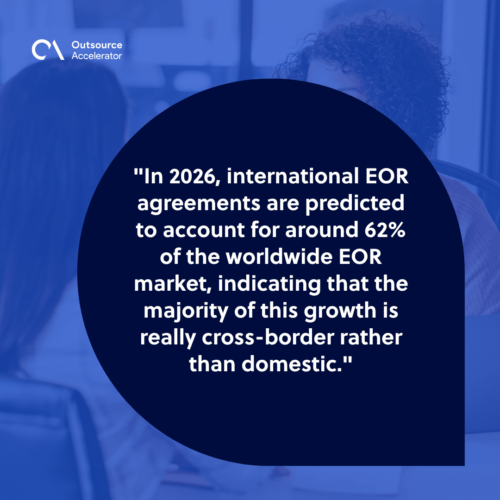
In 2026, cross-border EOR deals are projected to make up around 62% of the global EOR market. So most of this growth is cross-border rather than domestic.
Businesses do this because they can no longer set up a company in every country. So an EOR gives them a faster path.
What makes direct hiring in Spain complicated
Hiring someone directly means becoming their employer under Spanish law. For a foreign company with no local base, that is a long road. First, you register a Spanish company, open a local bank account, and set up with the social-security authorities. This can take months and rack up legal and accounting fees before you pay a single salary.
Second, there is the cost. Employer social-security contributions in Spain often run around 30% of gross salary on top of take-home pay. In addition, the rules have tightened, with a solidarity contribution added for higher earners.
Then there are the local details that catch people out:
- Salaries are often quoted across 14 payments a year, not 12, because of statutory extra payments.
- Most sectors fall under a collective bargaining agreement that sets minimum terms you cannot undercut.
- Contract type matters. Indefinite and fixed-term contracts carry different social security rates and different exit rules.
- Severance, notice, and the final settlement follow strict formulas.
So most foreign employers lean on a local gestoría to keep payroll and filings straight. That works. However, it leaves you stitching together an accountant, a lawyer, and an outsourced payroll provider while you remain the entity on the hook for every mistake.
EOR vs. PEO vs. setting up your own entity
These three routes get confused all the time. So it helps to line them up. The difference between an EOR, a PEO partnership, and your own entity often decides which one fits.
| Route | Who is the legal employer | Local entity needed | Typical setup time |
|---|---|---|---|
| Own entity | You | Yes | 3 to 12 months |
| PEO | You (co-employment) | Usually yes | Varies |
| EOR | The provider | No | 1 to 3 weeks |
A PEO shares employment duties with you under a co-employment model. In most cases, it assumes you already have a Spanish entity. You can see how a PEO splits these employer responsibilities in more detail. An EOR, by contrast, removes the entity requirement altogether.
So the choice depends on your plan. If you want to build a team of 50 people in Madrid over five years, your own entity may pay off in time. But if you want to hire two or three people now and test the market, an EOR is almost always the faster, cheaper start.
How to choose the best EOR for Spain
“Best” is not a single answer. The right provider for a two-person pilot differs from the one a 40-person team needs. So run any shortlist through the same checks.
1. Does it own a real Spanish entity?
For example, some providers quietly subcontract to a third party in the country. As a result, they add a layer between you and your employee, plus a margin on top. So ask directly whether the provider employs through its own legal entity in Spain or routes you through a partner.
2. Is the pricing actually transparent?
Look past the headline per-employee cost. Instead, find out how they handle the 14-payment system, any deposit needs, mandatory bonuses, and the convenio for your role. After all, a cheap sticker price with surprises later is not as good as a clear breakdown.
3. How deep is the compliance and HR support?
You need more than a payroll run. For example, you need help with local contracts, benefits, sick leave, and the occasional termination. A good HR outsourcing layer adds real value here. In fact, a provider that offboards well is worth more than one that only onboards smoothly, because Spain’s termination rules are strict.
4. What happens when you leave?
Good providers plan for the end as well as the start. They help move an employee to your own company later, or support a clean exit. So read the offboarding terms before you sign.

One simple test works well. For example, ask a provider to walk you through a sample payslip for the exact role and city you are hiring in. Those who can do it on the spot usually know Spain well. Still, those who stall often do not.
Mistakes to avoid when hiring in Spain through an EOR
Even with a provider doing the heavy lifting, a few errors show up again and again:
- Treating an EOR like a contractor platform. An EOR creates a real employee with real protections. So trying to dodge them defeats the point and adds risk.
- Ignoring the collective agreement. The convenio can set minimum pay, hours, and benefits above what you assumed. So confirm it early.
- Underbudgeting employer costs. Plan for the full loaded cost, not just gross salary. A clear view of payroll outsourcing trade-offs helps here.
- Skipping the offboarding talk. People leave. Knowing the notice, severance, and settlement process early saves a painful scramble later.
Find a reliable EOR in Spain
The pricing is fair for the quality you get. The talent is strong, and the EU access is real. Most firms do not struggle with hiring itself. Instead, they struggle with the entity, the social security math, and the local rules between a signed offer and a valid payslip.
So your choice of provider still matters a lot. Test it with a specific role first. Then give priority to one with real compliance depth, honest pricing, a clear exit route, and a true local entity. Do it right, and your first Spanish hire will feel less like a legal project and more like a smart addition to your team.
Frequently asked questions
What is an employer of record in Spain?
An employer of record in Spain legally employs your worker through its own Spanish company while you run their daily work. It handles the contract, pay, taxes, and compliance. So you can hire without registering your own business in the country.
How long does it take to start hiring employees in Spain with an EOR?
Usually one to three weeks. By contrast, setting up your own company takes many months. The exact timing depends on how fast the candidate provides documents and signs the local contract.
How much does it cost to hire employees in Spain?
Beyond gross salary, plan for employer social-security contributions of roughly 30%, plus the EOR’s per-employee fee. Salaries are also usually split across 14 payments a year. So model the full annual cost carefully before you make an offer.
Is an EOR legal for hiring in Spain?
Yes. Using an EOR is a legal, widely used way to hire employees in Spain. The provider must run a compliant local entity, and the worker must be treated as a genuine employee with full statutory rights.
Do I still manage employees hired through an EOR?
Yes. You direct the daily work, set goals, and decide on pay and promotions. The EOR handles the legal and admin side of employment. So the working relationship and performance management stay with you.






 Independent






