
Encouraging companies to start outsourcing: An outsourcing company CEO’s insight


How can companies be encouraged to start outsourcing?
Companies start outsourcing most easily when they drop old myths, begin with a small trial team, and keep the work transparent from day one.
- Modern outsourcing is global and tech-driven, so the old “sweatshop” and “call center only” labels no longer hold.
- A clear plan and a team of fewer than five people make a safe first step.
- Open reporting and shared wins turn a nervous first try into a lasting partnership.
Business process outsourcing remains one of the most practical ways for businesses to hire remote teams, save on costs, and delegate non-core tasks. Over recent years, BPO companies have given their clients a solid continuity plan when disruption hit.
Remote work has pushed companies worldwide to innovate and adapt to digital tools. As a result, demand for outsourcing has kept rising. Still, a stigma often comes to mind when firms send services offshore.
So how can companies be encouraged to start outsourcing? Derek Gallimore, CEO of Outsource Accelerator, and Carmen Booth, CEO and co-founder of Booth, discussed this in the 334th episode of the Outsource Accelerator podcast.
Breaking the outsourcing stigmas
As Carmen noted, outsourcing today is “far from its image decades ago.” New tools have made technology more accessible. Because of this, the industry has grown into a highly global one. Teams now use modern tools to work well even when miles apart. To understand the wider shift, see how firms gain from the main benefits of outsourcing.
The industry has also disproved some common myths, such as:
Being a “sweatshop” industry
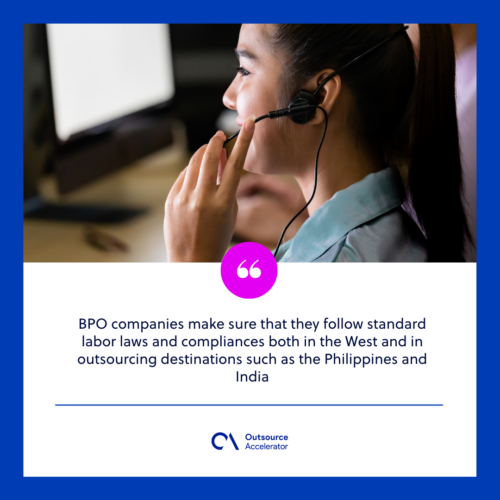
Overall, the sector is far from doing cheap labor practices. BPO companies make sure they follow standard labor laws in the West and in outsourcing hubs such as the Philippines and India. In fact, many of these Philippine outsourcing teams work under strong local protections.
Focusing purely on call centers
These days, outsourcing is not just about customer support and telemarketing. In fact, firms and boutique providers now offer a wide range of professional and admin services. For example, many teams handle outsourced customer service alongside skilled back-office roles.
Back-office tasks should stay in-house
Remote work has proved that a company does not always need an office to run well. So BPO firms now offer back-office outsourcing more than ever. This helps clients run leaner operations and support their client-facing teams.
How companies can start outsourcing
First-timers often feel unsure about delegating tasks. Entrepreneurs who are used to multitasking may hesitate or simply not know where to begin. As a result, they often assume outsourcing is too complex for them.
On the bright side, it does not have to be hard. These tips make a strong start:
Have a proper outsourcing plan
A proper outsourcing plan should come first. It should set out your purpose, objectives, basic processes, and metrics. In some cases, BPOs can help you build one while they set up your team. It also helps to review common BPO engagement models before you choose a partner.
Start with a small team
Carmen recommends starting with a small team for a set period. A team of fewer than five people can show you quickly whether the service fits your clients and your needs.
Assure transparency
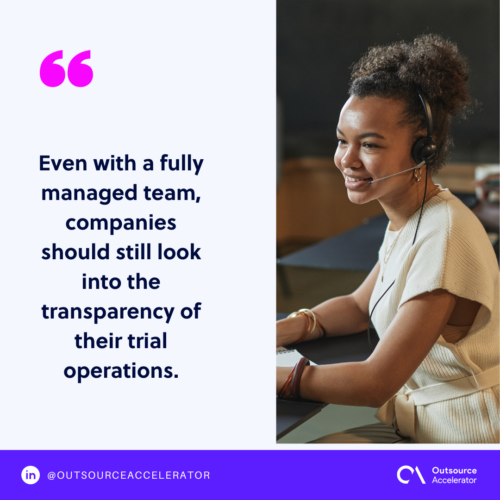
Even with a fully managed team, you should still check the transparency of your trial. So communicate clearly on progress reports and team performance. Then stay involved in every positive and negative result.
Share successes with the team
Finally, the Booth CEO believes that clients’ wins are their wins too, no matter how small. This shows that outsourced teams are a valued part of the client’s company.
Flexibility in outsourcing
Carmen was once a client herself, looking for outsourced customer support in the Philippines. Together with her business partner Jamie Booth, she set up Booth to provide flexible BPO and KPO services.
Their teams are trained to mimic each client’s culture. So clients treat them as an extension of their own company. Booth helps many firms outsource well and keep their work quality high, whatever their size or industry.
Learn more about their services through their website and check out the OA podcast’s latest episode here.
Frequently asked questions about starting to outsource
Here are a few questions business owners often ask before they start outsourcing.
What is the first step to start outsourcing?
The first step is a simple plan. Write down the tasks you want to delegate, your goals, and how you will measure results. With that in hand, you can brief a provider clearly and avoid confusion later.
How big should my first outsourced team be?
Keep it small at first. A team of fewer than five people lets you test the fit at low risk. Then you can scale up once the quality and communication prove themselves.
Is outsourcing only for large companies?
No. Small firms and startups outsource too. In fact, a small team can gain the most, because it frees the owner from routine work and keeps fixed costs low.
Which tasks are easiest to outsource first?
Many firms start with clear, repeatable tasks. Good examples include customer support, data entry, bookkeeping, and admin work. These roles are easy to document, so a new team can learn them fast.
How do I keep quality high with a remote team?
Set clear metrics and check them often. Hold short regular updates and share feedback both ways. Because the team feels included, they tend to stay motivated and deliver better work.






 Independent






