
Why employee lifecycle management matters for growing teams

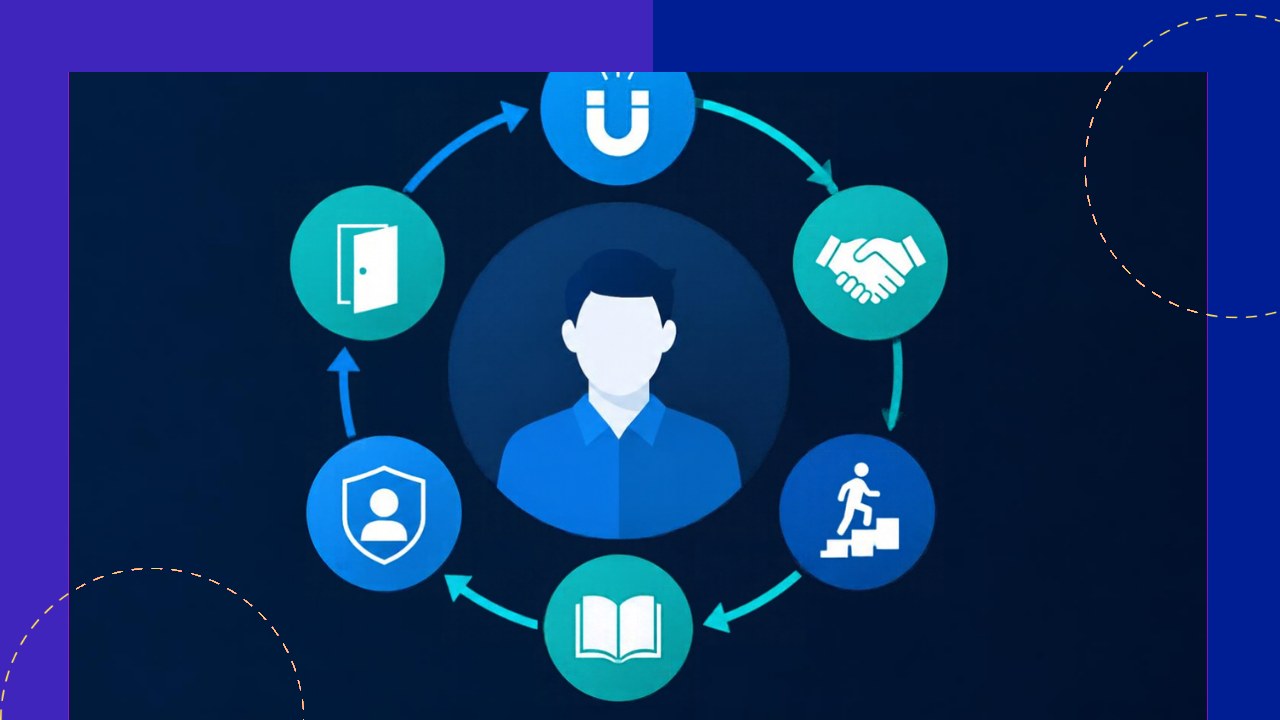
- Employee lifecycle management treats every stage of a worker’s journey, from first contact to final day, as one connected system.
- Weak stages quietly drain retention and output, so growing and distributed teams feel the gaps first.
- Managing each phase well builds trust, lifts performance, and keeps good people longer.
Employee lifecycle management is the practice of guiding a worker through every stage of their time with your company. It covers six phases: attract, hire, onboard, develop, retain, and offboard. Each one shapes how someone feels about the job, and each one feeds the next. When you treat these phases as separate boxes, people fall through the cracks between them.
For a small team, the cracks stay small. For a growing or distributed team, they widen fast. New hires join every week, managers stretch thin, and time zones blur the handoffs. So the firms that scale well tend to map the whole journey on purpose, not by accident.
What the employee lifecycle actually covers
The lifecycle is not a vague idea. It is a set of concrete moments, and you can design each one. Think of it as a loop rather than a line, because a strong exit often brings a rehire or referral back to the start.
1. Attract
This stage starts before anyone applies. Your careers page, reviews, and reputation all shape who shows up. Clear, honest job posts pull in people who fit, while vague ones pull in a flood you then have to sort. Growing teams win here by describing the real work, not a wish list.
2. Hire
Hiring covers screening, interviews, and the offer. Speed matters, but so does fairness. A slow or messy process signals how the company runs, and strong candidates notice. A tight, respectful process protects your brand even with people you turn down.
3. Onboard
Onboarding is where first impressions harden into habits. The stakes are high, because early exits cluster here. Harvard Business Review notes that up to 20% of staff turnover happens in the first 45 days. A structured first month, with a clear plan and a named buddy, cuts that risk sharply. For distributed teams, a written playbook matters even more, since a new hire cannot simply read the room.
4. Develop
Once someone settles in, growth keeps them engaged. Development means training, feedback, stretch projects, and a path forward. People rarely leave a job where they are learning, but they often leave one where they feel stuck. Regular check-ins do more here than any annual review.
5. Retain
Retention is the payoff for doing the earlier stages well. It rests on pay, purpose, recognition, and above all good management. Gallup reports that managers account for at least 70% of the variance in employee engagement scores. In other words, your frontline leaders carry most of the weight. Equip them well, and retention follows.
6. Offboard
People leave, and how they leave matters. A respectful exit keeps the door open for boomerang hires and referrals, and a proper exit interview hands you honest feedback. Treat leavers well, and some become your best recruiters later.
Why the stages fail when you ignore them
Each stage looks fine on its own. The damage shows up in the gaps. A great recruiter hands off to a weak onboarding, and the new hire feels misled. A strong onboarding stalls because no one owns development. Each broken handoff chips away at trust.
The cost is real. Replacing a worker can run from one half to two times their salary once you count hiring and ramp time. Median job tenure sits at about four years, according to the U.S. Bureau of Labor Statistics, so every exit you prevent buys years of value.
Why growing and distributed teams feel it most
Scale changes the math. A ten-person shop runs the lifecycle by instinct, because everyone sits close and the founder notices when someone struggles. At a hundred people across five time zones, instinct fails. You need written process, clear ownership, and shared tools, or quality drifts by location.
Distributed work adds its own strain. A remote new hire cannot wander to a desk for help, and managers cannot read body language on a call as easily. So the stages that rely on proximity, like onboarding and development, need deliberate design. That design is what a strong approach to the remote worker journey provides.
How to manage each stage well
You do not need a huge HR team to do this. You need clear owners and simple routines. Start by naming who owns each stage, then give each one a short checklist.
Map the journey on one page
Write every stage down, along with the key moments inside it. A simple doc works. Once you can see the whole journey, the weak spots jump out.
Standardize onboarding first
Onboarding gives the fastest return, because it protects your newest and most fragile hires. Build a repeatable 30, 60, and 90 day plan. Strong onboarding practices for distributed hires turn a nervous first week into a confident first quarter.
Invest in managers
Since managers drive engagement, train them. Teach them how to run one on ones, give feedback, and spot early flight risks. This single move lifts the retain and develop stages at once.
Measure a few things that matter
Track time to productivity, 90 day retention, engagement, and regretted attrition. Four clear numbers beat a dashboard no one reads. Review them each quarter, then fix the weakest stage next.
Together, these steps turn scattered HR tasks into one connected system: a team that joins faster, grows further, and stays longer as you scale.
Frequently asked questions
Who should own employee lifecycle management?
Ownership is usually shared. HR designs the framework, but line managers run the day to day moments inside it. In small companies, a founder or operations lead may hold the whole thing. The key is to name a clear owner for each stage, so no phase becomes an orphan that everyone assumes someone else handles.
How does lifecycle management differ from the employee experience?
The lifecycle is the structure, and the experience is how it feels. The lifecycle lists the stages a worker moves through. Experience describes the emotion at each touchpoint, such as pride on day one or frustration with a clunky tool. You manage the lifecycle to improve the experience, so the two work as a pair.
Can you outsource parts of the lifecycle?
Yes, and many growing firms do. Payroll, benefits admin, and some recruiting steps work well with an outsourcing provider or an offshore partner. Keep the human judgment stages, like development and retention conversations, close to your own managers. Hand off the admin, hold on to the relationships.
What is the quickest win for a stretched team?
Start with onboarding. It carries the highest early turnover risk and gives the fastest payback. A written 30, 60, and 90 day plan costs little to build and protects every future hire. After that, train your managers, since they shape retention more than any policy does.






 Independent





