
What you need to know about data science platforms

What is a data science platform?
A data science platform is software that combines data from many sources, cleans it, and organizes it, so teams can spot trends, build models, and make better decisions.
- It links scattered data, then helps teams analyze and visualize it in one place.
- Teams use it for data prep, modeling, and prediction, which saves hours of manual work.
- As a result, businesses gain customer insight, tighter security, and smarter finance choices.
Data science platforms are a type of software that pulls many data sources together. Then they clean the data and organize it in a clear way. As a result, it gets easier to find trends and patterns across data sets. In addition, they provide insights from many sources at once.
For businesses, these platforms open the door to growth. For example, they offer customer insight, stronger security, and better finance decisions. Along with data transformation tools, they are among the most useful solutions in the industry today.
Data science platform definition
A data science platform is software that helps you combine and analyze data from many sources. Data scientists use these platforms to aid data mining. For example, they analyze, predict, and automate tasks that would take too long by hand.
These platforms work in many ways. Businesses, governments, and individuals all use them. Most teams use them to build models. In turn, those models predict outcomes on new data based on past records, a method known as supervised learning. Clean inputs matter here, so data cleansing is often the first step.
When does your company need a data science platform?
A data science platform helps any company that wants to combine, analyze, and visualize data from many sources. So here are some signs your business could use one.
Your process needs fine-tuning
It helps to watch for friction in your work process. For example, a Salesforce study found that weak collaboration and communication is a key driver of business failure. So for teams that struggle to coordinate, a data science platform offers one central place to work. As a result, it gives everyone more visibility.
It’s getting more challenging to hire
Replacing staff is costly and tiring. In fact, turnover is one of the biggest reasons companies struggle to hire and keep talent. For example, lost productivity and hiring costs add up fast.
So a value-rich platform can help your team stay productive despite staffing gaps. It can cover tasks like data prep, monitoring, and model testing.
Your team is overwhelmed
Demand for data keeps rising. As a result, a small team of scientists can burn out and fall short of its potential. A data science platform can streamline data prep. So it eases the load in their workflow.
It also helps to act early. By adding a platform before your team is buried in work, you avoid many speed bumps down the road.
Advantages of using a data science platform
Data science has changed the way we do business. For example, it supports sales, finance, and many other functions. So there are strong reasons to put it to work.
Drives team collaboration
Working with data involves complex steps. For example, it includes knowledge base management and reporting. These tasks need accuracy and clear communication at the same time. As a result, smooth data access really matters.
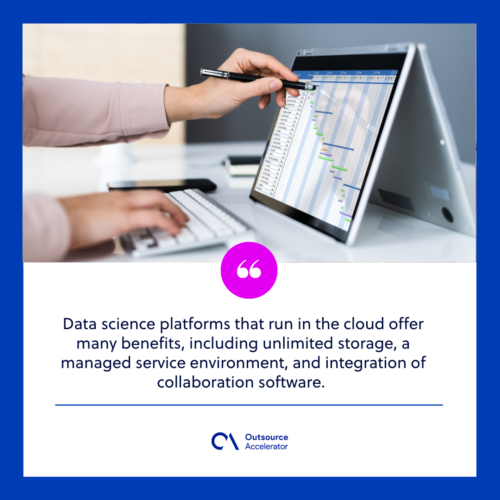
Cloud-based data science platforms offer many perks. For example, they provide large storage, a managed environment, and built-in collaboration tools. Good big data consulting can help you pick the right setup.
Minimizes error
A data science tool helps you make informed choices based on structured analysis. As a result, you waste less time and fewer resources. In addition, these platforms enable automation. So they speed up response times and cut human error.
They also let you view data in real time. For example, dashboards and projections give leaders more agility. In turn, teams can act on insights faster. Many pair this with predictive analytics tools for sharper forecasts.
Offloads low-value tasks
These platforms handle many routine data tasks. So data scientists can focus on better output and strategy. As a result, the leading tools cut the time spent on heavy work like experiments and research.
Best data science platforms to try
The top data science platforms drive productivity through model delivery, AI, and other modern tech. Today, most also center on machine learning and generative AI. So here is a quick look at a few options, which usually offer free and paid tiers. For more on the underlying tech, see our guide to machine learning.
Dataiku
Dataiku was founded in 2013 as an AI and machine learning company. It provides a cloud platform where teams build and deliver data and advanced analytics. In addition, it lets you customize, reuse, and share code. As a result, the production process runs more smoothly.
Kaggle
Kaggle was founded in 2010. It offers a place to discover and publish data sets, build models, and work with other data scientists. For example, users can tap a huge public library of datasets and notebooks for all kinds of projects.
Alteryx
Alteryx is a software company based in Irvine, California. Its data science and analytics products run on desktop and in the browser. So it makes advanced analytics easier for everyday users. It also offers a free trial.
Data science platforms help you combine and analyze data
The best data science platforms make it easy to combine your company data with other sources. Then they help you analyze it in a clear, readable format. In addition, they give you more control over what data is stored and how it is used. As a result, this helps a lot when you handle sensitive information, like credit card numbers or medical records. A skilled data scientist can help you get the most from these tools.
Frequently asked questions about data science platforms
What is a data science platform used for?
Teams use it to combine, clean, and analyze data in one place. So they can build models, run predictions, and share results. As a result, it supports smarter, faster decisions.
Do you need coding skills to use one?
It depends on the tool. Many platforms now offer visual, low-code workflows. Still, coding skills help for custom models and advanced work.
How is a data science platform different from a BI tool?
A BI tool mainly reports on past data through dashboards. A data science platform goes further. For example, it builds predictive models and automates data prep.
Are data science platforms expensive?
Prices vary widely by tool and scale. Still, many offer free tiers or trials. So you can test one before you commit to a paid plan.
Can small businesses use data science platforms?
Yes. Cloud-based options scale to small teams and budgets. As a result, even lean businesses can turn raw data into useful insight.






 Independent






