
8 CFO challenges and how to overcome them


This article is a submission by D&V Philippines. D&V Philippines has years of experience in the accounting and finance industry. This third-party services company can generate the financial reports you need to make real-time financial decisions.
What are the biggest CFO challenges and how can you overcome them?
The biggest CFO challenges include hiring finance talent, integrating data, using big data, adopting automation, securing data, innovating, meeting regulations, and supporting remote teams.
- The CFO role now goes well beyond finance into strategy and technology.
- Most challenges trace back to talent, data, security, and change management.
- Clear strategies and the right tools help CFOs solve each one.
Chief financial officers (CFOs) are a key part of any organization. They keep cash flow positive and check that financial statements are accurate. They also make sure the company follows tax laws and similar rules.
However, the CFO role has grown over time. Finance is still their main focus. Yet they now handle strategic calls that shape the whole company. So CFO challenges must be solved for them to do their best work. Many firms ease the load with outsourced accounting support.
8 CFO challenges and ways to solve them
Here are some of the challenges that many CFOs face today.
1. Acquire and retain talent
A CFO needs to find talent to fill vacancies in the finance team. CFO roles have evolved, and so have their teams. As a result, staff now need the right skills and experience to do the job well.
Technology is now central to managing and analyzing financial data. So this is a real challenge. Some candidates have strong finance skills but lack the tech skills to collect and analyze data. In that case, you may need to hire a data analyst and train them in finance over time.
In many cases, keeping staff beats hiring new ones, because it costs less. So offer a competitive package to keep people from leaving. Also talk with your team to learn their needs. Finally, gather feedback so you know which policies and targets work best.

2. Integrate diverse data
Good data gives many companies an edge. CFOs need current and accurate numbers to support their calls. However, data from many sources is hard to work with.
So integrate and unify your data sets. As a result, collection and analysis take less time and run more smoothly. It also helps your team build reports and cut mistakes. The work can be tough, but the payoff is worth it.
3. Leverage big data
Another CFO challenge is building a data-driven strategy that helps the company hit its goals. Used well, big data lets CFOs make accurate forecasts. In turn, the business stays financially flexible through any challenge.
CFOs and their teams now look beyond finance data. For example, they may gather and analyze data from marketing and operations. They do this to turn numbers into real strategies.
However, some CFOs still rely on intuition, even with strong tools on hand. So the goal is to lean on predictive data instead and plan ahead. Solid financial management practices make this shift easier.
4. Combine automation and technology
Many companies now use technology far more than before. However, CFOs still face a challenge. They must convince some staff to trust automation even more.
Others prefer to do finance tasks by hand instead of automating them. In short, doubts about automation still linger. So a CFO must show the clear benefits. For example, automation removes redundant and routine admin tasks. In turn, it frees staff to do more creative, analytical, and strategic work.
5. Improve cybersecurity and prevent fraud
Protecting financial data and preventing cyberattacks is a growing CFO challenge as a company scales. The cost of attacks and fraud eats into budgets and profits. Lost data can also threaten client privacy.
So a CFO must find the right tools to guard company data and stop fraud. For many firms, cloud-based software is the go-to choice. After all, it is easy to set up, easy to access, and built with layers of security.
6. Learn to innovate
CFOs must stay flexible and innovative to keep a competitive edge. So they need to embrace their wider role and the tools that make work easier. Their finance and industry knowledge helps them drive change and adopt new technology. In addition, clear KPIs and predictive analytics help them spot opportunities and act on them.
7. Make sure to comply with regulations
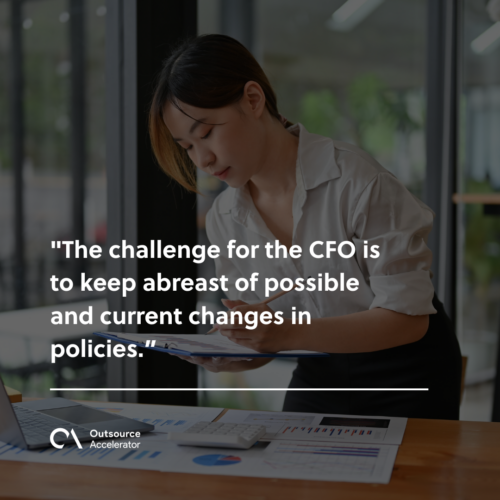
CFOs make sure their companies follow local laws, rules, and taxes. Delays and non-compliance bring penalties, such as extra fees or restrictions. Rules can also change with government policy.
So the CFO must track current and likely policy changes. Then they must comply quickly, with or without help from external auditors. An experienced financial controller can share much of this load.
8. Shore up your remote workforce
Remote and hybrid work are now common. Teams can get their tasks done in a work-from-home setting. As a result, many companies now run a hybrid setup.
However, this can push up work hours for many staff. When the line between work and home blurs, fatigue and stress rise. So CFOs must help their teams find a healthy work-life balance. They must also pick technology and software to protect the data those teams use.
Getting over these CFO challenges
These CFO challenges may be short-term setbacks for high-performing leaders. Still, they test a leader’s ability to guide the team and solve modern problems. Once they form effective strategies, they can perform at a high level for their companies. Many also outsource CFO services to add capacity at speed.
Frequently asked questions
Here are quick answers to common questions about CFO challenges.
What is the biggest challenge facing CFOs today?
There is no single answer, since it varies by company. However, talent and technology top most lists. CFOs need staff who know both finance and data tools. So hiring and training for that mix is often the hardest part.
How can a CFO manage cybersecurity risk?
First, map where sensitive financial data lives. Next, pick secure, cloud-based tools with strong access controls. Then train staff to spot fraud and phishing. Regular audits also help catch gaps early.
Should CFOs outsource finance and accounting tasks?
Often, yes. Outsourcing can cut costs and add skilled support fast. For example, firms may outsource bookkeeping, cash flow management, or reporting. This frees the CFO to focus on strategy.
How is the CFO role changing?
The role now reaches well beyond finance. Today, CFOs join strategy, technology, and data decisions. So they act as business partners, not just number keepers. As a result, broad skills matter more than ever.






 Independent






