
A quick guide to call center agent utilization


In the fast-paced world of call centers, optimizing the efficiency and productivity of agents is paramount.
Several critical issues can arise when there’s a lack of optimization for call center agents. First off, there can be longer waiting times for customers seeking assistance. This means more frustrated clients, leading to dissatisfaction and potential business loss.
Moreover, there might be unnecessary strain on resources, resulting in higher operational costs for the call center.
Agents might also feel overwhelmed or burnt out if they’re not working effectively, impacting their job satisfaction and potentially leading to higher turnover rates.
Call center agent utilization is a critical metric in the BPO industry that determines the effectiveness of resources in handling customer inquiries.
What is call center agent utilization?
Call center utilization refers to how effectively call center agents use their time while working. It measures the amount of time agents spend doing productive tasks, like talking to customers or solving issues.
It’s about ensuring that agents use their working hours efficiently to handle customer calls and tasks, which helps the call center run smoothly and serve customers better.
Why is call center agent utilization important?
Effective call center agent utilization significantly influences how well a call center operates.
When agents use their time efficiently, it positively impacts critical metrics such as:
- Average handling time. This refers to the duration agents spend on each call.
- First call resolution. It is about solving a customer’s issue or resolving requests in a single call.
- Customer wait times. This refers to the time customers spend waiting for assistance.
Higher call center agent utilization rates signal that resources are being used optimally, improving customer service delivery.
A streamlined operation enhances the customer experience and reduces operational costs for the call center.
When agents work efficiently, it often leads to increased employee satisfaction. Agents feel more productive and engaged when they can handle tasks competently within their working hours.
Moreover, call center agent utilization fosters a better work environment and reduces burnout.
How to calculate call center agent utilization
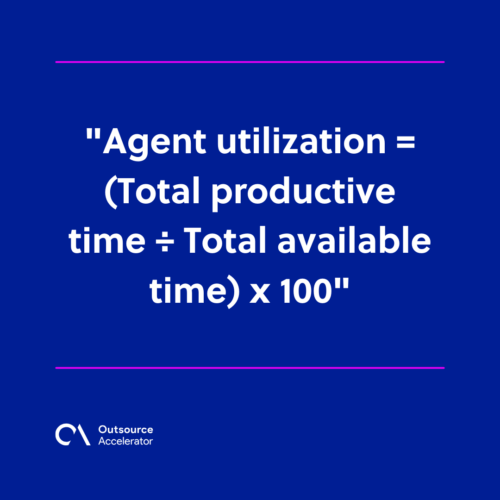
The formula for calculating call center agent utilization involves dividing the total productive time by the total available time and multiplying by 100 to get a percentage.
Productive time includes hours spent actively engaged in calls or handling customer-related tasks.
Agent utilization = (Total productive time ÷ Total available time) x 100
This simple formula helps management grasp the extent to which their agents are engaged in productive activities versus their overall working hours.
Productive time isn’t limited solely to the duration spent directly on calls but encompasses all tasks contributing directly to serving customers’ needs and addressing their concerns.
Ways to improve call center agent utilization rate
Since call center utilization is a fundamental factor influencing the overall success of the call center, here are the following ways to further improve its rate:
Use advanced scheduling tools
Implement advanced scheduling software to boost call center agent utilization in your organization. These sophisticated tools are designed to sync agent availability precisely with peak call periods, ensuring adequate coverage without overstaffing.
By accurately forecasting call volumes and patterns, these scheduling solutions empower call centers to allocate resources efficiently.
This means agents are scheduled precisely when they’re needed the most, preventing downtime or overwhelming surges.
Implement training and skill development
Invest in ongoing training and skill development programs to enhance your call center agent utilization rates. Well-trained agents possess the expertise and techniques to handle calls swiftly and effectively.
Through continuous learning initiatives, agents refine their communication skills, gain deeper product knowledge, and learn problem-solving techniques.
As a result, they can resolve customer issues more efficiently, reducing call times and increasing overall productivity.
Integrate latest technologies
Integrate cutting-edge technologies that can revolutionize your call center operations. AI-powered chatbots offer immediate assistance to customers for common queries, reducing agent workload and wait times.
Acquire Intelligence (formerly Acquire BPO) is one example of a firm that is staying competitive in terms of integrating AI with its call center operations.
Speech analytics tools enable the analysis of customer conversations, providing valuable insights for service improvement.
CRM systems centralize customer information, empowering agents with comprehensive data to swiftly personalize interactions and resolve issues.
Ultimately, this integration enhances the overall efficiency of the call center, leading to improved agent utilization rates and heightened customer satisfaction.
Conduct performance monitoring
Regular and systematic performance monitoring helps enhance your call center agent utilization rates.
Call centers gain a comprehensive view of agent performance by tracking metrics like:
- Call resolution rates
- Customer satisfaction scores
- Adherence to schedules
This data serves as a foundation for constructive feedback and targeted coaching sessions.
Based on the gathered information, agents can identify areas for improvement and refine their skills, leading to increased efficiency in handling calls and tasks.
Moreover, continuous monitoring allows for timely intervention in case of deviations from performance standards, ensuring that agents consistently operate at their peak.
Incentivize agent productivity
Incentivize your agents’ productivity to boost your firm’s call center agent utilization rates.
By offering rewards and incentives to agents who meet or surpass predefined performance goals, the call center motivates its workforce to excel.
These incentives can take various forms, from monetary bonuses to recognition programs or career advancement opportunities.
Such rewards create a tangible connection between an agent’s efforts and their outcomes, fostering a sense of achievement and encouraging continued high performance.
Consequently, agents are more inclined to maximize their productivity levels, ensuring that their time is effectively utilized in handling customer interactions.
Set clear call center agent utilization goals
Setting precise call center agent utilization goals is crucial for driving improvements. Regularly reassess and adjust these goals based on evolving business needs and performance data.
Implementing these strategies and setting clear goals allows call centers to enhance operational efficiency, elevate customer satisfaction, and achieve sustainable growth.






 Independent





