
What is co-sourcing and how does it help?


What is co-sourcing and how does it help?
Co-sourcing is a model where a business brings in outside experts to work side by side with its own in-house team.
- Internal staff and outsourced team members share the same goals.
- As a result, you add skills and hands without a big rise in cost.
- It also works well as a first step into outsourcing.
Firms always look for smart ways to cut costs. So over the years, many cost-saving models have popped up. Co-sourcing is one of them. In short, it takes a page out of the outsourcing playbook. As a result, employers can lower costs and still keep quality high.
Defining co-sourcing
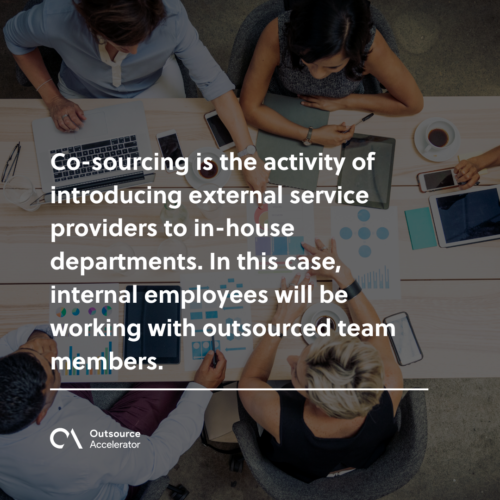
Co-sourcing means adding outside experts and providers to your in-house teams. So your own staff work with outsourced team members on the same tasks. In some cases, the outsourced staff sit in your office. In other cases, they work remotely alongside their teammates. Either way, both groups aim for the same goals.
Co-sourcing vs. Outsourcing
The main difference is the model each one uses. Co-sourcing runs as a hybrid setup. Outsourcing, meanwhile, can be an all-in or all-out setup. So one leans on teamwork more than the other.
Take an internal audit function as an example. With outsourcing, an outside firm takes over the whole task. With co-sourcing, the outside firm works with your team instead. As a result, the partner adds skills and support without replacing your staff. For many firms, that blend brings greater gains.
Business processes you can co-source
The list below is not complete, but it is a good start. Still, keep in mind that co-sourcing is a big decision. So it affects your staff. Because of this, make the choice in an open way and for the good of the team. Otherwise, it may hurt morale.
Content creation
Content covers a lot, from writing to film work. So firms can often find freelancers for these tasks. For example, you can start with a small in-house team and a manager. Then you add freelancers as you grow. As a result, you produce more content at a lower cost.
Human resources
HR is the heart of any firm, so it can gain a lot from co-sourcing. For example, many recruitment process outsourcing (RPO) firms handle select tasks, such as:
- Background checking
- Candidate sourcing
- Initial interview
- End-to-end recruitment process
So outside providers can take on these tasks. Meanwhile, in-house staff focus on engagement and other internal work.
Back-office activities
Back-office staff handle data entry and clerical work each day. So this is another good area for co-sourcing. As a result, firms cut waste and save resources. In addition, a blend of internal and external staff helps you hit your key performance indicators (KPIs) without spending more.
Telemarketing
Telemarketing takes a lot of work, from lead generation to cold calling. Agents face prospects daily and must hit their quotas. So why not co-source part of this team? After all, more hands mean more chances to close deals.

Advantages of co-sourcing
Co-sourcing is a good stepping stone into outsourcing. So it lets leaders test the waters first. Here are the main benefits it offers.
More strength in numbers
Co-sourcing means more people but not much more cost. So you get more from a bigger team without extra overhead or benefits. In addition, time wasters at work drop, and your own staff feel spurred to match the pace. As a result, you gain access to skills beyond your internal team. In turn, this can lift your overall performance.
Lower cost
Say a team has 50 internal staff paid $20 per hour. Then the firm adds 50 co-sourced workers at a fixed $10 per hour. So you get a whole extra unit at half the price. In addition, you skip extra overhead, such as utilities and office space.
Stricter quality assurance process
Your internal staff know the best practices. So they can run a tighter QA check on outsourced work. As a result, managers can set clear examples and standards. In this way, they filter out the best work from both groups.
Is co-sourcing beneficial to both vendor and client?
Yes, co-sourcing helps both sides. As shown above, the gains show up in firms that have tried outsourcing. So the only real way to know is to try it. For example, Business process outsourcing (BPO) firms can help teams that are just starting out. In finance, co-sourcing also fits areas like data management, portfolio work, compliance, and fund management.
Frequently asked questions about co-sourcing
What is co-sourcing in simple terms?
Co-sourcing is when outside experts work with your in-house team. So both groups share the same goals. As a result, you add skills without replacing staff.
What is the difference between co-sourcing and outsourcing?
Outsourcing hands a whole task to an outside firm. Co-sourcing, meanwhile, blends outside help with your own team. So co-sourcing keeps more control in-house.
What tasks can you co-source?
Many tasks fit this model. For example, firms often co-source content, HR, back-office work, and telemarketing. Finance teams also co-source audits and compliance.
Is co-sourcing cheaper than hiring in-house?
Often, yes. You add people at a fixed rate and skip extra overhead. As a result, you can grow a team for less.
Is co-sourcing a good first step into outsourcing?
Yes, it is a low-risk way to start. So leaders can test outside help while keeping their team. In this way, they learn what full outsourcing might bring.
Key takeaways
- Co-sourcing blends outside experts with your in-house team on shared goals.
- Unlike outsourcing, it keeps more control and teamwork inside the firm.
- You can co-source content, HR, back-office work, telemarketing, and more.
- As a result, firms add skills and hands without a big rise in cost.
- It also serves as a safe first step into full outsourcing.






 Independent





