
Will Voice AI Kill the Call Center? With Nikola Mrkšić of PolyAI

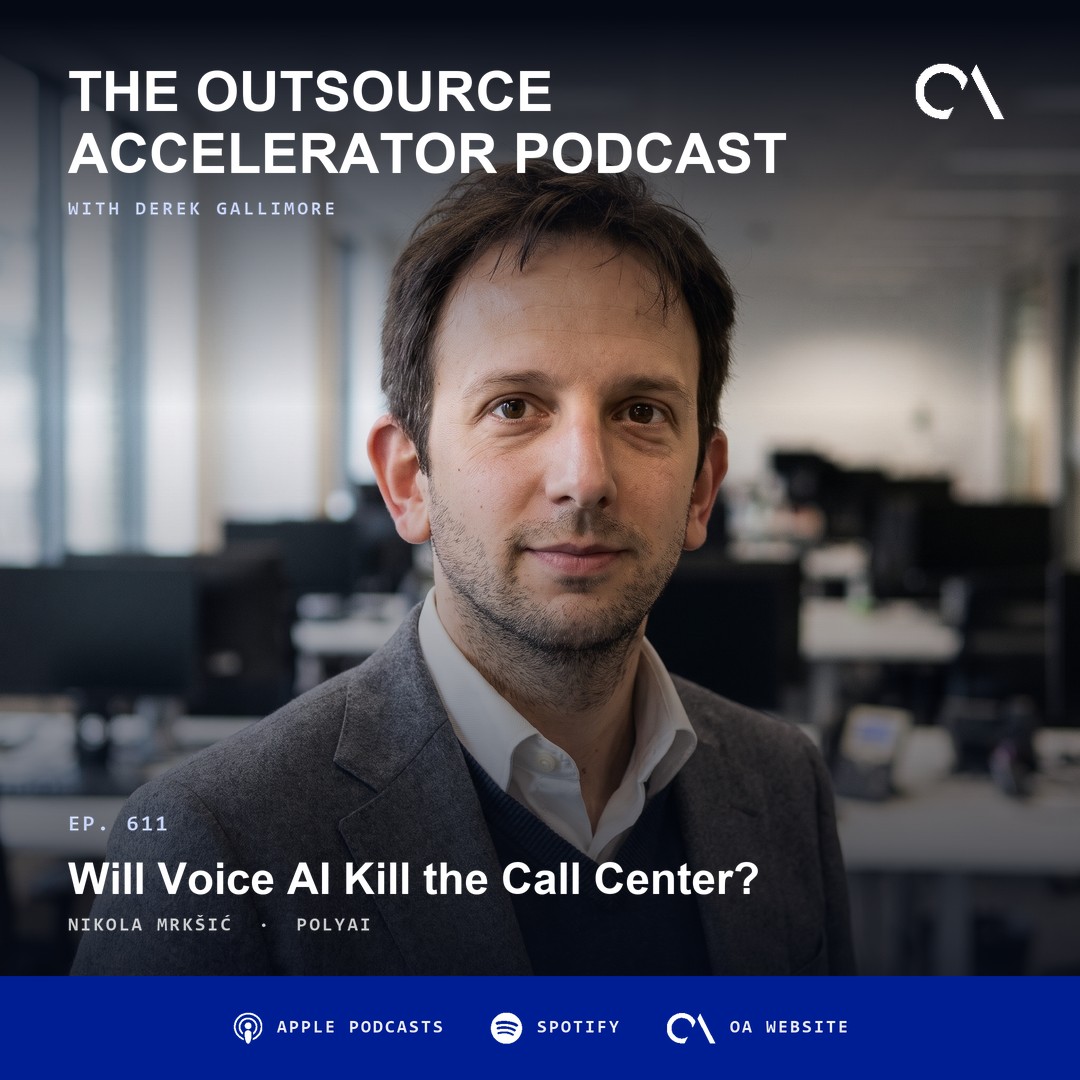
Nikola Mrkšić did a PhD in deep learning at the University of Cambridge when the field was still young. His previous company was bought by Apple to make Siri more conversational, and the complaints he kept hearing about Siri pushed him to build something better.
As co-founder and CEO of PolyAI, Nikola runs a company that builds AI agents to answer and resolve phone calls for some of the world’s largest companies. He joins the Outsource Accelerator Podcast to talk about whether voice AI will replace the call center.
The conversation covers why humans and AI will keep working side by side, why he calls outcome-based pricing a tax, and what BPOs should do now to stay relevant.
Inside PolyAI
Nikola sums up the company in a sentence.
“We are one of the leading AI companies that do customer service automation. We are known for high-grade, high-touch voice automation primarily, although we do full omni-channel.”
He is clear that saving money was never the main pitch.
“Companies that work with us would often do it to help grow revenue, and most frequently, they would just do it to create a much better customer experience.”
From Siri to the enterprise phone line
The idea came from his time at Apple and the feedback he heard about its voice assistant.
“My whole motivation for doing this was the fact that people kept telling me that Siri is terrible.”
Rather than build a general assistant, he chose a narrower problem with clear limits.
“How do we build a really good, more limited, but still powerful voice agent for a large enterprise, right?”
A hotel group, a bank or a utility gets calls about perhaps 50 or 100 things. That made customer service the right place to start.
Built for dialogue, not just language
PolyAI trains its own models instead of wrapping someone else’s. Nikola says memory and personal context are what make a phone conversation work.
“Customer service gets a whole lot better if you are remembered every time you call, if the model is custom to you, right?”

He also argues that speed matters as much as accuracy on a live call.
“At the moment, we’ve still got the only reasoning model fast enough to be used in real dialogue.”
Why the humans are staying
After about a decade of deployments, Nikola has seen almost no client hand every call to AI.
“It’s near on impossible to have 100% containment rate.”
He thinks the fear of mass job losses misses what really happens when AI arrives.
“When you add a lot of AI to do a lot of things, you just free up humans to do all the things that you’ve refused to do or deflected in kind of like contact center speak.”
He sees the contact center turning into a control room for the whole company, running a mix of AI and human workflows.
The myth of the single pane of glass
Many customer service problems, Nikola says, are not technology problems. They come from scattered knowledge inside the business.
“When you look at a contact center agent screen, they’re looking at a browser with 50 tabs open.”
Deploying AI often shows a company that it never had a clear answer to begin with. That changes the agent’s role.
“But really that means that that CX agent becomes a bit of a product person, right?”
Pricing without the tax
Nikola does not think AI needs a new pricing model. It should simply cost less than people.
“I don’t think it has to be any different to BPO pricing. It is just cheaper, right?”
He has strong views on outcome-based deals, which he believes tie clients into endless disputes over what each call is worth.
“So I think the outcome-based pricing is just complete and utter terrorism, where people are trying to, like, package up that consulting effort and charge for it in stickier recurring ways.”
He says prices per minute have already fallen sharply and will keep falling, though the cost of running the models sets a floor for now.
Why buying a BPO doesn’t work
In 2019, Nikola came close to buying a mid-sized BPO himself, before deciding against it.
“I went right to the edge of that precipice and I said, ‘No, I can’t build the best technology for this while doing that.'”
He believes large clients will never hand that much control to one provider.
“At the end of the day, for better or worse, most enterprises do not trust their BPO to run that process.”
Where BPOs win next
His advice for outsourcing firms is to become the people who drive AI change for their clients. He expects their account leaders to become far more valuable.
“I think that the future chief operating officers of many a company now are getting created in the kinda like senior managers of contact centers, right?”
He is already seeing it happen with PolyAI’s own customers.
“We see double, triple promotions at this point. We see contact center managers in front of board directors of multinationals presenting what they’ve done with AI, right?”
For Nikola, voice AI will not kill the call center. It will make it a place where people and AI agents work together, with humans owning the change.
To learn more about PolyAI, visit poly.ai or reach Nikola Mrkšić directly at [email protected]. And if you would like to learn more about what we do in the outsourcing space, send us an email at [email protected].






 Independent






