
Why company-wide BPO retention numbers tell you less than account-level data


At a glance
- A BPO’s company-wide retention figure averages across all clients, functions, and locations; your account’s performance may look nothing like that number.
- Account-level tenure, role-specific attrition, and team stability on your engagement are the metrics that actually affect your service quality.
- Vendors rarely share account-level retention data unprompted; asking for it directly is part of a sound vendor evaluation.
- Booth structures its managed support teams around above-market pay and full-coverage QA, designed to retain the people who deliver your service.
When buyers evaluate a BPO partner, they ask what seems like the most relevant question: “What’s your retention rate?”
The vendor has a number ready. It tends to sit between 85% and 92%, which sounds stable.
The issue isn’t that the number is false. The issue is what it actually measures.
A company-wide retention rate averages across every account the BPO manages: different industries, different functions, different markets, different tenure profiles. The number your operations team inherits may be significantly better or worse than the figure in the pitch deck.
This article covers why company-wide retention data creates a blind spot, what account-level metrics actually reveal, and what to ask before signing.
What company-wide retention figures actually measure
A BPO running 40 accounts may have high retention on its established back-office operations. The same provider may have high turnover on its newer customer-service engagements. The company-wide average combines both.
| What company-wide retention measures | What it doesn’t tell you |
|---|---|
| Average across all accounts and functions | How the team assigned to your work performs |
| Blends stable and new engagements | Whether your account is staffed with experienced hires or constant new joiners |
| Covers all roles and tenures | Role-specific attrition on the work you care about |
| Tracks corporate headcount trends | How long the specific agents on your account have been there |
A team where 60% of agents have been on your account for over a year operates differently from one averaging four months in tenure. The company-wide number won’t show you which one you have.

Pro Tip: Before accepting a retention figure from a provider, ask how the number is calculated and whether it covers all account types, functions, and tenures. A vendor who can’t disaggregate the figure by account age or function type is signaling something about their data infrastructure.
Why the gap between averages and accounts matters
Contact center attrition rates run high across the industry. Some accounts lose 40% or more of their team in a year. That scale of turnover shows up as a mild dip in a company-wide figure.
When that turnover concentrates on your account, the impact is direct. Service quality drops, onboarding cycles repeat, and the team delivering your work is constantly part-way through its learning curve.
Replacing an experienced BPO agent carries a real cost. According to Gallup’s research on the cost of turnover, replacing an employee typically runs between 50% and 200% of their annual salary. For customer-facing roles, what leaves with the agent is specific: knowledge of your product, your escalation paths, and your customers.
A new agent will replicate the job title. They won’t replicate the context that takes months to build.
The same principle applies to how performance data gets reviewed. Booth’s analysis of one client’s support queue found that an analyst was reviewing fewer than 3% of tickets each month.
When those tickets were re-scored weeks later, three of twenty had changed materially, service gaps the sample had missed.
Account-level retention data works the same way: an aggregate conceals the variation that shows up in your specific engagement.
What to ask instead of accepting the company-wide number
The alternative to a company-wide retention figure isn’t a refusal to engage. It’s asking for the data at the right level of specificity.
According to a 2026 Verint study reported by BusinessWire, nearly one in three contact center agents plan to leave their role within six months. The industry-wide pressure on retention is real.
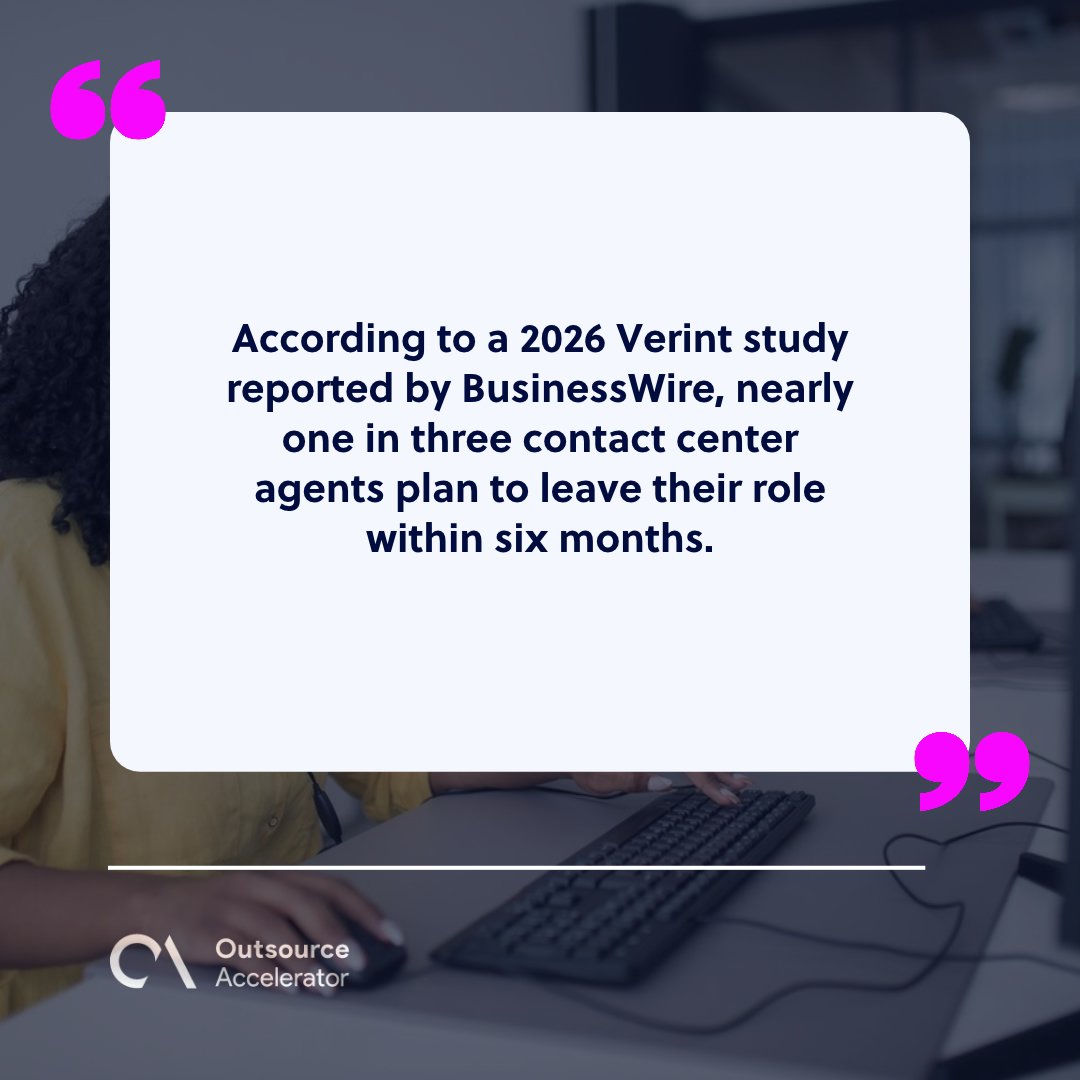
How that pressure distributes across your account is not visible in a headline figure.
That means the burden of visibility is on the buyer. Standard evaluation criteria don’t surface it.
A vendor evaluation guide from Booth identifies retention and culture as one of seven operational criteria in a managed services assessment. The list also covers live reporting, QA systems, documented processes, operational maturity, compliance, and scalability.
The recommendation is to ask for attrition data and to understand what the vendor does about it, not just how much they have.
Questions worth asking before signing:
- What is attrition on accounts running the same function as mine? Not the company figure; the function-specific one.
- What percentage of agents on comparable accounts have been there more than 12 months? This shows whether retention is structural or circumstantial.
- What is your process when a tenured agent leaves an account? Knowledge transfer protocols reveal whether continuity is planned for or scrambled.
- Will attrition data for my account be part of regular reporting? A vendor who agrees to this in writing is committing to transparency.
Pro Tip: Ask to speak with a team lead or operations manager on a current account similar to yours, not just an account executive. The people delivering the service know what the actual turnover picture looks like on the ground.
How Booth structures teams for account-level stability
Booth builds its managed support teams around the factors that drive account-level retention, not company-wide averages. The model addresses pay, QA, and operational structure as a system rather than separate variables.
Booth’s approach includes:
- Full-coverage QA: Booth’s AI platform RubriCore scores 100% of interactions on every account, rather than auditing a sample, giving operations teams a complete view of agent performance and service quality
- Above-market pay by skill level: compensation is set within a market band by role, paying agents with proven skills at or above the 50th percentile to reduce the wage-gap risk that drives attrition on cost-focused engagements
- Operational structure built in: the managed service model includes workforce management, coaching loops, and escalation paths, so stability doesn’t depend on a single senior agent holding the account together
- Account-level reporting: clients can track team tenure and engagement stability through regular business reviews, with visibility into what’s happening at the account level, not just the company level
- Coverage across functions: customer experience, back office, and professional support roles, with the depth to replace specialist staff without rebuilding a team from scratch
Organizations evaluating BPO partners can connect with Booth to discuss how their teams are structured and what account-level retention reporting is available before an engagement begins.






 Independent






