
Risk management in outsourced software development: A control framework for delivery, code, and vendor risk


This article is a submission by WiserBrand, a New York-based digital solutions company serving SMBs globally. WiserBrand specializes in AI development, custom software, digital marketing, and BPO services across industries including eCommerce, fintech, and SaaS.
At a glance
- Risk management in software development changes when the work is outsourced: the client keeps accountability for the product, but many of the risks now arise inside another company’s processes.
- Outsourced projects carry three risk families that need separate controls: delivery risk, code and security risk, and vendor risk.
- Each risk needs a named owner on both sides, an early warning signal, and a control that the client can verify without relying on the vendor’s own reporting.
- The highest-impact controls are set before work starts: client ownership of code and accounts, acceptance criteria, access rules, and exit terms.
Risk management in software development is the practice of identifying what could cause a project or product to fail, judging how likely and how damaging each risk is, and putting controls in place before the risk turns into an incident.
Standard treatments describe this as a cycle of identification, analysis, planning, and monitoring, and they usually assume that one organization controls the whole delivery process.
Outsourcing breaks that assumption. When an offshore or nearshore vendor writes the code, the client still answers for missed launches, security incidents, and lost data, but it sees the delivery process mainly through the vendor’s reports.
Risks such as key-person dependency, unreviewed dependencies, or uncontrolled access arise inside the vendor’s organization, where the client has limited visibility.
This article sets out a control framework for outsourced development: the risk families to track, a risk register with owners and warning signs, the controls to put into the contract and onboarding, and the metrics that show when risk is rising.
How outsourcing changes software risk
In an in-house team, the same management chain controls hiring, process, tools, and priorities. In an outsourced engagement, those levers are split.
The client controls scope, budget, and acceptance. The vendor controls staffing, engineering practices, and much of the tooling. Risk management has to work across that boundary.
Three changes matter most. First, information arrives with a delay and through a filter, because status reports are written by the party being evaluated.
Second, some risks become contractual rather than technical: who owns the code, what happens to it when the contract ends, and how fast the vendor must replace a departing engineer.
Third, the vendor becomes part of the client’s software supply chain, so its security practices affect the client’s product directly.
NIST’s guidance on cybersecurity supply chain risk management (SP 800-161 Rev. 1) names poor development practices within the supply chain as a source of vulnerability and treats supplier risk as part of the acquiring organization’s own risk management.
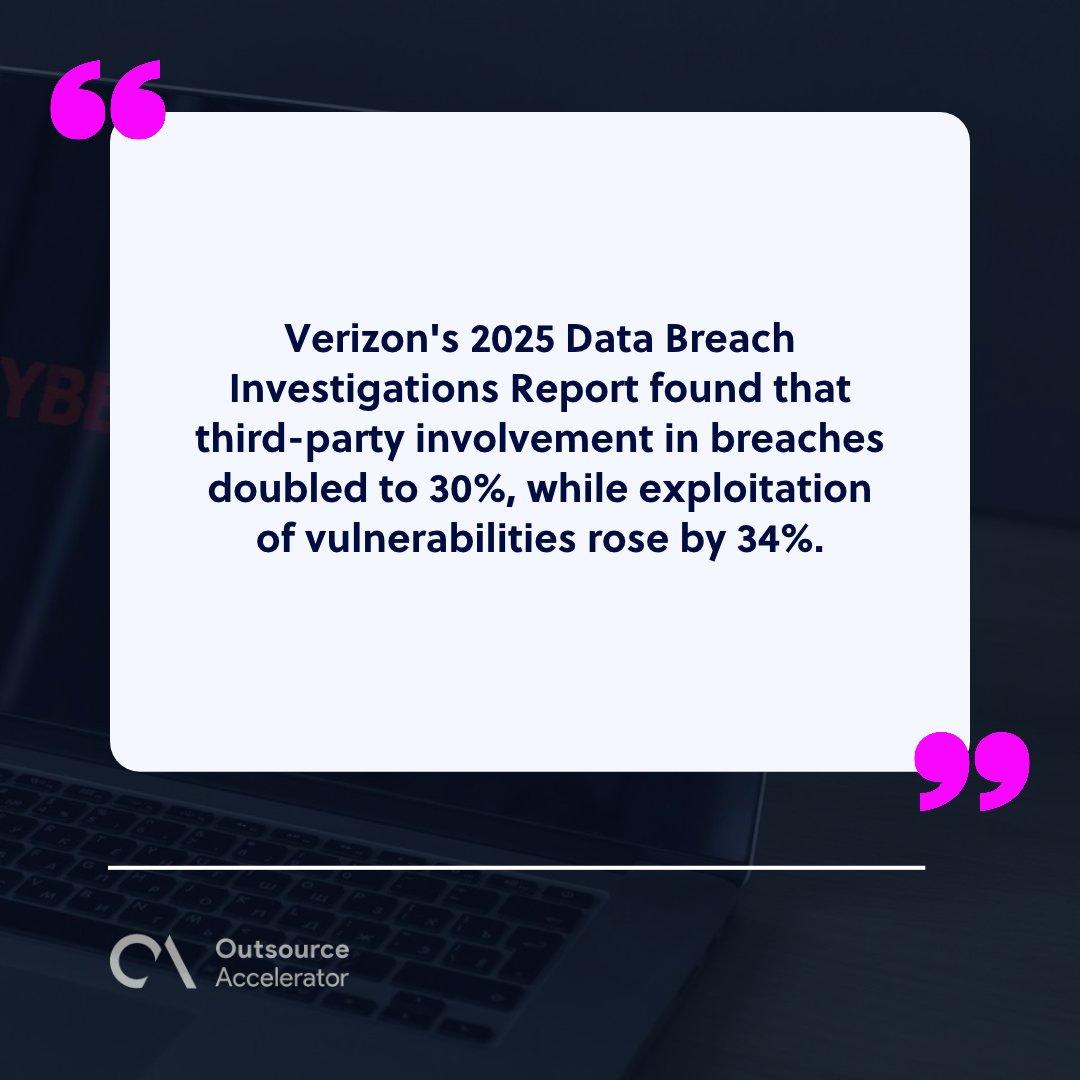
Breach data points the same way: Verizon’s 2025 Data Breach Investigations Report found that third-party involvement in breaches doubled to 30%, while exploitation of vulnerabilities rose by 34%.
Three risk families in outsourced development
Textbook software risk management usually sorts risks into project risks (schedule, budget, staffing), technical risks (design, integration, performance, security), and business risks (market fit, commercial loss).
Those categories still apply, but in an outsourced engagement it is more useful to group risks by where the control sits, so each family maps to an owner and a contract clause instead of becoming a list of fifty items nobody reads.
1. Delivery risk
Delivery risk covers scope, schedule, cost, and quality: requirements that are misunderstood, estimates that drift, releases that fail in production, and testing that happens too late.
2. Code and security risk
Code and security risk covers what is inside the product: insecure code, vulnerable third-party components, leaked secrets, missing documentation, and architecture that only the vendor understands.
3. Vendor risk
Vendor risk covers the relationship itself: dependence on a few people, staff turnover, financial instability, weak contract terms, and an unclear path to exit.
A risk register for outsourced software projects
A register works when every row has an owner who can act on it and a signal that appears before the damage. The table below is a starting point that most outsourced projects can adapt.
| Risk | Family | Early warning signal | Control | Client owner | Vendor owner |
|---|---|---|---|---|---|
| Requirements misunderstood | Delivery | Rework after demos, frequent clarification tickets | Acceptance criteria per feature, demo before sign-off | Product owner | Delivery manager |
| Estimate and cost drift | Delivery | Change requests filed after work is done | Change requests approved before work starts | Technical lead or fractional CTO | Account manager |
| Late discovery of defects | Delivery | Defects reported by users after release | Automated tests in the pipeline, test evidence at acceptance | Technical lead | QA lead |
| Insecure code or dependencies | Code and security | Scanner findings that stay open across releases | Code review, dependency scanning, fix deadlines by severity | Security owner | Tech lead |
| Leaked secrets or excess access | Code and security | Shared accounts, credentials in repositories | Individual accounts, secrets manager, access review each quarter | Security owner | DevOps lead |
| Knowledge held by the vendor only | Code and security | No architecture records, setup depends on one engineer | Documentation as a deliverable, architecture decision records | Technical lead | Tech lead |
| Key-person dependency | Vendor | Same engineer named in every incident or handover | Minimum two people per critical area, notice period for replacements | Vendor manager | Delivery manager |
| Code and account ownership | Vendor | Repositories or cloud accounts in the vendor’s organization | Client-owned accounts, IP assignment in contract | CEO or legal | Account manager |
| No practical exit path | Vendor | No handover terms, proprietary tooling | Exit plan with deliverables, format, and notice period | CEO or legal | Account manager |
The two owner columns matter. A risk with only a vendor owner is reported but not managed by the client. A risk with only a client owner is managed without the people who can change the underlying process.
Controls by engagement stage
Risk controls have different costs at different stages. Most of the inexpensive ones belong at the start, before signing, when the client still has the most negotiating power.
Before signing
Contract terms decide several vendor risks permanently.
The agreement should assign intellectual property to the client, require that code and infrastructure live in client-owned accounts, define replacement terms for departing engineers, set security obligations, and describe what the vendor hands over at exit.
The clauses also depend on the offshore development engagement model, from staff augmentation to full lifecycle outsourcing.
Under staff augmentation the client manages the work and carries more delivery risk, while under full outsourcing the vendor carries delivery risk and the client needs stronger acceptance controls.
Onboarding
The first weeks set the patterns that persist. The client creates repositories and cloud accounts, grants vendor engineers individual scoped access, and agrees on branch protection, review rules, and the deployment pipeline.
Secure development frameworks such as NIST’s Secure Software Development Framework provide a practice checklist the vendor can confirm in writing, covering code review, dependency management, and vulnerability response.
Delivery
During delivery, risk management becomes a review routine. A monthly risk review walks the register, updates signals with data from the pipeline and ticketing system, and records decisions.
Releases are accepted against criteria and test evidence, not against the vendor’s statement that the work is done.
Maintenance and exit
After launch, risk shifts toward patching, monitoring, and continuity. A maintenance and support contract that covers patching, backup, and recovery should state response times by severity and who is allowed to deploy fixes.
At exit, the vendor hands over code, documentation, credentials, and environment configuration, and the client revokes access the same day.
Metrics that show rising risk
Metrics help when they come from systems the client can read directly. Useful indicators for outsourced projects include:
| Metric | Risk it tracks | Warning pattern |
|---|---|---|
| Change failure rate | Delivery quality | Rising share of releases that cause incidents or rollbacks |
| Defects found after acceptance | Testing quality | Users finding defects that QA should have caught |
| Open high-severity vulnerabilities and their age | Security | Findings that remain open past the agreed fix deadline |
| Estimate accuracy | Cost and scope | Repeated overruns or retroactive change requests |
| People able to deploy or explain each critical component | Key-person dependency | Only one engineer can deploy or explain a component |
| Vendor team turnover | Continuity | Several replacements within a quarter |
| Time to revoke access after offboarding | Access control | Accounts active days after an engineer leaves |
None of these metrics is useful alone. A low change failure rate combined with very infrequent releases can mean the vendor is batching work to look stable.
Read the metrics together and look at trends across several months.
Where the framework reaches its limits
A register and a set of metrics do not replace technical judgment. Someone on the client side must be able to read code review findings, question an architecture proposal, and tell a reasonable estimate from an inflated one.
Companies without that capacity often bring in an independent reviewer or a fractional technical lead for the governance work.
The framework also has a cost. Monthly reviews, access audits, and documentation deliverables take vendor and client time.
For a short, low-risk project, a lighter version with the contract controls and a handful of metrics is often enough. For products that handle payments, health data, or personal information, the full framework plus independent security testing is a reasonable minimum.
Some risks sit outside both parties’ control: currency changes, regional disruptions, or the vendor’s financial health.
These belong in the register too, with business continuity responses such as escrowed documentation or a second vendor familiar with the codebase, even if the probability is low.
Making risk management in outsourced software development work
Settle code ownership, account ownership, and exit terms in the contract, because these controls cannot be added cheaply later.
Give every significant risk an owner on both sides and a warning signal the client can read from its own systems.
Accept releases against criteria and test evidence, not against the vendor’s completion report.
Scale the framework to the product’s risk: lighter for short internal tools, complete with independent security testing for systems that handle money or personal data.






 Independent






