
Tackling AI Disruption Head-On with Dale Pearce of Platintel

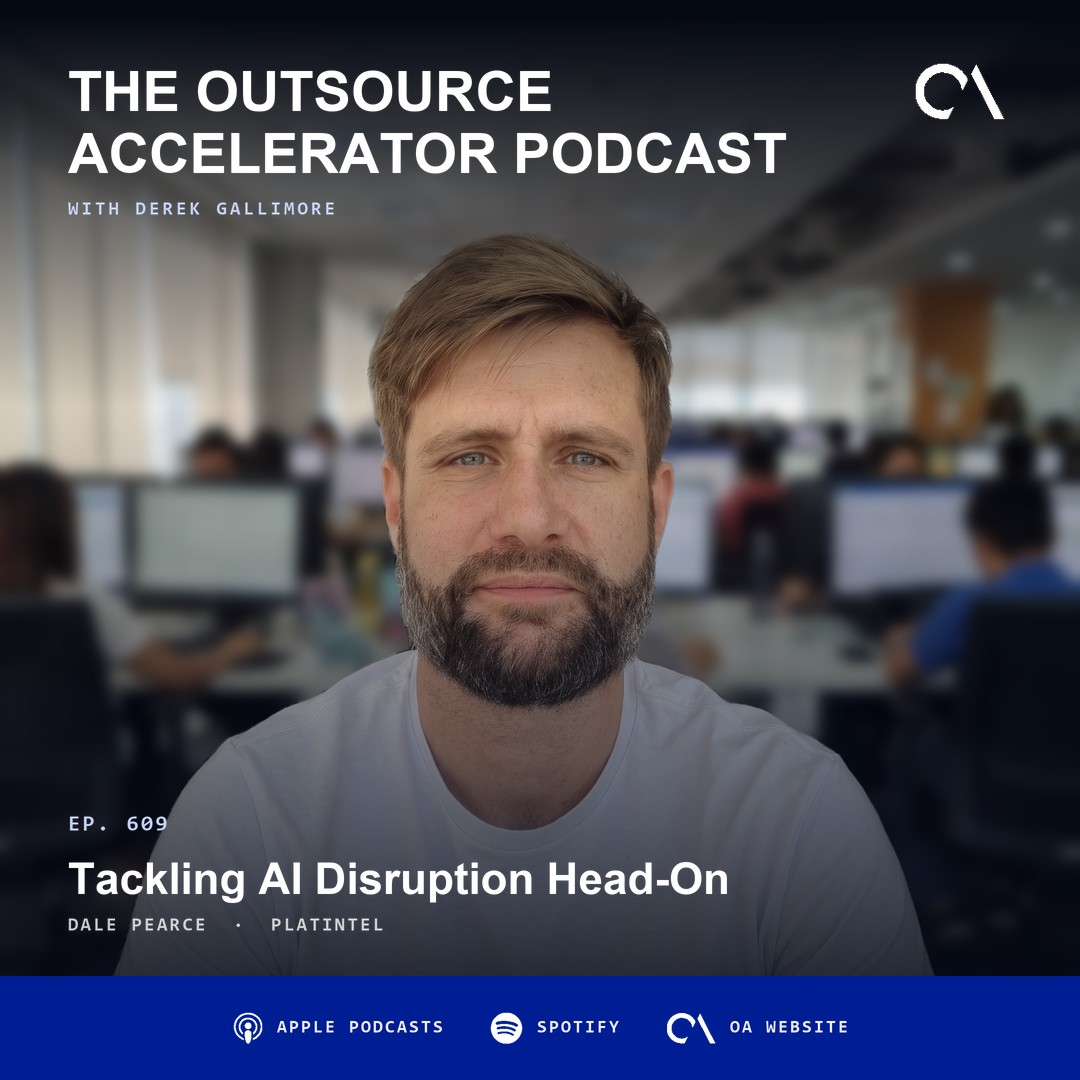
On his third visit to the Outsource Accelerator Podcast, Dale Pearce returns with a new company name and a broader vision for the business. Platinum Outsourcing is now Platintel, an offshoring firm that is putting AI at the front of what it offers.
As executive director, chief operating officer and one of two owners of Platintel, Dale helps businesses build offshore teams from delivery centers in Metro Manila, Jakarta and Pune. This time he talks through the rebrand and the AI consulting arm the firm is launching in January.
The conversation covers how businesses are approaching hiring this year, where AI adoption really stands, and why he expects most roles to become “human-in-the-loop orchestrators”.
Inside Platintel
Dale describes a business that now runs on two tracks.
“So essentially we help businesses build intelligent global teams. We have two arms of our business. We have the offshoring arm, and we have a, a newly minted AI consulting arm that officially launches in January of next year.”
The three delivery locations are a deliberate choice, each picked for its talent pool.
“Each of those geographies have quite distinct talent pools… So we wanted to give our client base access to a deeper and broader range of talent.”
India, the newest site, was chosen with the US market in mind, where Dale sees a shortage of technical talent.
“There’s quite a, a large talent vacuum a big gap between what businesses need in the US and what’s actually available in the talent market around technical talent.”
Reading a cautious market
High inflation in Australia, global uncertainty and open questions about AI have made many businesses cautious about hiring. Dale sums up their thinking.
“We’re just not going to hire at the moment… to work out where the economy’s gonna go, number one, but also to where we can find efficiencies in terms of automation to potentially reduce the need for additional headcount.”
A name for what comes next
The rebrand reflects how far the business has moved beyond pure outsourcing.
“Platinum Outsourcing served us well. But we’re not just an outsourcing business anymore.”
Dale timed the change for a calmer year, which gave the team room to step back and focus on the business. He is confident in the result.
“We’re, we’re happy with where we sit today and we think the Platintel brand is, is gonna be one that carries us into the future.”
AI adoption is slower than the headlines
For AI to reshape offshoring, Dale argues, onshore clients have to adopt it first. Citing the figures from memory, he estimates most businesses are not there yet.
“I think it’s only something like 13% or 14% of Australian employing businesses have actually formally embedded… or operationalized AI… into their corporate structure.”
He sees the bottleneck as people, not technology.
“The change management piece in organizations that are operating at scale is, is where the challenge is going to be.”
Three steps to an AI strategy
The rebrand came with a plan in three parts. The first was turning AI on inside Platintel’s own back office.
“The first one was enable and… operationalize AI in our own business, and that was not talking about billable staff, we’re not talking about client teams, but looking at our support staff, finance, HR, customer success, IT, sales, talent acquisition.”
The next steps were to build AI into the offshore offering and to turn what the team learned into new revenue. That produced two things: a consulting arm for businesses of 20 to 200 staff, and a planned AI academy for offshore staff. Dale sees the academy as a way to lead the AI conversation with clients, not to charge more.
“If we don’t control the narrative in terms of AI use as an offshoring provider our customers will control that for us, and I think there’s more risk in the latter.”
Graduates would join clients ready to work with AI from the start.
“When they start with the client at no additional cost, that, that team member is essentially AI-enabled on the tools that they’re gonna be using… in their business.”
The rise of the human in the loop
Dale expects most jobs to change shape over the next two to three years, rather than disappear.
“The vast majority of, of roles will essentially become human-in-the-loop orchestrators.”
He describes that person as the one who prompts the tools and checks the output.
“They will be the orchestrator that sits and… essentially prompts and… manages the checkpoints through each workflow.”
Where offshoring fits next
Dale still sees growth ahead for the industry, because the cost case hasn’t gone away.
“We’ll always have a need for humans to be doing work in some capacity, and my belief is that businesses will still seek lower cost economies.”
He knows that helping clients use AI may change the size of some teams, and he would rather lead that conversation than leave it to others.
“If we don’t do it, someone else is… And I’d rather it be us having the discussion with them.”
Selling honesty in a noisy market
Platintel’s own search for AI help shaped how Dale plans to sell the consulting arm.
“The amount of snake oil salesmen that were trying to sell us things we didn’t need… I really think that there’s some fatigue in the market and businesses are crying out for someone to just come and be honest with them.”

His hope for the next three to five years is a practical one.
“We’re all working alongside agentic tools in our day-to-day role, that it… makes our work more meaningful, more valuable.”
For Dale, the way to handle AI disruption is to face it early: use the tools in-house first, train offshore staff before clients ask, and tell clients plainly what will and won’t save them money.
To learn more about Platintel, visit platintel.com or reach the team directly at [email protected]. And if you would like to learn more about what we do in the outsourcing space, send us an email at [email protected].






 Independent






