
Employee Retention

Definition
Employee Retention
Employee retention is an organisation’s ability to keep the people it has already hired. Retention is an outcome produced by conditions, not a programme that can be bought, which is why initiatives aimed at it so often fail to move the number.
The concept is often collapsed into its measure. Retention is the state; the retention rate is one arithmetic view of it over a chosen period.

That matters because the same rate can describe very different situations. Losing ten new starters is not the same problem as losing two experienced supervisors, though both dent the percentage.
Retention is also relative to the market. A figure that looks poor in one city can be strong in another where competing employers sit on the same street.
Key takeaways
- Retention is the ability to keep staff; the retention rate is one measure of it.
- Who leaves matters more than how many, because replacement cost rises with tenure.
- Early-tenure loss and experienced-staff loss have different causes and different fixes.
- Retention is judged against the local labour market, not against a universal benchmark.
How it works
Retention is produced by the gap between what staying offers and what leaving offers. Pay, progression, manager quality, schedule control and commute all feed that comparison, and a weakness in any one of them can outweigh strength elsewhere.
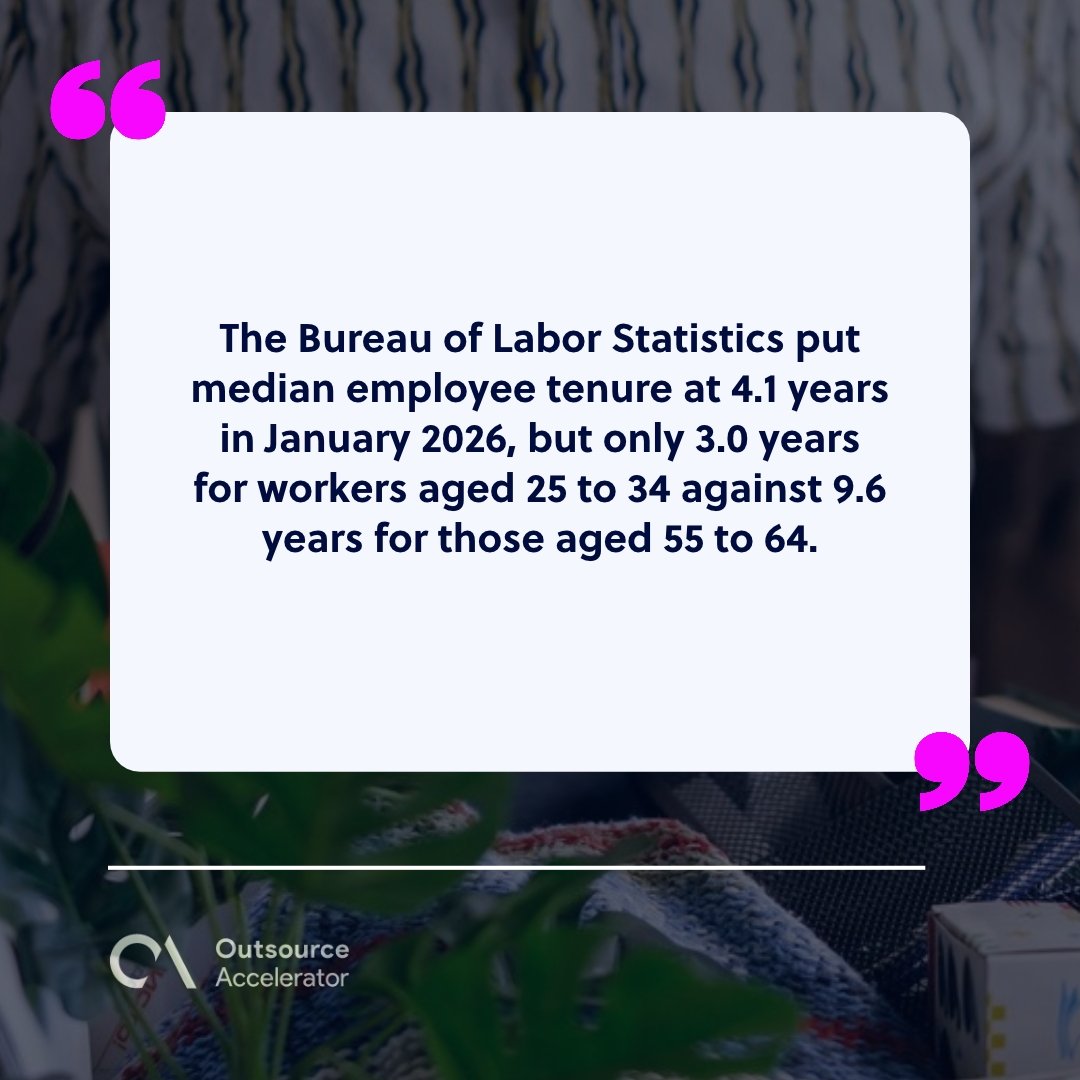
Tenure data shows how uneven the picture is. The Bureau of Labor Statistics put median employee tenure at 4.1 years in January 2026, but only 3.0 years for workers aged 25 to 34 against 9.6 years for those aged 55 to 64.
Industry matters as much as age. The same release records leisure and hospitality at 2.4 years — the lowest of the major industries, against 5.0 years in financial activities.
Cost is why the measure earns attention. Replacing a person carries recruitment, training and lost-productivity cost, and that cost climbs steeply with the seniority of the role.
| Loss pattern | Where it concentrates | Usual cause |
|---|---|---|
| Early-tenure | The first 90 days | Hiring accuracy or thin induction |
| Experienced staff | Supervisors and senior agents | Progression and manager quality |
| Shift-driven | Night-shift offshore roles | Social and health cost of the schedule |
| Seasonal | Immediately after a peak | By design, not a failure |
Engagement sits upstream of retention. Gallup’s State of the Global Workplace reports global engagement at 20% in 2025, with low engagement costing the world economy an estimated $10 trillion in lost productivity.
The leaving decision is rarely sudden. It usually follows a trigger laid over months of accumulated dissatisfaction — which is why exit interviews capture the trigger and miss the cause.
Examples
Retention problems are usually specific rather than general, and the shape of the loss points at the cause. The three patterns below are the ones that recur most often in outsourced operations.
Early-tenure loss concentrates in the first 90 days. When staff leave that quickly, the cause normally sits in hiring accuracy, induction or the gap between the role advertised and the role performed.
Experienced-staff loss is a different failure. When supervisors and senior agents leave, the cause is usually progression or manager quality, and the operational damage runs far deeper than the headcount suggests.
Shift-driven loss appears in offshore delivery. Night-shift roles serving a distant time zone carry social and health costs that daytime roles do not, and retention work that ignores schedule is treating the wrong variable.
Seasonal loss follows the campaign calendar. Operations that hire hard for a peak and release afterwards record poor retention by arithmetic, even when the employment model worked exactly as designed.
Related terms
Retention is measured and described through several adjacent terms, and the arithmetic differs between them. The entries below keep the state, its measures and its causes apart.
- Employee Retention Rate: the share of staff still employed at the end of a defined period.
- Employee Attrition Rate: the share of staff who left over that period, retention’s mirror image.
- Attrition Rate: the general measure of loss from any population, staff or customer.
- Call Center Attrition: the contact centre case, where rates run well above most industries.
- Employee Engagement Score: the survey measure of commitment that sits upstream of leaving decisions.
- Employee Lifecycle Management: the end-to-end handling of a person’s time with an employer.
- Net dollar retention: what a board reads out of a retention figure, not a separate calculation.
FAQ
Is employee retention the same as the retention rate?
No. Retention is the ability to keep staff; the retention rate is one arithmetic measure of it across a chosen period and population.
What is a good retention rate?
It depends entirely on the industry and local labour market. Contact centre work runs far higher turnover than professional services — so cross-industry comparison misleads.
Does paying more fix retention?
Rarely on its own. Pay sets a floor below which nothing else works, but above that floor manager quality, progression and schedule usually explain more of the variance.
Why do people leave in the first 90 days?
Because the job differs from what was described, induction was thin, or hiring selected for the wrong attributes. All three are fixable before the person starts.
Should every departure be treated as a failure?
No, since some turnover is healthy and some roles are designed to be temporary.
What is the cheapest retention improvement available?
Better first-line management.
Explore workforce resources and provider models in the Outsource Accelerator hubs to see how retention is managed at scale.






 Independent






