
Job hopping: The pros, the cons, and how to do it strategically


At a glance
- Job hopping means changing employers often, usually every one to three years, to grow pay, skills, or seniority faster.
- The upside is faster raises, broader skills, and quicker promotions. Job switchers still out-earn stayers, but the gap has shrunk sharply since 2022.
- The downside is the “job hopper” stigma, lost tenure-based benefits, and less depth in any one role.
- Done with a clear plan, job hopping reads as ambition, not instability.
Career loyalty used to be the norm. Today, more professionals treat each job as a stepping stone instead.
Some people switch employers every few years to win faster raises and broader experience. However, that pattern can also earn them the “job hopper” label, which many recruiters still read as a warning sign.
Whether you’re planning your next move or screening applicants, it helps to understand both sides.
This article gives a balanced view of job hopping. It covers the main pros and cons, then explains how to make frequent moves work in your favor.
What is job hopping?
Job hopping is the practice of changing employers frequently, typically every one to three years.
For context, the median U.S. worker had been with their current employer for 4.1 years in January 2026, according to the Bureau of Labor Statistics (BLS). Workers aged 25 to 34 had a median tenure of 3.0 years.
Unlike a single, well-timed career move, job hopping is a deliberate, fast-paced strategy. People use it to speed up their growth in salary, seniority, and industry experience.
The approach is common among in-demand talent, who often move between short-term or project-based roles.
Views on job hopping differ. Some see it as smart career strategy, while others see it as a sign of instability.
Why job hopping is more common in some industries
Job hopping is far more common in some sectors than others. Leisure and hospitality has the shortest tenure of any major U.S. industry, with a median of just 2.4 years, according to the BLS.
Part of that reflects age, because hospitality workers tend to be younger. Pay matters too, though. In sectors with lower wages and demanding work, changing employers is often the quickest way to earn more.
Workers in these fields often see the job market as a ladder of opportunities. Each move is a chance to trade up in pay, skills, or work-life balance.
The pros of job hopping
So why do people choose to job hop? Three advantages stand out.
Faster pay growth
Better pay is the most common reason people job hop. A new employer often pays more than an internal raise would.
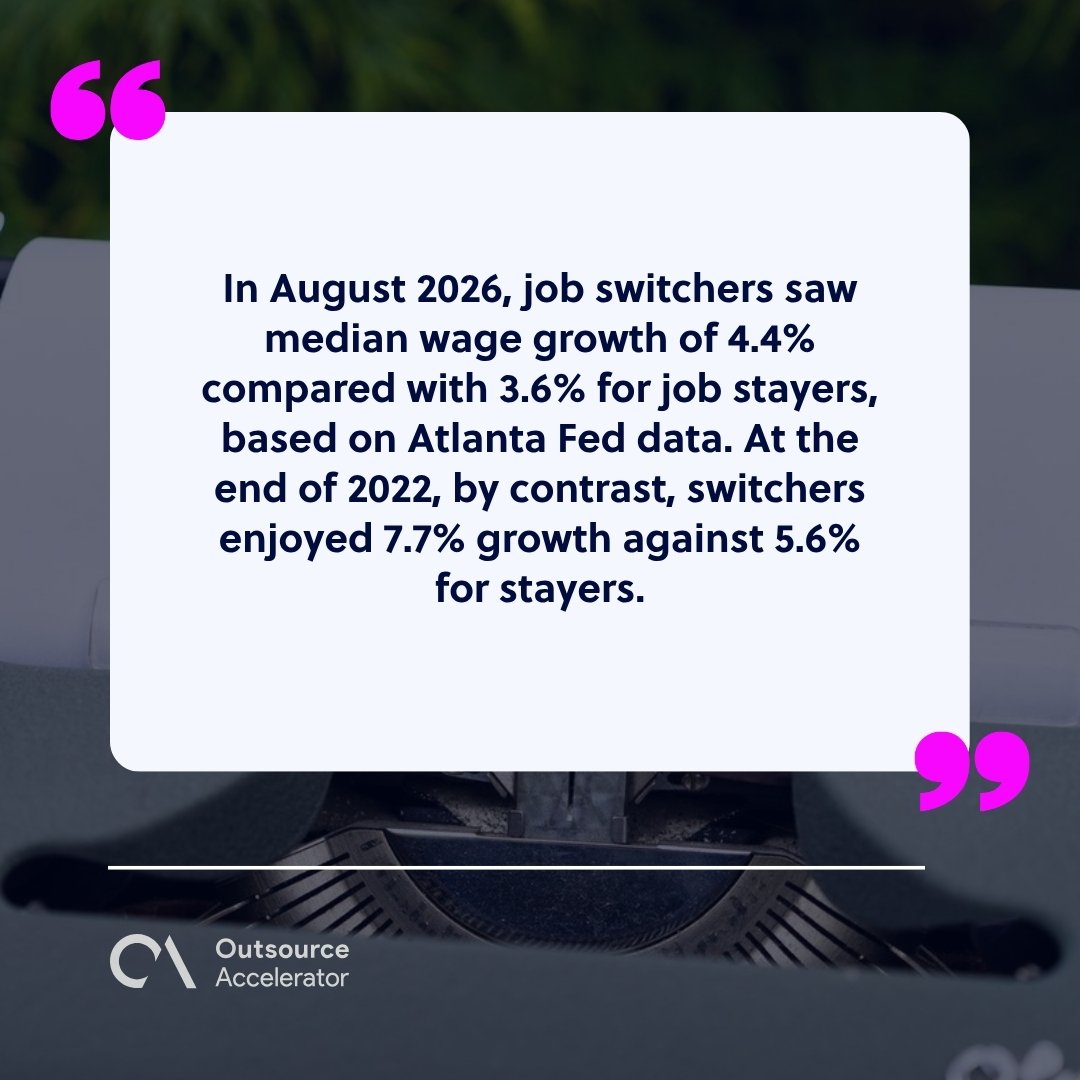
The data backs this up, although the edge has narrowed. In August 2026, job switchers saw median wage growth of 4.4% compared with 3.6% for job stayers, based on Atlanta Fed data. At the end of 2022, by contrast, switchers enjoyed 7.7% growth against 5.6% for stayers.
Changing jobs also lets you reset your pay to current market rates for your skills, which strengthens your hand in negotiation.
Broader skills and adaptability
Each new employer brings new industries, cultures, tools, and ways of working.
As a result, job hoppers build a wide skill set and learn to adapt quickly. That flexibility is valuable in a job market that changes fast.
Faster career progression
Internal promotions can be slow, especially in companies with rigid structures. In contrast, moving to a new employer can mean stepping straight into a more senior title.
The same applies in the hybrid workforce. Today, remote talent can work for several clients and take on roles at different levels.
The cons of job hopping
Job hopping also has real drawbacks. Knowing them helps you plan your career with clear eyes.
The “job hopper” stigma
Many recruiters still see a string of short stints as a red flag.
They may worry that you lack commitment or that you’re a “flight risk” who will leave once trained. Consequently, frequent moves can cost you interviews, particularly with traditional employers and senior roles.
Lost tenure-based benefits
Frequent moves can also interrupt benefits that build up over time.
For example, you may leave before your employer’s retirement contributions fully vest. You may also lose accrued leave or seniority-based perks.
In addition, some employers reserve leadership programs and executive training for long-serving staff.
Limited depth of expertise
Job hopping builds breadth, but it can limit depth. Mastering a complex or technical role often takes longer than a year or two.
Without a record of sustained results in one place, moving into management or executive leadership roles gets harder.
How to approach job hopping strategically
The difference between strategic job hopping and instability is purpose.
Each move should be a deliberate step toward a goal, not an escape from a frustrating job.
Before you leave, make sure you’ve delivered clear results you can point to. Also check that you’ve stayed long enough to master the skills the role offered.
Finally, map out your long-term career path. Then every move has a clear reason that you can explain in an interview.
Handled this way, a varied résumé tells a story of ambition and growth rather than restlessness.






 Independent






