
Egypt vs Philippines for multilingual support: Which wins?

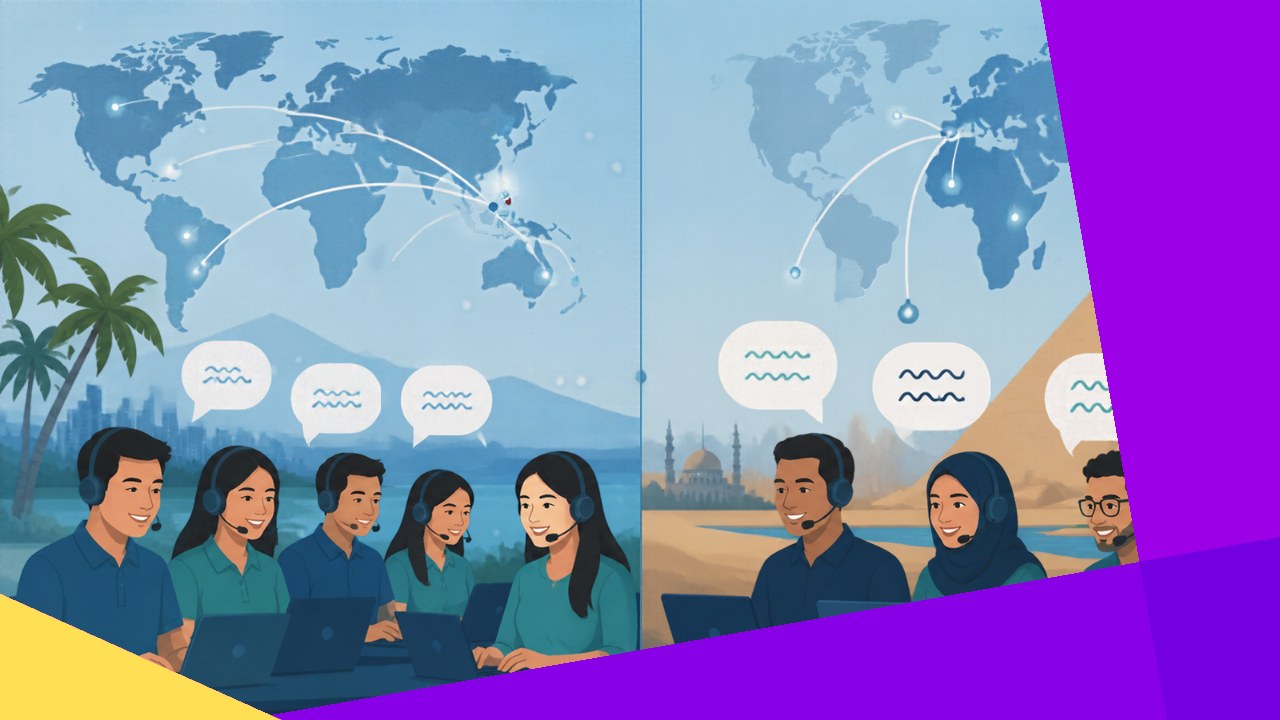
At a glance
- The Philippines leads on English and scale; Egypt leads on Arabic, French, and European languages for serving the EMEA region.
- Choose the Philippines for high-volume English support to the US, UK, and Asia-Pacific; choose Egypt for multilingual service across Europe, the Middle East, and Africa.
- Your customers’ languages and time zones should drive the decision more than cost alone.
When a company needs support in more than one language, two very different hubs come up. The Egypt vs Philippines for multilingual support choice rests on two questions: which languages you serve, and which regions you cover. Each country is strong in different ones. Both offer skilled, affordable agents, yet they point in different directions.
The Philippines is an English-first powerhouse that serves mainly the Americas, the UK, and Asia-Pacific. Egypt is a multilingual gateway that serves Europe, the Middle East, and Africa in several languages.
Here is how the two compare for multilingual support.
The Philippines for multilingual support
The Philippines is best known for its huge supply of fluent English agents. It ranks 28th worldwide with a score of 569 on the EF English Proficiency Index, among the highest in Asia.
Its strength is English depth and scale, not language breadth. You can staff large English teams fast, and some providers add a few other languages. Say your “multilingual” need is mostly English plus light extras. Then the Philippines is a natural fit, above all for US, UK, and Asia-Pacific customers.
Egypt for multilingual support
Egypt’s edge is genuine language variety. Arabic is native, and French is widely taught. Many agents also speak European languages like German, Italian, or Spanish. That makes it a strong base for EMEA support.
English is solid too, if not dominant. Egypt scores 458 on the EF English Proficiency Index and ranks 89th. The real draw is different. You can cover several European and Middle Eastern languages from one place, in a time zone that overlaps with Europe. For true multilingual coverage across EMEA, Egypt is hard to match.
Head-to-head comparison
| Factor | Philippines | Egypt |
|---|---|---|
| English proficiency | Very strong (rank 28) | Solid (rank 89) |
| Arabic, French, European languages | Limited | Strong |
| Best regions served | US, UK, Asia-Pacific | Europe, Middle East, Africa |
| Time zone fit | Americas and APAC | Europe and EMEA |
| Scale and maturity | Very large | Growing, focused |
In short, the Philippines wins on English and scale, while Egypt wins on language breadth and EMEA coverage.
When the Philippines wins
The Philippines is the better choice when your support is mostly English and high-volume. If you serve US, UK, or Asia-Pacific customers and need large teams fast, its depth is hard to beat.
It also fits round-the-clock English support, since its hours cover the Americas overnight. For companies that mainly need scalable English help, with maybe one or two extra languages, the Philippines is the simpler, cheaper path.
When Egypt wins
Egypt is the better choice when you truly need many languages, especially for EMEA. If your customers speak Arabic, French, German, or Italian, Egypt lets you serve them all from one hub.
Its European time-zone overlap also helps teams work alongside EMEA customers in real time. For companies weighing where to base their outsourced customer support across several European and Middle Eastern markets, Egypt offers a reach the Philippines cannot easily match.
How to choose
Start with your languages and regions. English-first and Americas or Asia points to the Philippines. Arabic, French, or European languages for EMEA points to Egypt.
Then weigh scale and time zone. Very large English operations favor the Philippines, while multilingual EMEA teams favor Egypt. Some companies use both, with the Philippines handling English and Egypt handling European and Middle Eastern languages. If you are unsure, map your customers by language first. The biggest language groups usually point clearly to one hub.
Think beyond cost
With these two hubs, cost is rarely the deciding factor. Both cost far less than onshore teams, and their rates are broadly similar.
What really sets them apart is reach. The Philippines gives you English at scale. Egypt gives you many languages in one place. So the smart question is not “which is cheaper?” but “which one speaks my customers’ languages?”
Frequently asked questions
Which country is better for European language support?
Egypt, by a clear margin. Its agents commonly speak French and other European languages, and it shares time zones with Europe. The Philippines can supply some European languages, but rarely with the same depth or regional fit that Egypt offers.
Is the Philippines or Egypt cheaper?
Both are affordable compared with onshore staff, and rates are broadly similar. The Philippines may edge ahead on cost for large English teams, thanks to its scale. Egypt’s value is different. It lies in combining several languages in one place, not in rock-bottom pricing.
Can one provider cover all my languages?
Sometimes, but not always from a single country. For broad multilingual needs, many companies split work by region. They use the Philippines for English and Asia-Pacific, and Egypt for EMEA languages. That way each hub does what it does best.
Does time zone matter for multilingual support?
Yes. Egypt’s overlap with Europe suits live daytime support for EMEA customers, while the Philippines aligns better with the Americas and Asia-Pacific. Matching the hub’s hours to your customers’ regions keeps response times fast and staffing simple.






 Independent






