
AI chatbots vs offshore call center agents: Which is right for you?

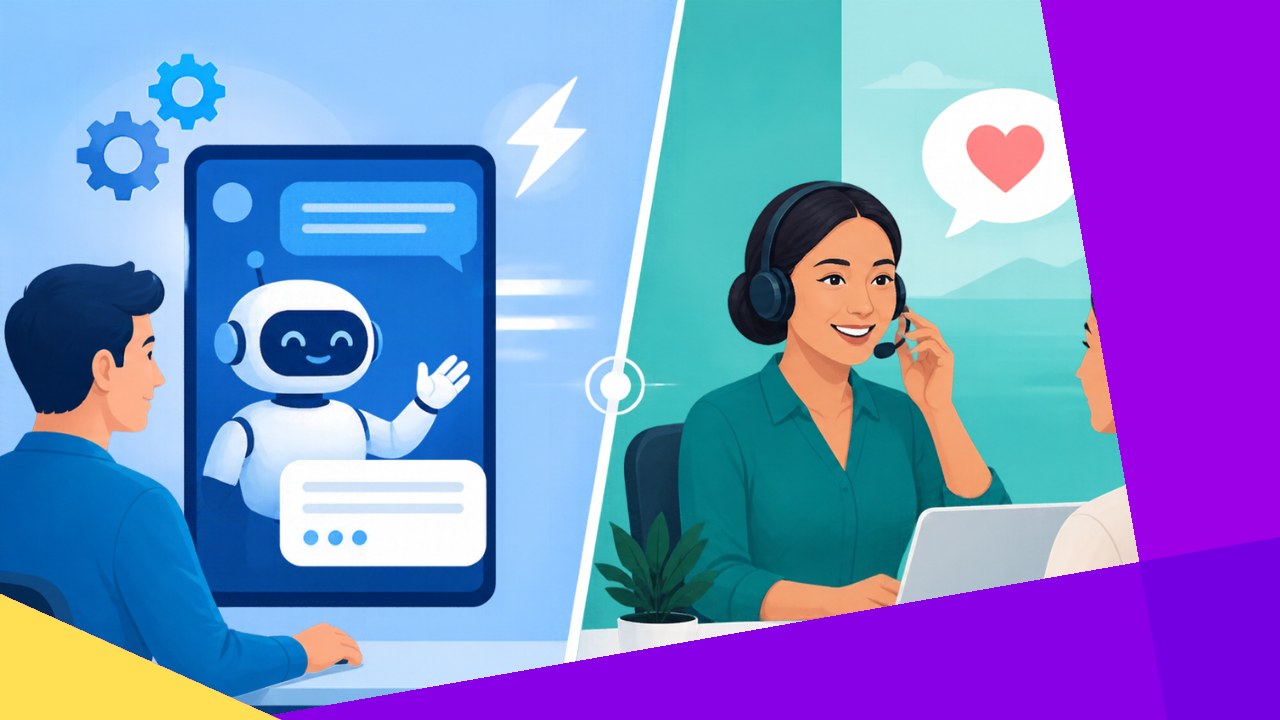
At a glance
- AI chatbots handle simple, high-volume questions instantly and cheaply, while offshore call center agents handle complex, emotional, or nuanced issues.
- Chatbots win on speed, cost, and 24/7 scale; human agents win on empathy, judgment, and tricky problem-solving.
- Most businesses get the best result by combining the two, using bots for the easy cases and people for the rest.
Every support team faces the same question: should a customer’s first contact be a bot or a person? The choice between AI chatbots vs offshore call center agents shapes your cost, speed, and customer satisfaction all at once. The honest answer is that each shines in different situations, so the smart move is knowing when to use which.
AI chatbots are software that answers customers automatically through chat or voice. Offshore call center agents are trained people, based in a lower-cost country, who handle support by phone, email, or chat.
Here is how they compare, and when each one wins.
What are AI chatbots?
AI chatbots use automation and, increasingly, generative AI to understand questions and reply on their own. They can answer FAQs, track orders, and guide simple tasks at any hour.
Their reach is growing, but they are not everywhere yet. Pew Research found that about half of adults do not use chatbots at all, so a large share of customers still expect a human option.
What are offshore call center agents?
Offshore call center agents are support staff in countries like the Philippines, India, or Colombia who serve customers for companies abroad. They bring real human judgment at a fraction of onshore labor cost.
Automation is reshaping this work, not erasing it. The U.S. Bureau of Labor Statistics projects that customer service roles will decline 5 percent from 2025 to 2035 as simple tasks get automated. The agents who remain focus on the harder, more valuable conversations.
Head-to-head comparison
| Factor | AI chatbots | Offshore agents |
|---|---|---|
| Cost per interaction | Very low once built | Low, but higher than a bot |
| Speed and availability | Instant, 24/7 | Fast, within staffed hours |
| Simple, repetitive queries | Excellent | Good, but can be overkill |
| Complex or emotional issues | Weak | Strong |
| Empathy and nuance | Limited | Natural |
| Scaling for spikes | Effortless | Needs more staff |
The pattern is clear. Bots excel at volume and speed, while people excel at understanding and care.
When AI chatbots make sense
Chatbots are ideal for simple, repetitive, high-volume questions. Think order status, password resets, store hours, and basic how-to answers.
They also shine when customers want instant answers at 2 a.m. or when request volumes swing wildly. For these cases, a bot resolves the issue in seconds at almost no marginal cost, and it frees your people for harder work.
When offshore agents make sense
Human agents win whenever a conversation needs empathy, judgment, or flexibility. Complaints, billing disputes, confused customers, and sales conversations all benefit from a real person.
Offshore agents deliver that human touch affordably, which is why so many companies weigh outsourcing their customer support rather than staffing it all onshore. When a customer is frustrated, a calm, capable human often saves the relationship in a way no bot can.
The hybrid approach usually wins
For most businesses, this is not an either-or decision. The strongest support blends both.
Let the chatbot handle the first contact and the simple cases, then hand off smoothly to an offshore agent when the issue gets complex. This keeps costs low and speed high without sacrificing the human help that hard problems demand. Many providers now build exactly this mix, with AI handling routine volume and skilled agents taking over the moment judgment is needed.
AI-assisted agents: a middle path
There is also a third option worth knowing. Instead of choosing bots or people, you can give offshore agents AI tools that help them work faster.
In this setup, AI drafts replies, summarizes long histories, and suggests answers, while the human makes the final call. The customer still talks to a person, yet that person responds quicker and better informed. For many teams, this blend captures the speed of automation and the warmth of human support at the same time. It often lifts both productivity and satisfaction without the cold feel of a pure bot.
Frequently asked questions
Are AI chatbots cheaper than offshore agents?
Per interaction, yes, especially at high volume, since a bot answers thousands of queries at almost no extra cost. However, building and maintaining a good chatbot takes real investment, and poor bots that frustrate customers can cost more in lost goodwill than they save.
Can AI chatbots fully replace human agents?
Not for most businesses. Bots handle simple tasks well but struggle with complex, emotional, or unusual issues, where customers still want a person. The realistic goal is to automate the easy cases and reserve human agents for the conversations that truly need them.
Do customers dislike chatbots?
Many customers are happy to use a chatbot when it solves their problem quickly, but they dislike being trapped in one with no way to reach a human. The key is an easy, fast handoff to a live agent whenever the bot cannot help.
How do I decide the right mix for my business?
Start by sorting your incoming requests by volume and complexity. Route the simple, repetitive ones to a chatbot and the complex or sensitive ones to offshore agents, then adjust the split as you see which issues the bot handles well.






 Independent






