
Forensic Accountant Offshore

Definition
Forensic Accountant Offshore
A forensic accountant offshore investigates where money went. The role covers fraud work and asset tracing, putting a figure on a loss, handling evidence under a logged chain of custody, and backing litigation, insurance and expert work from a delivery centre abroad.
The distinction from routine finance work is sharp. An offshore accountant keeps the books, closes the month, prepares tax and supports the audit; a forensic accountant is called in once somebody suspects the numbers were deliberately falsified.
Everything the role produces may end up in front of a court, a regulator or an insurer — that changes the working method. Evidence gets logged, versions get frozen, and the analysis has to survive cross-examination by someone paid to break it.
Offshore delivery works here because the bulk of the job is document and data work. Transaction analysis, email review and reconstruction of records all travel, while the deposition and courtroom appearance stay with a named onshore expert.
Key takeaways
- A forensic accountant offshore investigates suspected fraud, traces assets, and puts a defensible figure on the loss.
- Chain of custody and version control matter as much as the analysis, because the output is evidence.
- Expert opinion testimony in US federal court must meet four reliability conditions set by Rule 702.
- The onshore expert signs and testifies; the offshore team builds the underlying analysis and exhibits.
How it works
An engagement starts from an allegation or an anomaly. The forensic accountant scopes what is being alleged, preserves the records before anyone can edit them, reconstructs what actually happened in the accounts, then quantifies the resulting loss.
| Stage | What the forensic accountant does | Output |
|---|---|---|
| Preservation | images systems and freezes ledgers, mailboxes and bank data | a logged evidence inventory |
| Reconstruction | rebuilds the real transaction history behind the reported one | a restated transaction trail |
| Tracing | follows funds across accounts, entities and jurisdictions | a flow-of-funds schedule |
| Quantification | measures the loss against a stated counterfactual | a damages calculation |
| Reporting | writes the findings and the exhibits behind them | an expert or investigation report |
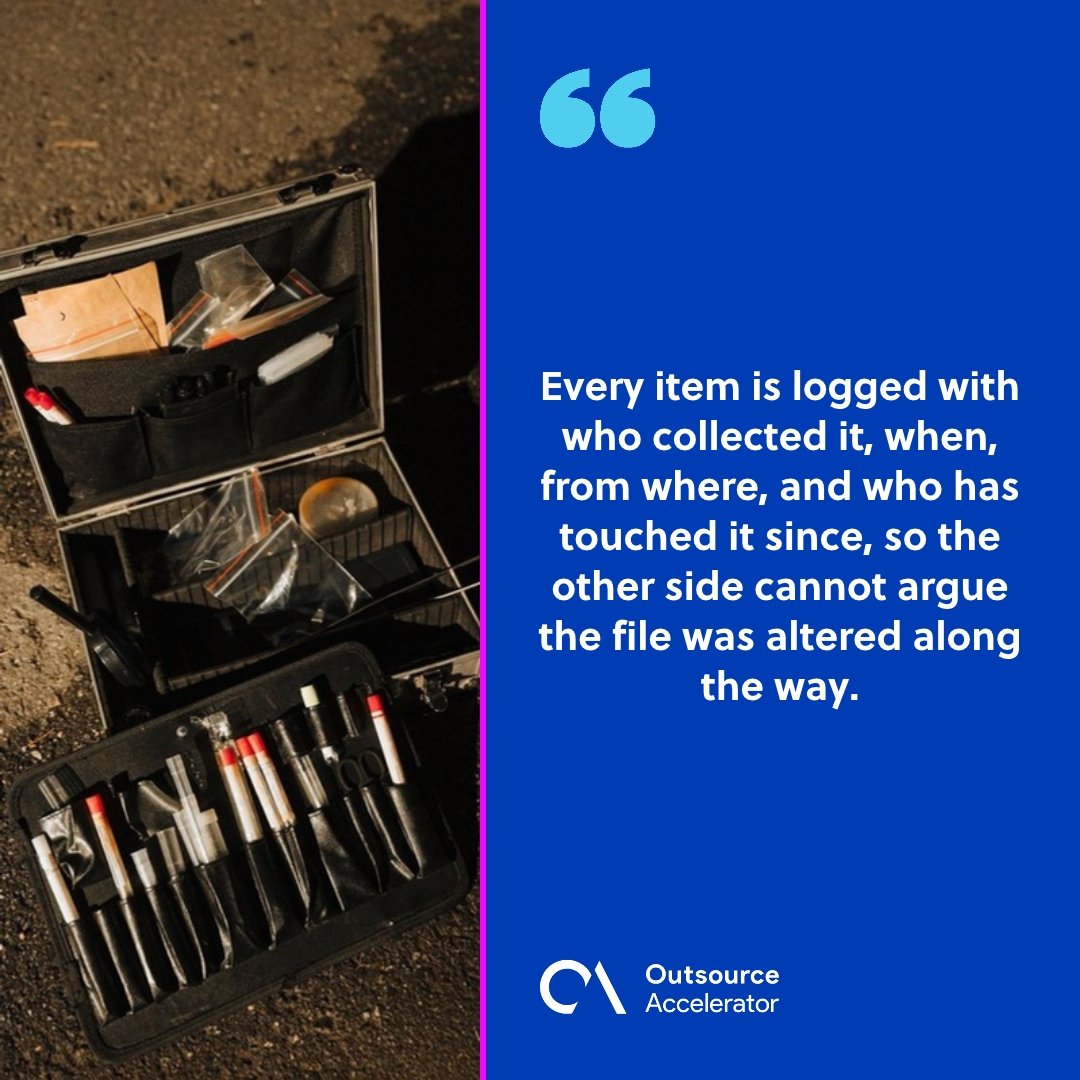
Chain of custody is the discipline that makes the rest usable. Every item is logged with who collected it, when, from where, and who has touched it since, so the other side cannot argue the file was altered along the way.
Quantification is where arguments actually happen. The number depends on the counterfactual chosen — what would have happened without the fraud or breach — so the forensic accountant states that assumption plainly instead of burying it.
Regulated evidence has its own retention clock. FinCEN guidance tells banks to keep supporting documentation for a suspicious activity report for five years from the date of filing and to hand it over on request.
Expert work has a legal threshold. In United States federal courts, Rule 702 admits expert opinion only where the testimony is based on sufficient facts or data, rests on reliable principles and methods, and applies them reliably to the case.
A good forensic accountant writes for a non-accountant — the report has to be followed by a judge, a claims handler or a board member who will not open the appendix, with the workings underneath for the ones who will.
Examples
Forensic accounting offshore turns up in four recurring engagement types, and the offshore share of each is the document-heavy middle, not the testimony at the end. Dispute, insurance and internal-investigation work dominate the volume.
Employee fraud investigations. A procurement manager approves invoices from a supplier they control. The offshore team matches vendor bank details against payroll records, reconstructs the approvals trail and sizes the total diverted.
Insurance claim quantification. After a business-interruption claim, the forensic accountant rebuilds what trading would have looked like without the event, using prior-year ledgers and industry seasonality, then sets that against what was actually earned.
Commercial dispute support. In a shareholder or earn-out dispute, the offshore team builds the damages model and exhibit pack that an onshore expert will defend in a deposition.
Offshore delivery teams. Big Four forensic practices and specialist risk firms such as Kroll and FTI Consulting run India-based delivery teams that handle data analytics, document review and transaction testing for live cases.
Preventive work sits alongside the reactive kind, which is why the role touches fraud prevention strategy and often reports findings into the same committee that owns governance, risk and compliance.
Related terms
A forensic accountant offshore sits where accounting, investigation and law overlap. These related entries cover the general offshore finance role, the licence behind the work, the assurance function that raises the first flag, and the compliance side of the response.
- Offshore Accountant: the general offshore finance role covering bookkeeping, reporting, tax and audit support.
- Certified Public Accountant (CPA): the licence most forensic practitioners hold before specialising.
- Internal Audit Strategy: the in-house assurance plan that often surfaces the anomaly in the first place.
- Compliance Officer: the role that owns regulatory reporting once an investigation finds something.
- Enterprise Risk Management: the framework for identifying and sizing the fraud exposure before it crystallises.
FAQ
What is the difference between a forensic accountant and an auditor?
An auditor tests whether financial statements are fairly stated and works to materiality. A forensic accountant investigates a specific suspicion, works to an evidential standard, and expects the findings to be challenged in a dispute.
Can a forensic accountant offshore give expert testimony?
Rarely in person. The usual split puts the analysis, exhibits and draft report with the offshore team, while a named onshore expert signs the report and takes the deposition or witness stand.
What tools does the role use?
Data analytics over full transaction populations, e-discovery and email review platforms, bank statement parsers, and link-analysis software for tracing funds between entities.
How long do forensic engagements take?
From a few weeks for a contained payroll or expense fraud to well over a year for a multi-jurisdiction asset trace with litigation attached.
What qualifications matter?
A CPA, CA or ACCA licence plus a forensic credential such as CFE or CFF, backed by evidence-handling experience.
Compare providers that staff offshore forensic and finance teams in the Outsource Accelerator directory.






 Independent






