
Why IT project management matters for enterprises

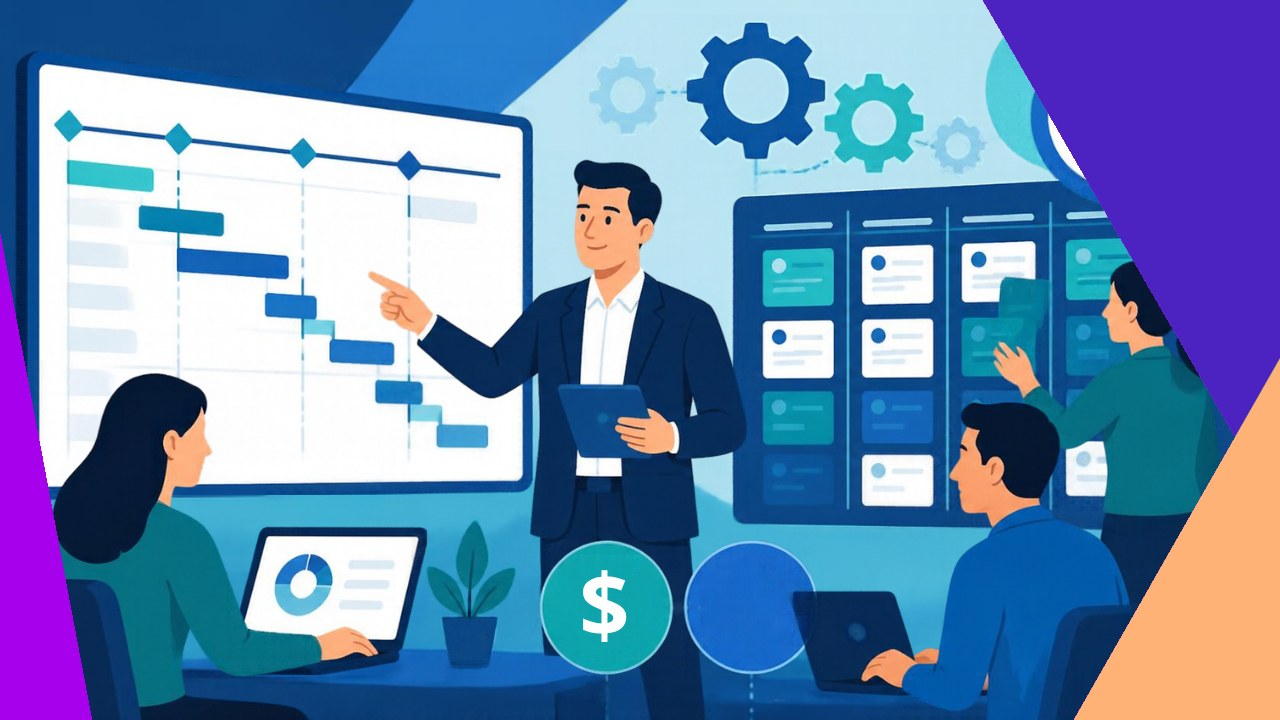
- IT project management keeps enterprise technology work on scope, on schedule, and on budget.
- Waterfall, agile, and hybrid methods each suit a different kind of IT project.
- Weak project oversight is a leading cause of blown budgets and stalled launches.
Large enterprises rarely run one technology initiative at a time. They juggle cloud migrations, security upgrades, new applications, and data projects at once, often across several countries. IT project management is the discipline that keeps all of that work pointed at a clear goal, delivered on time, and tied to a budget. Without it, good ideas drift, costs creep, and deadlines slip.
The stakes grow with company size. A missed milestone on a core banking system or an ERP rollout can ripple across thousands of users and cost millions. So for enterprises, strong project management is not paperwork. It is how technology actually gets delivered.
What IT project management actually is
IT project management is the practice of planning, running, and closing technology projects so they meet their goals. A project manager owns the scope, schedule, budget, risks, and people. They turn a business request into a plan, then steer the work until it ships.
The Association for Project Management describes the field as “the application of processes, methods, skills, knowledge and experience” to achieve clear objectives. In an IT setting, that means coordinating developers, vendors, infrastructure teams, and users toward a working system.
Good managers also protect the business. They flag risks early, control changes to scope, and keep sponsors informed. As a result, leaders can make decisions with real information instead of guesses.
Common methodologies: waterfall, agile, and hybrid
Enterprises do not pick one method for everything. They match the approach to the work. Below are the three that dominate IT delivery.
Waterfall
Waterfall runs in fixed phases: requirements, design, build, test, and release. Each phase finishes before the next begins. This suits projects with stable, well-known requirements, such as a data center move or a compliance upgrade. The trade-off is flexibility, since late changes are costly.
Agile
Agile breaks work into short cycles and delivers in small increments. Teams review progress often and adjust as they learn. The Agile Manifesto states a core value plainly: “Individuals and interactions over processes and tools.” Agile fits software products and fast-moving work where needs shift during the build.
Hybrid
Many enterprises blend the two. They plan the overall program like waterfall, then build the software in agile sprints. This hybrid model gives executives a predictable roadmap while teams keep the freedom to adapt. For large, multi-vendor programs, it is often the practical choice.
| Method | Best for | Main trade-off |
|---|---|---|
| Waterfall | Stable, well-defined projects | Hard to change late |
| Agile | Evolving software products | Needs active involvement |
| Hybrid | Large multi-team programs | More coordination effort |
What good IT project management delivers
Strong practice shows up in results, not reports. Three outcomes matter most to enterprise leaders.
First, projects land on time. Clear milestones and honest status tracking mean fewer surprises near a deadline. Second, projects land on budget. Tight scope control stops the slow creep of “just one more feature” that quietly doubles costs. Third, risks stay managed. A good manager spots a vendor delay or a security gap early, while there is still time to act.
Governance ties these together. Regular reviews, a clear owner for each decision, and a documented change process keep large programs steady. Teams move faster when everyone knows who decides what.
The cost of poor project management
When oversight is weak, the damage is rarely small. Harvard Business Review research on IT project risk found that failures tend to arrive as rare but severe “black swan” events, not minor overruns. In one case the authors cite, a project with “a budget of less than $5 million” ended in a $192.5 million charge against earnings.
Most failures are less dramatic but still painful. Unclear scope, no single owner, and poor communication lead to rework, missed dates, and frustrated users. For an enterprise, a stalled rollout can also freeze dependent projects. So the cost compounds.
In-house versus outsourced project management
Enterprises can staff project management internally, hire it from a provider, or mix both. Each path has a clear case.
An in-house team knows the company, its systems, and its politics. That context speeds decisions and builds lasting knowledge. The downside is capacity. Hiring senior project managers takes time, and demand often spikes during big programs.
An outside partner adds experienced managers quickly and brings proven methods from many clients. This helps during peak workloads or for skills the business lacks. Many firms now extend their capacity by handing delivery to a trusted remote team, while keeping strategy and sponsorship in house.
The common middle ground is a split. Internal leaders own priorities and relationships. An external partner supplies delivery muscle and tooling. Clear roles and shared systems for coordinating work across distributed teams keep the two sides aligned. Whichever model you choose, the goal is the same: predictable delivery at a controlled cost.
Frequently asked questions
What is a project management office (PMO)?
A PMO is a central team that sets project standards, templates, and reporting across the enterprise. It does not run every project itself. Instead, it gives managers a common playbook and gives executives one clear view of all active work, which helps when priorities compete for the same budget and staff.
Which metrics show whether an IT project is healthy?
Beyond simple “on time and on budget,” enterprises watch schedule and cost variance, scope change rate, open risks, and defect counts after release. Many also track benefits realization, meaning whether the finished system delivered the savings or revenue it promised months later.
What is the difference between a project manager and a project sponsor?
The project manager runs the daily work and the plan. The sponsor is a senior leader who owns the business case, secures funding, and clears blockers the manager cannot. Projects without an engaged sponsor often stall, because no one with authority defends the budget when pressure rises.
Do agile teams still need project managers?
Agile teams use roles like product owner and scrum master for day-to-day flow. Yet at enterprise scale, someone still coordinates budgets, vendors, and dependencies across many teams. That role may carry a different title, but the planning and governance work does not disappear.






 Independent





