
What is strategic HR planning?

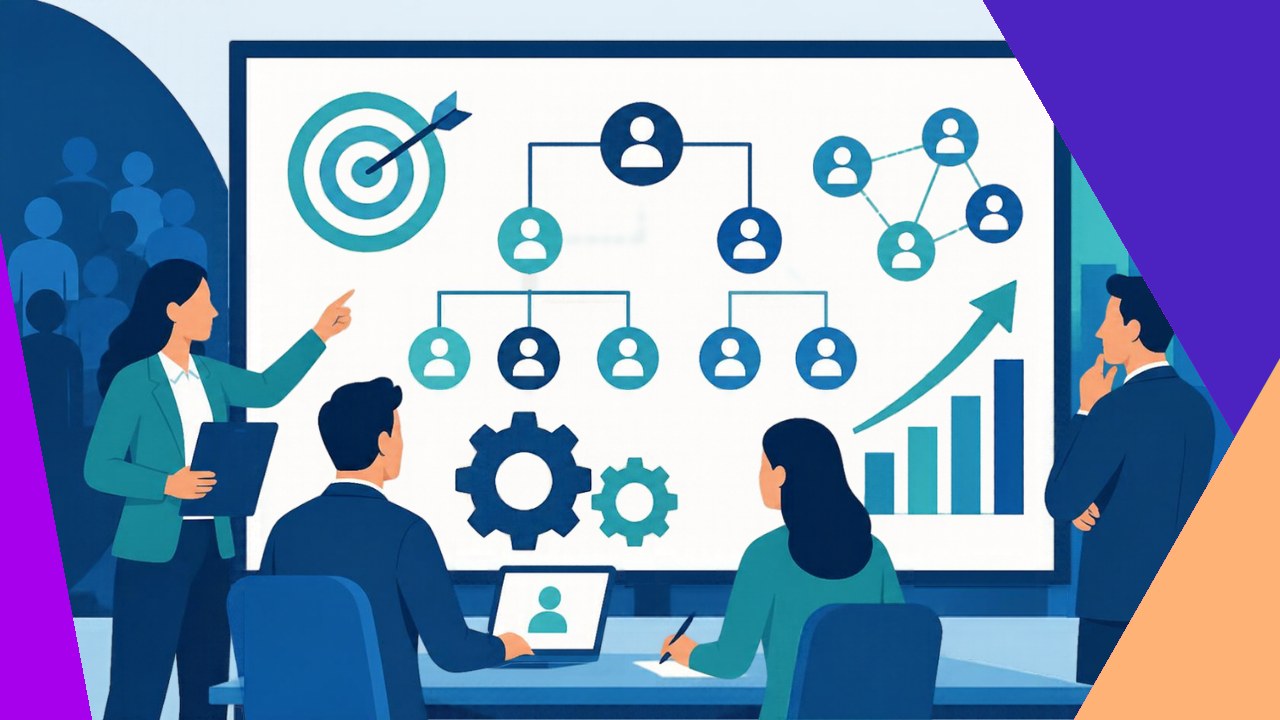
- Strategic HR planning connects people decisions to business goals, so hiring and skills follow where the company is actually headed.
- It works over a multi-year horizon, unlike short-term staffing, and runs through a repeatable cycle of analysis, forecasting, and action.
- Done well, it closes skill gaps before they bite and turns HR into a planning partner rather than a service desk.
Every growth plan rests on people. You can set bold revenue targets, but you only hit them if the right skills sit in the right roles at the right time. That is the job of strategic HR planning: lining up your workforce strategy with where the business wants to go. It looks past this quarter’s open roles and asks what talent the company will need in two or three years.
Many teams still treat HR as a reactive function. A manager asks for a hire, and recruiting fills it. Strategic HR planning flips that order. It starts with the business strategy, then works backward to the people, skills, and structures needed to deliver it.
What is strategic HR planning?
Strategic HR planning is the process of aligning your human resources strategy with your long-range business goals. It answers a simple question. What people capability does the company need to win, and how do we build it?
The scope is broad. It covers headcount, of course, but it also covers skills, leadership pipelines, culture, and how work gets done. In other words, it is wider than forecasting exact headcount by role, which sits inside it as one piece.
Think of it as the bridge between a strategy deck and the people who execute it. Executives approve goals. Strategic HR planning makes them staffable.
Strategic HR planning vs. workforce planning
The two terms get mixed up often. They are related, yet they sit at different altitudes. Workforce planning is mostly about numbers: how many people, in which roles, by when. Strategic HR planning covers the whole people agenda behind the strategy.
| Dimension | Workforce planning | Strategic HR planning |
|---|---|---|
| Main question | How many people, and where? | What capability do we need to hit the strategy? |
| Scope | Headcount and roles | Skills, leaders, culture, structure, and headcount |
| Horizon | Often 12 months | Two to five years |
| Owner | HR and finance | HR with the executive team |
Why it matters for growing companies
Growth multiplies people problems. New markets need new skills. New customers need new support. If hiring lags the plan, projects stall. If it races ahead, costs balloon. A clear plan keeps both risks in check.
The labor market also keeps shifting underneath you. The U.S. Bureau of Labor Statistics projects that total employment will grow by 5.9 million jobs from 2025 to 2035, with demand concentrated in specific sectors and skills, according to its employment projections. Companies that map those shifts early can hire and reskill before the competition does.
There is a strategic payoff, too. Deloitte argues that “competitive advantage is now primarily less driven by technology differentiation and more by cultivating the human edge,” in its Human Capital Trends research. In short, people planning is now a source of advantage, not just a cost line.
The strategic HR planning process
The work follows a clear cycle. Each stage feeds the next, and the whole loop repeats as conditions change.
1. Understand the business strategy
Start with the company’s goals, not the org chart. Where is revenue coming from next year? Which products are growing? Which are winding down? Sit with leaders and translate those plans into people implications.
2. Analyze your current workforce
Next, take stock of who you have today. Map roles, skills, performance, and tenure. Note where key knowledge sits with only one person. This baseline shows your real starting point.
3. Forecast future needs
Now project forward. Based on the strategy, estimate the roles and skills you will need and when. Model a few scenarios, because no single forecast is ever exact. Plan for faster growth and for a slowdown.
4. Identify the gaps
Compare the future picture with today. Gaps show up in three ways: too few people, missing skills, or weak leadership depth. Rank these gaps by how badly they threaten the strategy.
5. Build and execute the plan
Then decide how to close each gap. Options include hiring, training, promoting, restructuring, or using an outsourcing provider for roles that are hard to staff in-house. Scaling startups often blend several of these as they grow, a theme covered in this guide to adding people capacity in growth stages.
6. Measure and adjust
Finally, track results and revisit the plan. Strategy changes, and so should the people plan behind it. Treat the document as living, not a once-a-year slide.
Common pitfalls to avoid
A few mistakes sink otherwise good plans. The first is building the plan in an HR silo, far from the executives who set strategy. The second is planning headcount alone and ignoring skills and leadership. The third is writing a polished plan and then never updating it.
Frequently asked questions
How often should a strategic HR plan be refreshed?
Most companies set the core plan annually, then review it each quarter against actual results. Certain events should trigger an off-cycle refresh, such as an acquisition, a funding round, a new product bet, or a sudden market shift. The point is cadence plus triggers, not a fixed calendar date alone.
Who should own strategic HR planning?
HR leads the process, but ownership is shared. The CHRO or head of people drives the cycle, while the CEO and executive team supply the strategy and sign off on trade-offs. Line managers contribute ground-level data on skills and attrition risk. Without that executive buy-in, the plan rarely gets funded.
What metrics show the plan is working?
Look beyond headcount filled. Useful measures include time-to-fill for business-critical roles, internal fill rate for leadership openings, skills coverage against the roadmap, and the retention of high performers. Rising internal mobility is often the clearest early signal that planning and development are connecting.
Can small companies do strategic HR planning?
Yes, and the stakes are higher for them. A single wrong hire hurts more at twenty people than at two thousand. Small teams can run a lighter version: a one-page view of goals, current skills, and the three capability gaps that matter most.






 Independent





