
The true cost of agent attrition: Formula and benchmarks


- The cost of agent attrition includes direct costs (recruiting, training) and larger indirect costs (lost productivity, coverage, SLA impact).
- A working formula: agents lost per year multiplied by the cost to replace one agent.
- Replacing one employee costs roughly one-half to two times their annual salary.
- Contact center agent turnover is among the highest of any industry, averaging 58% in one ICMI survey, and early-tenure exits are the most expensive kind.
- Because most departures are preventable, most of this cost is recoverable, starting at the hiring stage.
Ask most BPO operators what an agent who quits costs them, and the answer is usually the recruiter’s time and a job ad. The real number is many times larger, and most of it never appears on a single line of the P&L.
When you add up everything you spent to hire and ramp that agent, plus everything you lose while the seat sits empty, agent attrition becomes one of the largest controllable costs in the business.
This guide breaks down what it actually costs, how to calculate it, and the benchmarks to measure yourself against.
What is the cost of agent attrition?
The cost of agent attrition is the total financial loss a contact center absorbs each time an agent leaves and has to be replaced.
It is not one number but a stack of them: what you spend to fill and ramp the seat, plus what you forfeit in output, coverage, and service quality while the role is vacant or held by someone not yet productive.
Early-tenure attrition, agents who leave within their first 90 days, is the costliest form, because you pay the full hiring and training bill and recover almost none of the productivity.
The hidden costs of losing an agent
Attrition is underestimated because most of its cost is indirect and never shows up as a distinct expense line. Here is the full stack.
| Direct costs (visible) | Indirect costs (hidden) |
|---|---|
| Job advertising and sourcing | Lost productivity during the ramp period |
| Recruiter and screening time | Overtime or coverage for the vacant seat |
| Assessments and background checks | Supervisor and trainer time pulled from other work |
| Training and nesting | SLA misses and client penalties |
| Onboarding and equipment | Team disruption, lower morale, and quality dips |
The hidden column is usually the bigger one, which is exactly why attrition cost is so easy to miss and so damaging when it compounds across hiring classes.
The formula for the cost of agent attrition
You can size the total with a simple formula:
Annual attrition cost = agents lost per year × cost to replace one agent
Where:
- Agents lost per year = your annual attrition rate × average headcount.
- Cost to replace one agent = 0.5 to 2.0 × the agent’s annual salary. According to Gallup, replacing an employee costs from one-half to two times their annual salary once you include recruiting, training, nesting, supervisor time, and lost productivity.
Here is the formula filled in for a sample program. The salary and multiplier are assumptions to replace with your own; every other line is derived.
| Input | Sample value |
|---|---|
| Average headcount | 200 agents |
| Annual attrition rate | 40% |
| Agents lost per year | 80 |
| Fully loaded cost per agent (your figure) | US$30,000 |
| Replacement multiplier (conservative) | 0.5x |
| Cost per replacement | US$15,000 |
| Annual attrition cost | US$1.2 million |
At the higher end of the Gallup range (2x salary), the same 200-seat program loses closer to US$4.8 million a year. Agent cost varies widely by market, so plug in your real headcount, attrition rate, and cost per agent to get your own number.
Cost per hire vs the cost of attrition
It is easy to confuse the two, and the gap between them is the whole point. SHRM’s 2026 benchmarking puts the median cost per hire for a nonexecutive role at about US$1,300. That figure covers only sourcing, recruiting, and onboarding: the cost of filling a seat.
The cost of attrition is much larger because it also counts everything the departure costs you afterward: the lost productivity of an empty or ramping seat, coverage overtime, supervisor time, and service impact.
That is why total replacement cost lands at 0.5 to 2 times salary, not a flat few thousand dollars. Cost per hire is one line in the stack; attrition cost is the whole stack.
Agent attrition benchmarks
Benchmarks tell you whether your attrition is normal or a problem worth attacking. Contact centers are consistently among the highest-turnover operations in any industry, running well above the typical employer.
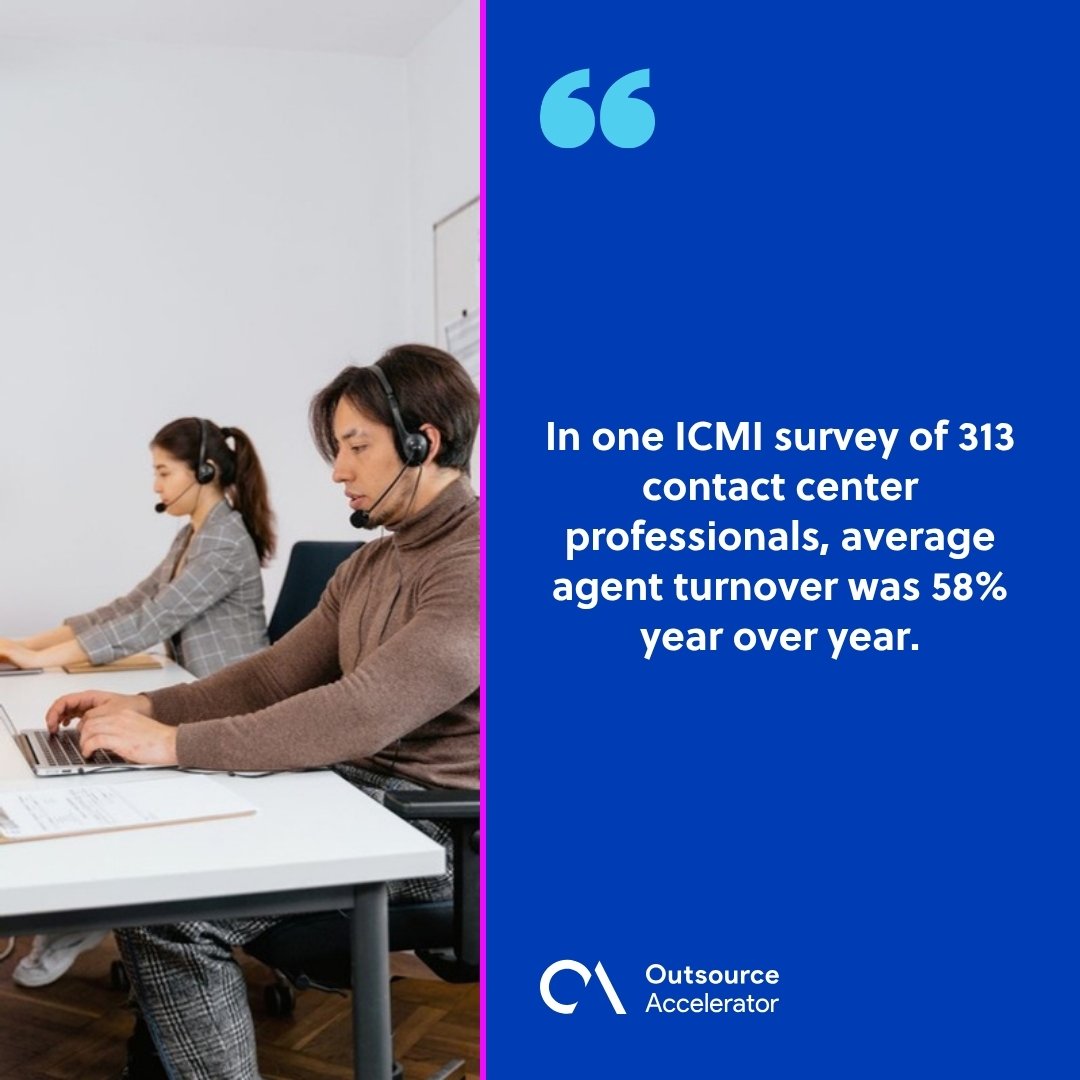
In one ICMI survey of 313 contact center professionals, average agent turnover was 58% year over year. Surveys vary, but the direction is consistent: attrition runs far above most employers.
| Metric | Benchmark | Source |
|---|---|---|
| Average contact center agent turnover | About 58% a year | ICMI survey (via Five9), 2021 |
| Median cost per hire (nonexecutive) | About US$1,300 | SHRM benchmarking, 2026 |
| Cost to replace one employee | 0.5x to 2x annual salary | Gallup |
| Preventable departures | About 75% | Work Institute 2025 |
| Early-tenure (0 to 90 day) exits | The largest and costliest share | Widely observed |
The preventability figure is the encouraging one: the Work Institute’s 2025 Retention Report, based on more than 120,000 exit interviews, found that 75% of departures were preventable. That means most of the cost above is not fixed overhead. It is addressable.
Why the bill is higher for BPOs
BPOs carry cost pressures that in-house teams do not. You hire in large classes against tight client timelines, so a churned class does not just cost money, it risks an account.
Attrition on one program can trigger SLA penalties, force premium emergency hiring, and damage a client relationship that took years to build.
That is why the same attrition rate is more expensive for a BPO than for most employers, and why getting ahead of it matters more.
How to lower the cost, not just the rate
The fastest way to cut the cost is to cut early-tenure attrition specifically, because that is where the money concentrates. Every agent who clears their first 90 days and becomes productive converts a pure loss into a return.
That starts before day one: hiring for fit reduces the wrong-fit hires that drive early exits.
Choosing among predictive hiring platforms is one lever; the broader levers for how to reduce agent attrition (structured onboarding, stronger team leads, realistic previews) protect the investment once agents are in the door.
Cut your attrition cost at the source with Journeyfront
Since most attrition cost is set in motion at hiring, the most direct place to attack it is who you let in the door. Journeyfront is the applicant tracking and assessment platform purpose-built for BPO hiring.
It combines automated screening, job simulations, and predictive assessments to help contact centers fill high-volume hiring classes across multiple clients and geographies, faster and with far better retention.
Journeyfront reports that BPOs using the platform reduce new-hire turnover by 29% and improve hiring efficiency by 71%. More than 50 BPOs run over 100,000 agent hires a year on it.
If early attrition is quietly draining your margins, see how predictive hiring changes the math at journeyfront.com/bpo.






 Independent





