
What are augmented workforce models?

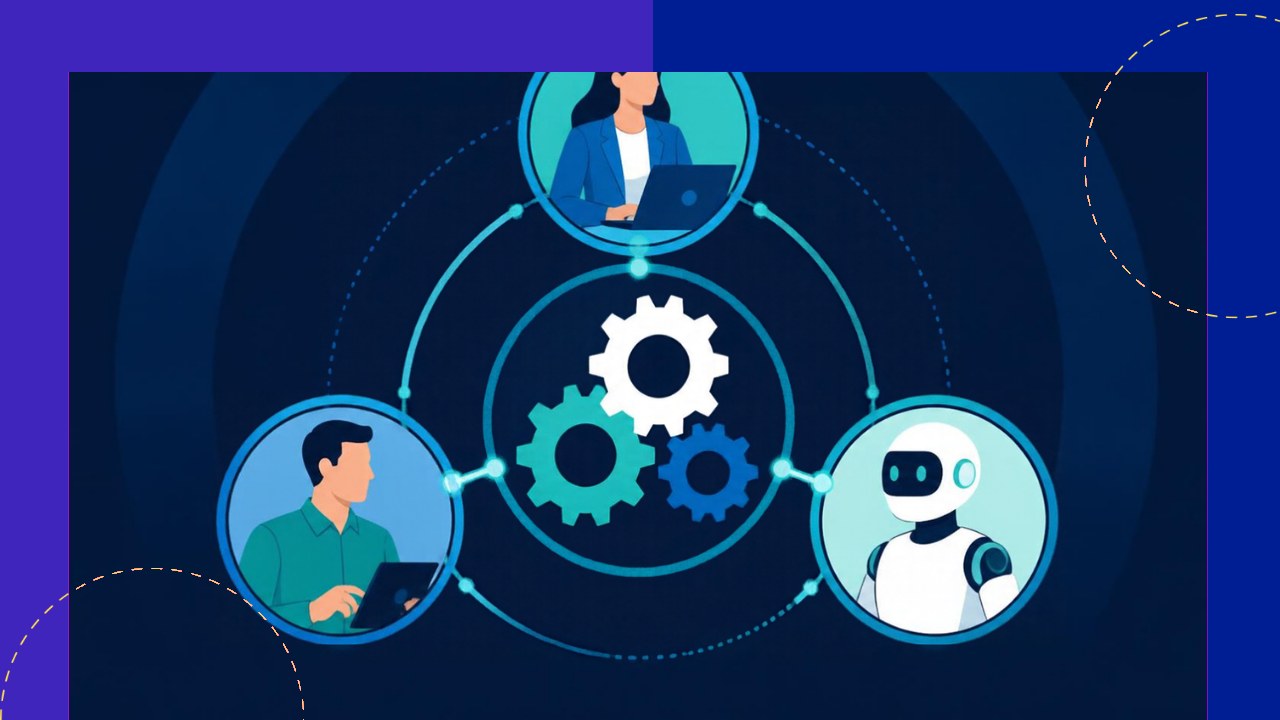
- An augmented workforce model blends full-time employees, contractors, outsourced teams, and automation into one flexible talent mix.
- The right blend depends on the work itself: how long it lasts, how much control you need, and how fast demand shifts.
- Good design starts with clear roles, shared tools, and steady governance, so the mix stays productive instead of chaotic.
Augmented workforce models combine permanent staff with contractors, outsourced teams, and automation or AI to get work done. Instead of hiring only full-time employees, you build a flexible mix and adjust it as needs change. The goal is simple. You want the right skills, at the right cost, exactly when the work calls for them.
This approach has moved from a nice idea to a real strategy. Work is changing quickly, and headcount alone cannot keep up. In fact, the World Economic Forum’s Future of Jobs Report 2025 projects 170 million new jobs and 92 million displaced by 2030, with roughly 39% of core skills set to change. So leaders need talent plans that flex, not fixed org charts.
What an augmented workforce actually includes
An augmented workforce is not one thing. It is several talent sources working side by side. Each source has a clear job to do.
Full-time employees
Your core team holds the knowledge, culture, and long-term ownership. They handle strategy, key relationships, and decisions. In short, they run the parts of the business you never want to hand off.
Contractors and contingent workers
These workers join for a project or a busy season, then move on. They add specialist skills fast. For context, the U.S. Bureau of Labor Statistics reported that 11.9 million people worked as independent contractors in July 2023, about 7.4% of total employment. That pool is large, and it is easy to tap.
Outsourced and offshore teams
An outsourcing provider or offshore partner runs whole functions for you, such as support, billing, or back-office admin. You get a managed team without building it yourself. This works well when a process is steady and clearly defined.
Automation and AI
Software and AI tools take on repetitive, rule-based tasks. They sort data, answer common questions, and flag exceptions. As a result, your people spend more time on judgment and less on busywork.
When each model fits
Start with the work, not the label. Ask three questions first. How long will the work last? How much daily control do you need? How much does demand swing? Your answers point to the right source.
| Talent source | Best for | Watch out for |
|---|---|---|
| Full-time staff | Core, ongoing, high-trust work | Slower to scale up or down |
| Contractors | Short projects and skill gaps | Classification and turnover risk |
| Outsourced teams | Defined, repeatable processes | Less direct control day to day |
| Automation and AI | High-volume, rule-based tasks | Setup effort and oversight |
For example, a growing company might keep product and sales in-house. Meanwhile, it can outsource customer support, hire contractors for a website rebuild, and automate invoice matching. Each piece scales on its own.
If you want to compare these approaches in more depth, it helps to match staffing approaches to real demand before you commit to any one path.
Benefits of blending your workforce
The upside is real when the design is sound. Here are the gains leaders notice most.
Flexibility. You scale up for a launch and scale down when it ends. You pay for the work, not for idle time.
Access to skills. You reach niche talent worldwide without a full-time hire. Rare skills become a phone call away.
Cost control. You match spending to demand. Fixed payroll shrinks, and variable capacity grows.
Speed. You add capacity in days, not months.
Deloitte’s research backs the shift. In its 2023 Human Capital Trends report, 84% of leaders said inclusively leading an expanded workforce matters, yet only 16% felt very ready to do it. So the appetite is clear. The readiness gap is the real hurdle.
The challenges to plan for
A blended workforce brings new risks. Ignore them, and the model gets messy fast.
First, worker classification. Treat a contractor like an employee, and you can face fines. Get the rules right before you sign.
Second, culture and cohesion. Contractors and offshore staff can feel like outsiders. Clear onboarding and shared tools help them belong.
Third, security and quality. More hands touch your systems and data. So you need strong access controls and clear standards.
Finally, oversight. A patchwork of sources is hard to see all at once. Without one view, work slips through the cracks.
How to design an augmented workforce model
You do not need to solve everything on day one. Follow a simple sequence instead.
1. Map the work
List your core tasks. Then sort them by how often they change and how strategic they are. This shows what to keep and what to flex.
2. Match each task to a source
Assign core work to employees. Send steady processes to an outsourcing partner. Give short projects to contractors. Route repetitive tasks to automation.
3. Set up governance
Pick one owner for the whole talent mix. Agree on tools, security rules, and quality checks. Track cost and output in one place, so nothing hides.
4. Start small and review
Pilot one function first. Measure the results. Then expand what works and fix what does not. One flexible option is to add skilled people to your team on a temporary basis while you test the wider blend.
Done well, the model gives you a workforce that bends with demand while you keep control of what matters most.
Frequently asked questions
Is an augmented workforce the same as staff augmentation?
No, though they overlap. Staff augmentation is one tactic: you add outside workers to your own team under your direction. An augmented workforce is the bigger picture. It includes staff augmentation plus outsourced teams, gig workers, and automation, all managed together as one talent system.
How do I keep contractors and offshore staff aligned with my culture?
Treat onboarding the same for everyone. Share your mission, tools, and communication norms on day one. Invite external workers to relevant team rituals, such as standups or reviews. Small inclusion habits build trust and reduce the us-versus-them feeling.
Where does AI fit without replacing my people?
Point AI at volume, not judgment. Let it handle data entry, first-line questions, and routine sorting. Keep humans on decisions, exceptions, and relationships. Used this way, automation lifts capacity and frees your team for higher-value work.
How do I measure if the model is working?
Track three things together: cost per outcome, speed to fill capacity, and quality or error rates. Compare them against your old all-employee setup. If cost drops while speed and quality hold, the blend is earning its place.






 Independent





