
How Dynamics 365 helps retailers manage inventory, sales, and customers


At a glance
- Retailers running inventory, POS, and customer data on separate systems create blind spots that drive stockouts, overstock, and missed personalization opportunities across every channel.
- Dynamics 365 consolidates those functions into one platform, giving operations, merchandising, and customer service teams access to the same real-time data without manual exports or system switching.
- According to IHL Group research, retailers globally lose $1.73 trillion annually to inventory distortion (split between out-of-stocks and overstock requiring markdowns), equal to 6.5% of global retail sales.
- Itransition is a Microsoft Solutions Partner with 100+ CRM and 50+ ERP projects completed, covering the full Dynamics 365 retail suite from Commerce and Supply Chain Management to Business Central.
Most retail operations run on more than one system. Inventory sits in one platform. Point-of-sale data sits in another. Customer purchase history lives in a CRM that doesn’t connect to either.
That fragmentation has a cost. When a service agent handles a return, they are switching between screens.
When a buyer is making replenishment decisions, they are working from yesterday’s export. When stockouts happen, the team is reacting rather than anticipating.
According to IHL Group research, as reported by board.com, global retailers lose $1.73 trillion annually to inventory distortion: $1.157 trillion from out-of-stocks and $572 billion from overstock requiring deep discounts.
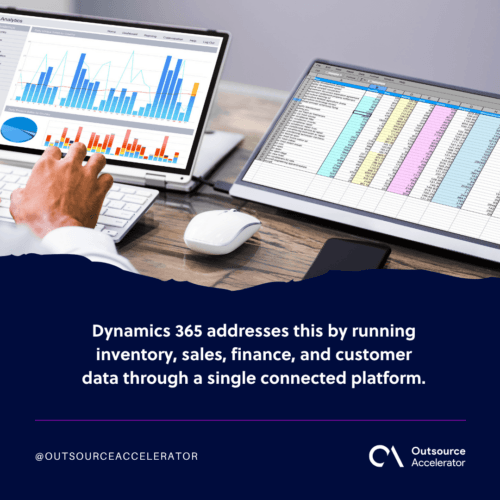
Dynamics 365 addresses this by running inventory, sales, finance, and customer data through a single connected platform. For retailers weighing enterprise software implementation options, the implementation partner shapes how much of that value the business actually captures.
This article covers what Dynamics 365 changes for retail operations, which modules address which problems, and what a well-structured implementation involves.
What Dynamics 365 covers across a retail business
Dynamics 365 is not a single application. It is a suite of connected modules, each addressing a specific operational domain, that share a common data layer. For retailers, the value is in what happens when those domains stop operating in silos.
| Module | Primary retail use case |
|---|---|
| D365 Commerce | Omnichannel POS, e-commerce, order management, loyalty programs |
| Supply Chain Management | Inventory, procurement, warehouse, demand forecasting |
| Finance | General ledger, accounts payable, cost accounting, financial reporting |
| Customer Insights | Unified customer profiles, segmentation, campaign personalization |
| Customer Service | Case management, order lookup, full service history per customer |
| Business Central | Full ERP for SMB retailers combining finance, inventory, and sales |
A purchase made in Commerce updates inventory in Supply Chain Management in real time. A return processed in Customer Service updates the customer’s profile in Customer Insights without a manual export. The shared data model is what makes that possible.
Pro Tip: Many retailers start with Business Central as a single-platform ERP, then scale to individual enterprise modules as volume grows. Because all D365 modules share Microsoft’s Common Data Model, moving between tiers does not require rebuilding your data structure or migrating customer records.
Inventory and Supply Chain Management
Inventory accuracy depends on real-time visibility across every touchpoint: in-store sales, online orders, warehouse transfers, returns, and supplier deliveries. Systems that don’t share data create lag between what happened and what the inventory record reflects.
Dynamics 365 Supply Chain Management centralizes that data.
Demand forecasting runs against live sales figures rather than periodic exports. Replenishment triggers fire automatically when stock falls below defined thresholds. Transfers between locations update the shared record immediately.
For retailers carrying product across multiple channels or fulfillment locations, that visibility is the difference between planned replenishment and reactive firefighting.
A Forrester Total Economic Impact study commissioned by Microsoft found that enterprises deploying Dynamics 365 ERP achieve 101% ROI over three years, with midmarket organizations reaching payback in 16 months.
The primary drivers: consolidating legacy systems and eliminating manual processes across finance and supply chain.
Pro Tip: D365’s demand forecasting uses Azure Machine Learning to generate replenishment recommendations from sales history, seasonality, and supplier lead times. Accurate historical data loaded during the migration phase, not after go-live, is what makes those recommendations reliable from day one.
Omnichannel sales and customer data
Customer-facing retail runs across channels that often don’t share data. A loyalty balance visible in the app but not at the register. A purchase history the service agent can’t see. An email campaign sent to customers who already bought the promoted item.
D365 Commerce handles POS, e-commerce, order management, and loyalty on a single platform. D365 Customer Insights aggregates purchase history, service interactions, and behavioral data into unified customer profiles that both marketing and service teams can act on.
The result is that a service agent handling a return can see the customer’s full history.
A marketer building a campaign can exclude customers who already own the product. A loyalty member’s balance is consistent across channels because there is one data source.
This also enables business intelligence reporting that connects sales performance, margin, and customer behavior in dashboards that merchandising, finance, and marketing share from the same data set.
How Itransition implements Dynamics 365 for retailers
Itransition’s retail D365 practice covers implementation, customization, integration, and ongoing support across the full Dynamics 365 suite, with an internal ecommerce Center of Excellence and a track record spanning 100+ CRM and 50+ ERP projects.
- Microsoft Solutions Partner since 2008: 25+ years in enterprise software, 10+ years in CRM/ERP, with Microsoft-certified specialists across all D365 modules
- Full retail module coverage: Commerce, Supply Chain Management, Finance, Customer Insights, Customer Service, and Business Central
- Success by Design methodology: Microsoft’s phased implementation framework covering architecture, configuration, QA, Azure cloud deployment, and data migration
- Customization and integration: Custom fields, business rules, retail-specific module builds, and third-party integrations including Microsoft 365, Azure, and Power Platform
- Retail case study: Helped a fashion accessories conglomerate achieve a 28% reduction in order processing time after migrating from a legacy system to D365 Finance and Supply Chain Management
- ISO 9001 and ISO 27001 certified: Quality and information security management across all client engagements; 4.9 Clutch rating
Retailers evaluating Dynamics 365 for their operations can connect with Itransition’s D365 retail team for an architecture review and module scoping.
Key takeaways
- Retail inventory distortion costs $1.73 trillion globally per year, split between out-of-stocks and overstock, a direct result of systems that don’t share data in real time
- Dynamics 365 consolidates inventory, POS, e-commerce, finance, and customer data into a single platform, eliminating the lag and manual exports that create those blind spots
- A Forrester TEI study found enterprises deploying Dynamics 365 ERP achieve 101% ROI over three years, with midmarket payback in 16 months, driven by supply chain and process consolidation
- Itransition is a Microsoft Solutions Partner with 100+ CRM and 50+ ERP projects, covering the full D365 retail suite from Commerce and Supply Chain Management to Business Central






 Independent





