
Will AI Replace Outsourcing? Derek Gallimore’s Answer on the Asia Tech Podcast

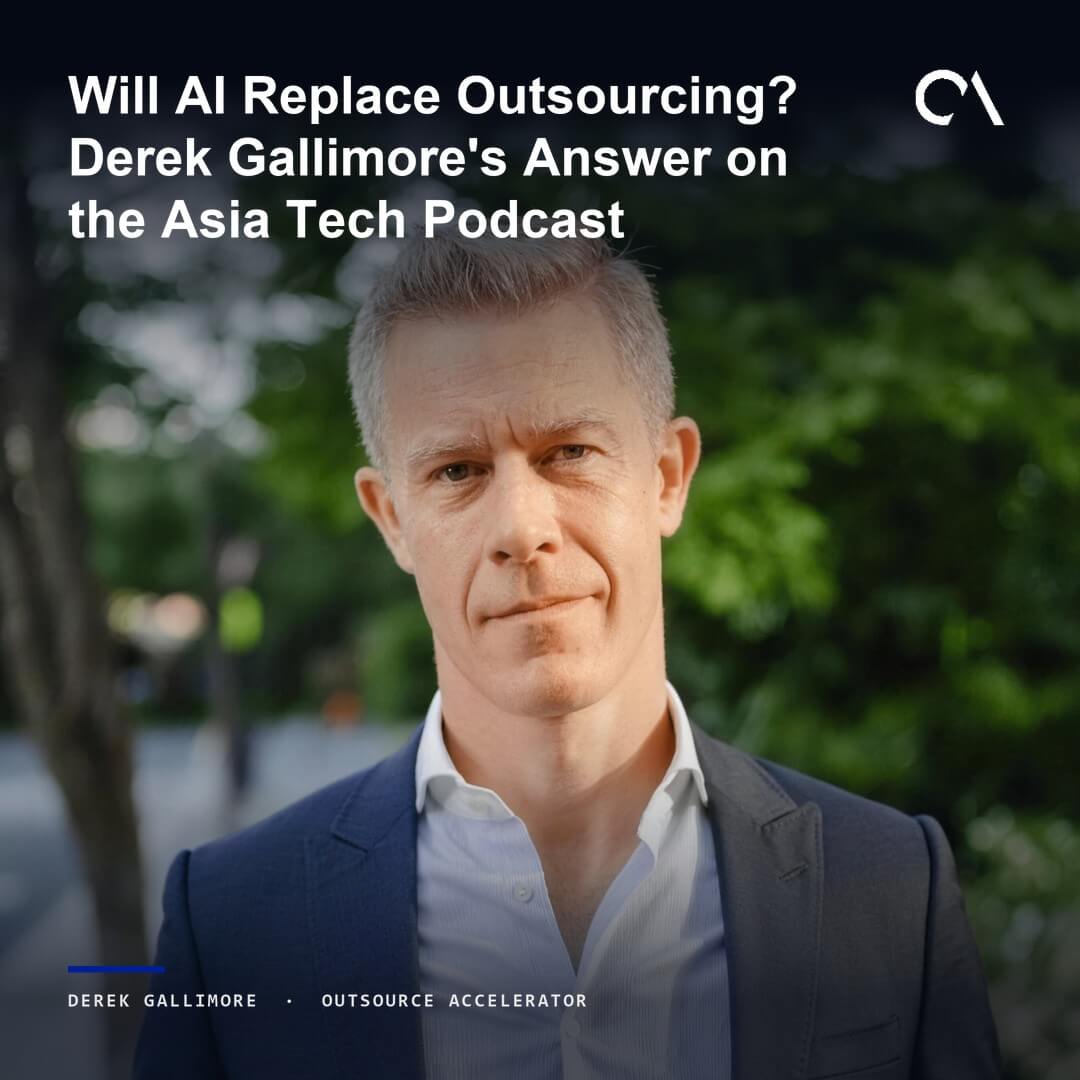
Ask almost anyone in tech whether AI will gut the outsourcing industry, and you’ll get a confident yes. Ask Derek Gallimore, and you get the opposite. The founder of Outsource Accelerator went on the Asia Tech Podcast to take the question head-on, and he did not hedge:
“The general consensus is that it’s going to destroy the entire market. But I think this is completely oversold.”
That one line sets up one of the more grounded takes you’ll hear on AI and offshoring. It’s worth unpacking.
The quick take
No, AI is not on track to replace outsourcing.
On the Asia Tech Podcast, Derek argued that outsourcing is a “proxy for employment,” so it’s no more exposed to AI than any other part of the economy. Repetitive, low-complexity roles will shrink everywhere, onshore and offshore alike.
But AI is also a leveler that makes offshore teams more capable, not less, and the real trajectory is toward higher-value, AI-augmented global employment.
“Completely oversold”: The panic vs the reality
Derek’s problem with the doom narrative is that it treats outsourcing as uniquely fragile. He reaches for a comparison the tech crowd will recognize:
“It’s a little bit like the SaaS apocalypse, how all the SaaS stocks have collapsed. Equally, the call center stocks have collapsed.”
Markets, in other words, have already priced in an extinction event that hasn’t happened. And this is no fringe corner of the economy he’s defending: the global business process outsourcing market was worth more than $300 billion in 2025 and is forecast to keep growing.
The reasoning behind the panic, he says, doesn’t survive once you define what outsourcing actually is.
The hinge: Outsourcing is “a proxy for employment”
This is the core of his whole argument. Outsourcing isn’t a separate industry waiting to be automated away. It’s simply a substitute for hiring.
“Outsourcing is essentially a proxy for employment. So I don’t see that it will be hit any differently than any other industry.”

Play that out and the doomsday case falls apart in two directions:
- If AI does eliminate jobs wholesale, that’s an economy-wide reckoning, not an outsourcing story. In that case, as Derek put it, “we all have to review what we do with ourselves and how the economy works.”
- If it doesn’t, an offshore role is no more replaceable than the same role onshore. The exposure is identical whether the worker sits in the US, the UK, Asia, the Philippines, or India.
So what does AI actually change?
Derek isn’t claiming nothing shifts. He’s blunt that some work disappears:
“Lower-capability roles, higher-repetition roles, they will be wiped out.”
The nuance that everyone misses: this cuts everywhere, not just offshore.
Broadly:
- At risk: repetitive, low-complexity, high-volume tasks, in any country.
- Resilient: judgment-heavy work, management, and anything that means directing AI rather than being replaced by it.
- A wash: offshore vs onshore. A routine job is exposed to automation no matter the time zone.
And his optimism isn’t an outlier. The World Economic Forum’s Future of Jobs research projects that AI and technology will create more roles than they displace this decade, a net gain of tens of millions of jobs worldwide. Framing it as “AI versus offshoring,” then, is a category error.
AI as a leveler, not just a threat
Here’s where Derek flips the script. AI doesn’t only subtract, he argues, it upgrades, and it upgrades everyone:
“AI is an enabler. It’s also a leveler. So it can actually elevate very ordinary people up to a quasi-superhuman capability.”
That’s exactly why he sees staff augmentation, not commodity call center work, as the future of the industry, and the part most insulated from AI:
“Staff augmentation is really the story of the future, and that is very resilient to AI and is actually enabled by AI.”
Then comes the line that should make any CFO look twice. If tomorrow’s work is people harnessing AI, location becomes a choice about cost and talent, not capability:
“Why not do it from the Philippines? Why not do it from India instead of the US?”
The bigger picture: Globalized employment
Step back, and Derek thinks the whole “outsourcing” frame is dated. The label misleads: plenty of so-called virtual assistants are “running entire businesses,” and you never actually hand over control of your people or processes, they’re just skilled people who happen to sit elsewhere.
As remote work becomes frictionless, he expects the default to flip toward globalized employment:
“It’s ridiculous to think that globalized employment will not dominate versus localized employment. That’s going to seem quaint in a few years.”
Key takeaways
- Derek calls the “AI will destroy outsourcing” narrative “completely oversold.”
- Outsourcing is a proxy for employment, so its AI exposure matches the wider economy, not more.
- Repetitive, low-capability roles will shrink, but everywhere, not only offshore.
- AI is a leveler that makes offshore workers more capable, which boosts staff augmentation.
- The long game is globalized, AI-augmented employment, not the end of outsourcing.
Derek shared these insights as a guest on the Asia Tech Podcast. Listen to the full conversation.






 Independent





