
Retrieval Augmented Generation

Definition
Retrieval Augmented Generation
Retrieval augmented generation is an AI technique pairing a large language model with an external data source — so the model retrieves fresh facts at query time and grounds answers in verified context, not just parametric memory. Meta researchers introduced it in 2020.
The core idea is simple. Instead of relying only on what the model learned during training, RAG queries a document store or vector database at inference time. The retrieved passages get injected into the prompt as context before generation begins.
This grounding matters because artificial intelligence systems trained on static corpora go stale, hallucinate confident but wrong facts, and cannot reach private or proprietary data. RAG addresses all three without the cost of retraining the underlying model.
Interest surged after the 2023 wave of enterprise generative AI pilots hit the wall of hallucinations and stale training data. RAG became the default retrofit, cheaper than fine-tuning and more current than a static prompt.
Key takeaways
- RAG combines retrieval from an external index with generative language modeling, so responses cite live sources instead of relying purely on training data.
- The pattern reduces hallucinations, adds real-time knowledge, and lets enterprises expose proprietary documents to an LLM without fine-tuning it.
- A typical stack has three parts: an embedding model, a vector database for similarity search, and the generative model that composes the final answer.
- Costs typically stay well below fine-tuning for the same coverage, since only the index and per-query tokens grow, not the model weights.
- Adoption is fastest in customer support, legal research, healthcare, and knowledge-heavy BPO workflows where accuracy and citations matter.
How it works
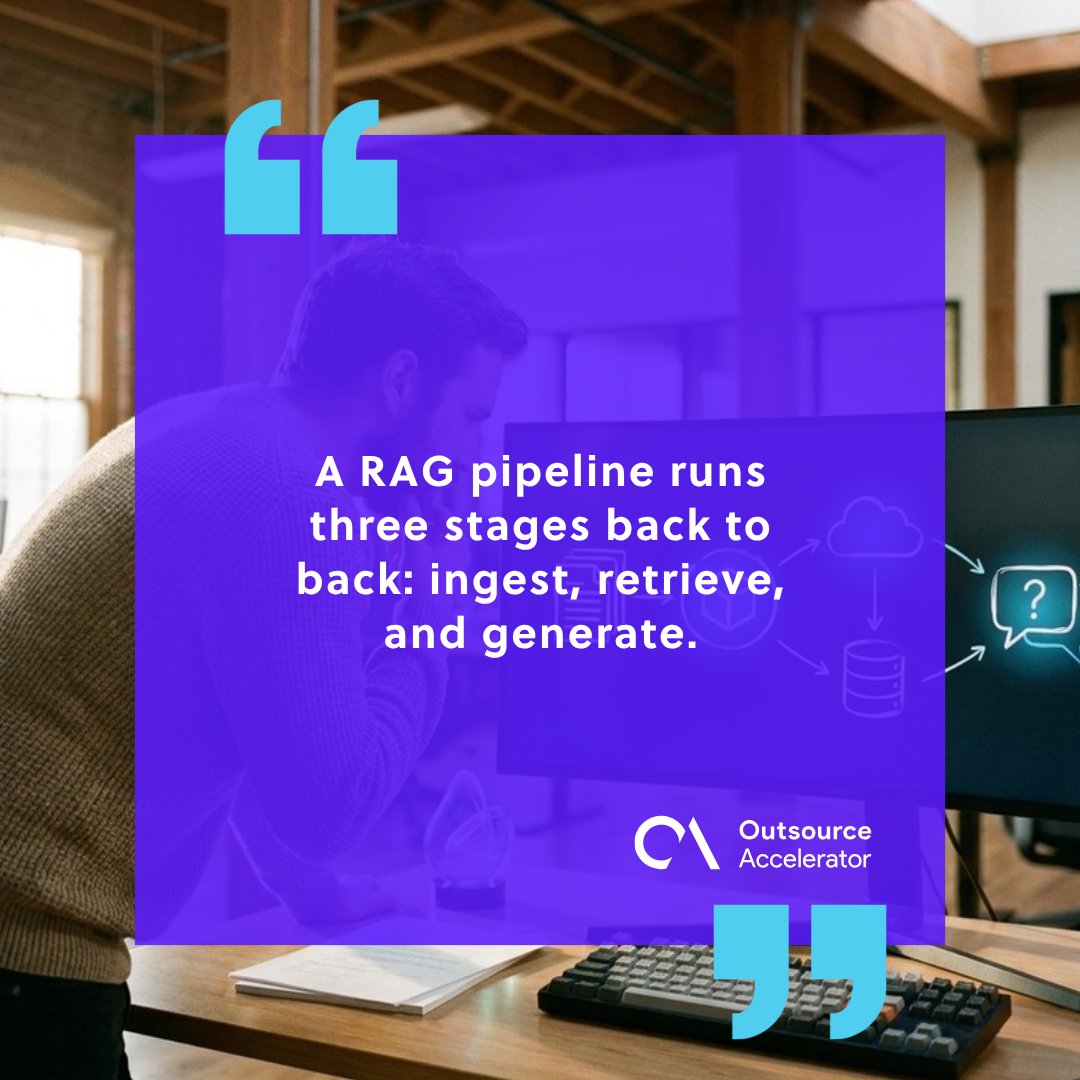
A RAG pipeline runs three stages back to back: ingest, retrieve, and generate. Ingestion converts source documents into embeddings and stores them in a vector database. Retrieval matches the user query against that index and passes top hits to the model.
Generation sits on top — the generative AI model receives the original prompt plus the retrieved passages, then composes an answer conditioned on both. Some pipelines add a reranker between retrieval and generation to sharpen relevance before the LLM sees the context.
| Stage | Input | Output | Common tools |
|---|---|---|---|
| Ingestion | Raw documents | Vector embeddings | LangChain, LlamaIndex |
| Retrieval | User query | Top-k passages | Pinecone, Weaviate, FAISS |
| Reranking | Retrieved passages | Reordered set | Cohere Rerank, ColBERT |
| Generation | Prompt + context | Final response | GPT-4, Claude, Llama 3 |
Modern pipelines mix retrieval methods. Sparse retrieval like BM25 handles exact keyword hits well; dense retrieval with transformer embeddings catches paraphrased matches.
Hybrid search runs both in parallel then merges scores, which usually beats either method alone on real corpora.
Latency, index freshness, and chunk size become the three levers engineers tune. Nightly re-indexing keeps the store current for domains where facts shift, like pricing or policy. Vendor stacks from NVIDIA, AWS, and Azure now ship RAG as a reference architecture.
Evaluation of a RAG system splits into retrieval quality and generation quality.
Precision at k, recall, and mean reciprocal rank score the retriever; groundedness, faithfulness, and answer relevance score the generator. Frameworks like RAGAS and TruLens automate the scoring loop.
Security matters too. Enterprise deployments enforce per-user access-control on the retrieval layer so private documents never leak into another user’s answer.
Encryption at rest, VPC-locked stores, and prompt-injection filters have become standard controls since mid-2024.
Examples
Retrieval augmented generation now powers customer-facing assistants and internal knowledge tools across finance, healthcare, and legal services — every major LLM vendor now ships a reference RAG architecture, and adoption keeps climbing month over month.
Origins (2020): Meta AI researchers led by Patrick Lewis published the founding paper at NeurIPS 2020, pairing a dense-vector Wikipedia index with a seq2seq generator and beating parametric baselines on open-domain question answering.
Bing (2023): Microsoft rebuilt Bing search on top of GPT-4 with a RAG layer in February 2023, retrieving live web pages so answers cite current sources rather than the model’s older training snapshot.
Morgan Stanley (2023): The bank’s wealth-management arm launched an internal GPT-4 assistant in September 2023 that retrieves against 100,000+ internal research documents, so advisors get grounded answers without leaving the CRM.
Klarna (2024): The Swedish fintech rolled out an OpenAI-powered support agent in February 2024 that handles 2.3 million conversations a month, using RAG to pull answers from its policy and product knowledge base in 35 languages.
In outsourcing, BPO providers use RAG to power agent-assist tools that surface the right knowledge-base article mid-call, cutting average handle time. Contact centers in Manila and Bogotá have piloted these copilots since mid-2024 with North American brands.
Related terms
RAG sits inside a wider family of AI patterns. Understanding how it differs from fine-tuning, prompt engineering, and vector search helps teams pick the right technique for a given accuracy, cost, and freshness constraint.
- Machine Learning: the subset of AI where models improve at a task from data rather than explicit rules.
- Generative AI: AI systems that produce new text, images, or code, which RAG grounds with retrieved facts.
- Natural Language Processing: the field that lets software parse and produce human language, a prerequisite for RAG pipelines.
- Chatbot: conversational interface where RAG is often deployed to keep answers factual and current.
- Automation: broader category of software that executes tasks without human input, often augmented by RAG-powered decision support.
- Knowledge Process Outsourcing: higher-order outsourcing work that RAG-equipped tools increasingly augment.
FAQ
How is RAG different from fine-tuning?
Fine-tuning bakes new knowledge into the model weights, which is slow, expensive, and hard to update. RAG leaves the model alone and swaps knowledge in at query time through the retrieval index.
Does RAG eliminate hallucinations?
No, but it reduces them significantly by anchoring answers to retrieved passages. Hallucinations still happen when retrieval misses, when passages contradict, or when the model ignores the supplied context.
What tools power a RAG stack?
A typical stack pairs an embedding model, a vector database like Pinecone or Weaviate, and a generative model. Orchestration frameworks such as LangChain or LlamaIndex tie the pieces together.
What is the difference between RAG and vector search?
Vector search retrieves. RAG uses that retrieval as one step, then feeds the results into a generative model that composes a natural-language answer citing the source. Vector search alone stops at ranked documents.
When should a team choose RAG over fine-tuning?
Choose RAG when the source data changes often, when you need citations, or when the corpus is too large or too private to bake into weights. Fine-tune for style, format, or narrow tasks where knowledge is stable.
Where does RAG show up in outsourcing?
BPO providers use it inside chatbots, agent-assist copilots, and legal or medical research workflows to keep answers grounded in client-approved sources.
Outsource Accelerator connects buyers and providers building AI-enabled workflows — start your search here.






 Independent





