
What is agentic AI evaluation and how is it used to improve model reliability?

- Agentic AI systems (models that plan, execute multi-step tasks, and adapt to changing inputs) fail in production at rates that lab benchmarks consistently underpredict.
- Standard benchmark scores measure performance on controlled test sets, not real-world operational reliability; the gap between the two is where enterprise AI deployments break down.
- Agentic AI evaluation is the structured process of testing, reviewing, and verifying AI agent behavior across realistic task conditions, including edge cases, failure modes, and safety constraints that benchmarks exclude.
- Hugo supports AI evaluation and operations through specialist human review teams covering Data and AI services (annotation, model evaluation, red teaming), trust and safety, and digital operations, with 4,500+ team members across operations in Africa and the US.
A model that scores well on a benchmark is not necessarily a model that performs reliably in production.
The distinction matters more for agentic systems than for any other AI category. Agentic models aren’t just predicting a label, they’re planning, making decisions, and taking actions with real-world consequences.
This is why agentic AI evaluation has become a discipline in its own right, and why the organizations deploying AI agents at scale invest in it before and after production launch, not just during initial testing.
AI outsourcing companies that support evaluation and operations provide the human oversight layer that agentic systems require to reach and maintain production reliability.
Why standard benchmarks fail for agentic systems
The benchmark problem in AI evaluation is well-documented, but it’s especially acute for agentic systems.
Research compiled by Kili Technology in their 2026 AI benchmark analysis documents a 37% gap between lab benchmark scores and real-world deployment performance for enterprise agentic AI systems.
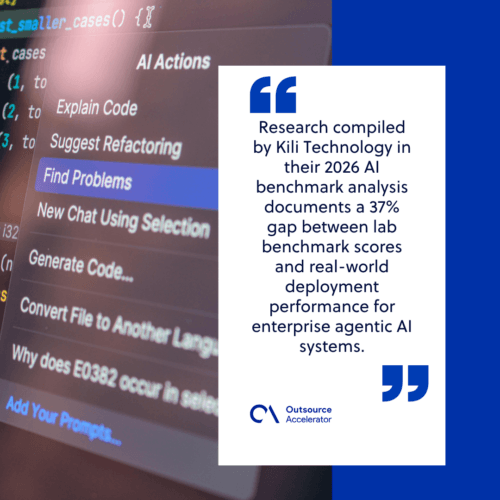
The same paper found that model consistency dropped from 60% accuracy on a single test run to 25% across eight consecutive runs, with no change to the model itself, only the run sequence.
The root causes of benchmark unreliability include:
- Data contamination. Frontier models train on internet-scale datasets that may include benchmark test sets, inflating scores without reflecting genuine capability.
- Binary success measures. 13 out of 15 major benchmarks evaluate only whether a task was completed, not whether it was completed safely, efficiently, or in a way that generalizes to adjacent tasks.
- Annotation errors in the benchmarks themselves. Audit studies have found annotation error rates exceeding 50% in some standard benchmarks, meaning the “correct” answers used to score models are frequently wrong.
The consequence: 88% of AI agents fail to reach production. Surviving deployments return 171% ROI, but the selection pressure that gets an agent to production is precisely the evaluation rigor that most organizations underinvest in.
Pro Tip: When evaluating your agentic system’s benchmark performance, run the same benchmark eight times with minor input variations and track consistency. A system that scores 80% on one run but drops to 30% on variation runs is not a reliable system: it’s a system that has partially overfitted to the benchmark format.
What agentic AI evaluation actually covers
Agentic AI evaluation is not a single test, it’s a set of structured processes that probe different aspects of agent behavior.
| Evaluation method | What it tests | Failure modes it catches |
|---|---|---|
| Task reliability testing | Performance across input variations | Brittleness to phrasing changes, out-of-distribution inputs |
| Safety and boundary evaluation | Behavioral limits under adversarial inputs | Prompt injection, scope violations, unsafe outputs |
| Human review and annotation | Output quality and intent alignment | Plausible-but-wrong outputs, judgment failures |
| Red-teaming | Domain-specific failure modes | Compliance violations, security vulnerabilities |
| Post-deployment monitoring | Production behavior drift over time | Distribution shift, model degradation, edge case accumulation |
Task reliability testing
Does the agent complete tasks correctly across realistic input variations, not just the clean inputs used in development?
Task reliability testing systematically varies the phrasing, format, and completeness of task inputs to identify failure modes that only appear when conditions deviate from the training distribution.
Safety and boundary evaluation
Does the agent respect defined behavioral boundaries? Safety evaluation uses adversarial inputs (deliberate attempts to elicit unsafe behavior) to identify the agent’s actual safety boundaries, not its intended ones.
Agentic systems operating in production environments need to handle out-of-scope requests and attempted misuse without taking harmful actions.
Human review and annotation
Automated evaluation tools miss failure modes that require judgment about whether an output is appropriate, helpful, or aligned with user intent.
Human reviewer programs, where specialist teams evaluate agent outputs against defined criteria, catch the failures that automated metrics don’t capture.
Post-deployment monitoring
Production agentic systems drift as input distributions change. Post-deployment monitoring tracks key reliability metrics against thresholds, flags anomalous behavior patterns, and triggers human review when agent outputs fall outside acceptable ranges.
Pro Tip: Build post-deployment monitoring into your AI agent architecture before launch, not after the first production incident. The cost of instrumenting monitoring retrospectively is significantly higher than designing it from the start, and the time between an unmonitored failure and its discovery in production is often measured in weeks rather than hours.
How evaluation connects to production reliability
The business case for agentic AI evaluation is straightforward: the cost of evaluation is significantly lower than the cost of production failures.
Industry analysis of agentic AI deployment outcomes in 2026 finds that Gartner predicts over 40% of agentic AI projects will be cancelled by end of 2027, citing escalating costs, unclear business value, and inadequate risk controls. The common thread in cancelled projects is insufficient evaluation investment before and during production deployment.
Most enterprise teams building agentic AI systems don’t have the headcount to run continuous human review programs internally.
Outsourcing these AI operations functions, including human review, annotation, and safety evaluation, gives teams the evaluation capacity to run proper oversight without building it from scratch.
How Hugo supports agentic AI evaluation and operations
If your agentic AI deployment needs ongoing human oversight infrastructure, Hugo builds and runs those functions at enterprise scale, covering annotation, model evaluation, trust and safety, and digital operations.
- Data and AI. Annotation, model evaluation, red teaming, alignment work, and quality review programs under Hugo’s Omni Evals framework, covering perception tasks, audio and speech diarization, multimodal grounding, agentic evals, and embodied AI.
- Trust and safety. Content moderation, fraud detection, and community management, including the adversarial review processes that support AI safety evaluation in production.
- Dedicated team model. All programs run through dedicated teams, not shared resource pools. The same reviewers develop domain expertise on your system over time, improving evaluation quality as they accumulate institutional knowledge.
- Scale and breadth. 4,500+ team members across operations in Africa (Nigeria, South Africa, Kenya, Senegal, Cape Verde, Ghana) and the US, with a 5.0/5 rating on Clutch (28 verified reviews) and Fastest-Growing BPO for Customer Service Outsourcing for three consecutive years (Clutch 2024, 2025, 2026).
Reach out to Hugo to build the human operations infrastructure your agentic AI deployment requires, from specialist annotation teams to trust and safety operations at enterprise scale.
Key takeaways
- Standard benchmarks underpredict real-world agentic AI reliability by an average of 37%, because they test controlled inputs, not the variable, ambiguous conditions of production deployment.
- Agentic AI evaluation covers task reliability testing, safety and boundary evaluation, human review programs, red-teaming, and post-deployment monitoring, each targeting failure modes the others don’t fully surface.
- Gartner predicts 40% of agentic AI projects will be cancelled by end of 2027, with inadequate risk controls and evaluation investment cited as primary causes.
- Hugo provides the human operations infrastructure (Data and AI services, trust and safety teams, and dedicated review programs) that agentic AI deployments require to reach and sustain production reliability.






 Independent





