
Copilot vs autonomous agent: which fits your outsourced process?

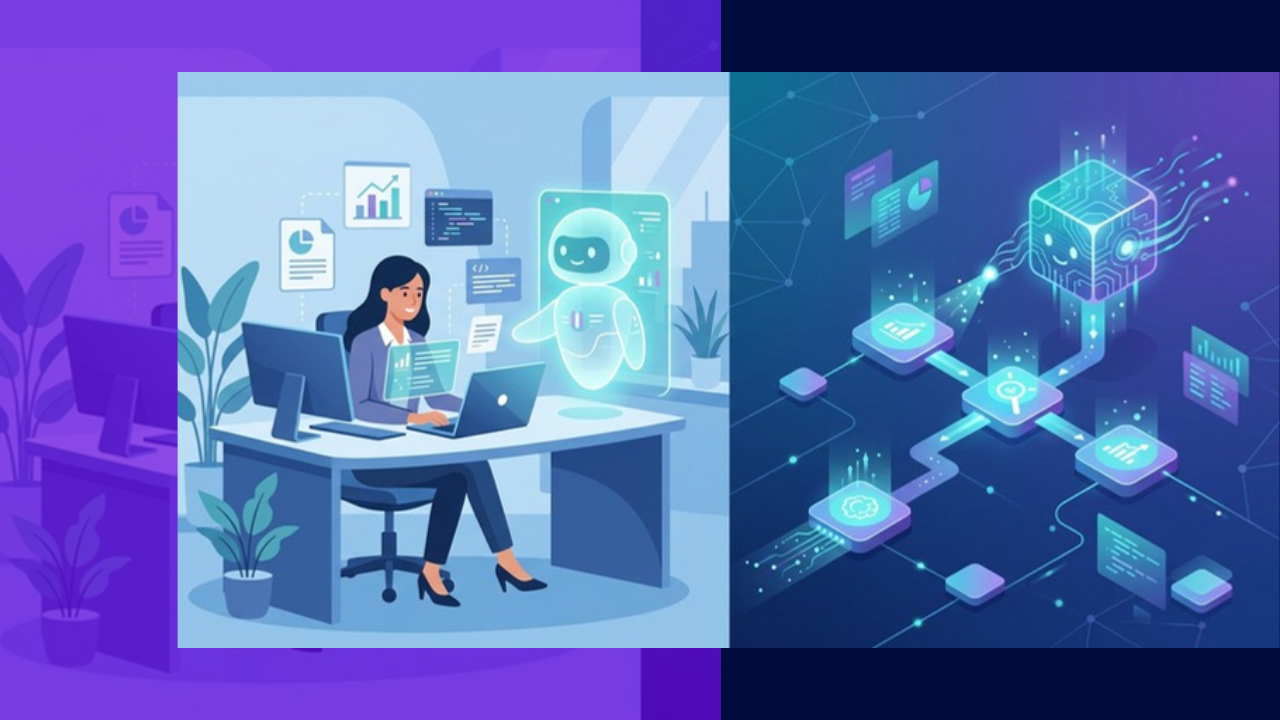
- An AI copilot assists a person who stays in control, while an autonomous agent plans and acts on its own toward a goal.
- The right fit depends on task risk, how repeatable the work is, and how much human oversight you can realistically keep.
- Copilots suit judgment-heavy, exception-prone tasks; agents suit high-volume, rule-bound steps with clear guardrails.
- Most outsourced operations end up blending both, with people reviewing agent actions at key decision points.
The AI copilot vs agent decision now shapes how outsourced work gets delivered. Buyers want faster turnaround, and providers want to prove they can automate without adding risk.
The two tools solve different problems. A copilot suggests and drafts while a person decides. An autonomous agent takes a goal and runs the steps itself.
This explainer defines each option, contrasts how they behave, and gives you a practical way to match them to a specific outsourced process.
What is an AI copilot?
An AI copilot is an assistive tool that works beside a person who keeps final control of every action.
In a contact center, a copilot might draft a reply, summarize a long case, or suggest the next step for a live agent. The human reviews the suggestion and chooses whether to use it.
Because a person approves each move, copilots fit work that needs judgment, empathy, or context that is hard to codify. They speed up skilled staff rather than replacing them, which is the core idea behind AI-augmented BPO services.
What is an autonomous agent?
An autonomous agent pursues a goal on its own, planning and running the steps with little human input at each stage.
Given an objective such as resolving a refund request, an agent can read the ticket, check policy, update the record, and send a response. It uses connected tools and makes decisions inside limits you define.
That independence is powerful, but it changes who is accountable. Stanford research found that most workers still want a say, with many favoring human oversight at critical junctures rather than full automation.
How an AI copilot and an autonomous agent differ
The clearest way to separate the two is to ask who makes the decision and who carries the risk.
| Factor | AI copilot | Autonomous agent |
|---|---|---|
| Who decides | The human, on every action | The agent, within set limits |
| Human role | Reviews and approves suggestions | Sets goals and oversees outcomes |
| Best suited to | Judgment-heavy, exception-prone tasks | Repeatable, rule-bound, high-volume steps |
| Speed | Faster skilled work | End-to-end execution with little wait |
| Risk profile | Lower, because a person approves | Higher, because actions run on their own |
| Oversight needed | Built into daily use | Guardrails, audit logs, and checkpoints |
| Typical outsourced use | Agent-assist in customer service | Automated ticket triage or invoice matching |
How to choose the right fit for your process
Start with the process itself, not the technology, and work backward to the level of autonomy it can safely support.
Weigh risk and the cost of an error
Ask what happens when the tool gets it wrong. If a mistake is cheap and easy to reverse, an agent can run more freely. If an error is costly or hard to undo, keep a copilot and a human approver in place.
Check how repeatable and rule-bound the work is
Agents perform best on high-volume steps with stable rules, such as data entry, ticket triage, or invoice matching. Judgment-heavy tasks with many exceptions usually call for a copilot, a pattern reflected in the automation and AI trends reshaping BPO.
Confirm you can keep meaningful oversight
Decide where a person reviews output before it reaches a customer or a ledger. If you cannot staff that checkpoint, scale back the autonomy until you can.
Risks and the role of human oversight
More autonomy raises the stakes, so governance has to grow with it.
Agents can act quickly on flawed data or an unclear instruction, and a single error can repeat across thousands of cases before anyone notices. The NIST AI Risk Management Framework urges teams to build trustworthiness into the design, development, use, and evaluation of these systems.
Practical controls include clear limits on what an agent may do, audit logs, and human review at decision points. Many providers pair these safeguards with BPO automation tools so speed never outruns accountability.
Frequently asked questions
These are common questions buyers and providers ask when weighing an AI copilot against an autonomous agent for outsourced work.
Is a copilot just a chatbot?
No. A chatbot answers questions turn by turn, while a copilot works inside a task to draft, summarize, and suggest next steps for the person doing the work.
Can one process use both?
Yes, and many do. An agent can handle the routine, high-volume portion while a copilot supports the staff who manage exceptions and sensitive cases.
Which is cheaper to run?
It depends on volume and error cost. Agents can lower cost per task at scale, but rework and oversight from mistakes can erase those savings on risky processes.
How much human oversight does an agent need?
Enough to catch and correct errors before they cause harm. High-stakes work needs review at each decision point, while low-risk tasks may need only periodic audits.
Key takeaways
Choosing between a copilot and an autonomous agent comes down to control, risk, and the shape of the process.
- Use a copilot when human judgment, empathy, or high error cost means a person should approve each action.
- Use an autonomous agent for repeatable, rule-bound, high-volume steps where errors are cheap and reversible.
- Match the level of autonomy to the risk of the task, then build oversight to fit.
- Expect a blend, with agents handling routine work and copilots supporting people on the exceptions.






 Independent





