
Outsourcing to the Philippines: all your questions answered


- Outsourcing to the Philippines remains the default offshore choice for English-language voice and back-office work, backed by a workforce of roughly 1.9 million.
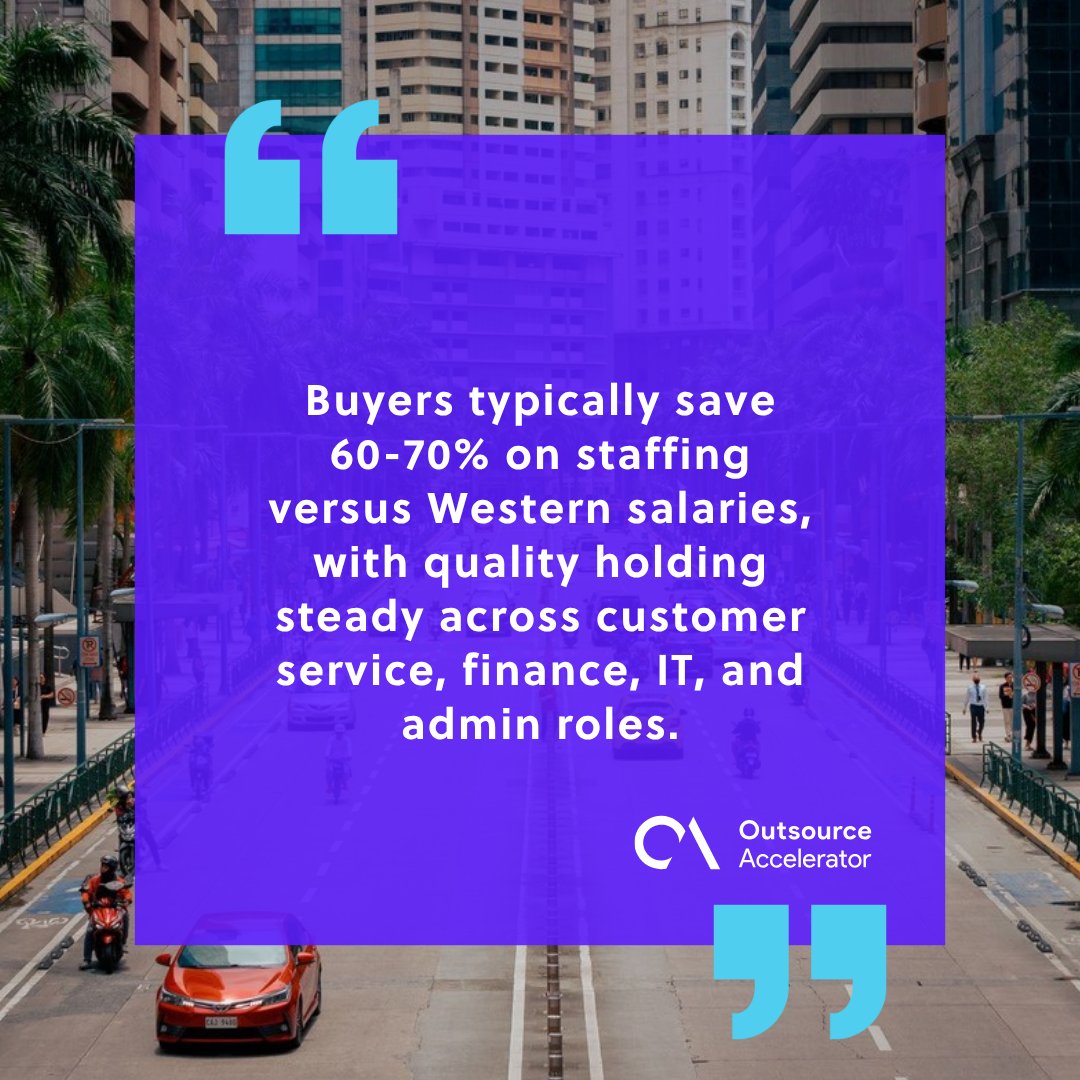
- Buyers typically save 60-70% on staffing versus Western salaries, with quality holding steady across customer service, finance, IT, and admin roles.
- The main risks are time-zone management, data security, and choosing the wrong provider, all of which are manageable with the right contract.
- You can start through a BPO firm, an offshore staffing partner, or by setting up your own entity, depending on headcount and control needs.
Companies weighing outsourcing to the Philippines usually arrive with the same cluster of questions: what it costs, what can be delegated, whether quality holds up, and how to avoid the obvious traps.
This guide answers them in plain terms for both sides of the market, the firms hiring offshore teams and the providers selling the service.
The Philippines has been the leading destination for offshore voice and support work for over a decade, and the fundamentals behind that, language, cost, and a deep talent pool, have not shifted much.
What has changed is how buyers structure deals, which is where most of the confusion now sits.
Why companies keep outsourcing to the Philippines
The short answer is cost, language, and scale, in roughly that order. None of these is a marketing claim; each is measurable.
Filipino English proficiency is the differentiator that competing destinations struggle to match. The country ranks second in Asia and in the “high proficiency” tier of the EF English Proficiency Index, a full band above India.
For customer-facing roles, that gap shows up directly in call quality and customer satisfaction scores.
Cost is the second pillar. A Filipino agent or back-office hire generally runs at a fraction of an equivalent US or Australian salary, and the savings stay intact after you account for provider margins and overhead.
The gap is structural rather than promotional: lower local living costs, a younger median workforce, and a government that has treated the sector as a strategic export all keep wages competitive without forcing a trade-off on output.
Buyers who model the full loaded cost, including recruitment, attrition, and management time, still tend to land well below an onshore equivalent for the same role.
Scale is the third. The sector employs close to 2 million people and posted export revenues above $40 billion in 2025, according to the Philippine Daily Inquirer. That depth means you can hire one bookkeeper or a 200-seat campaign without exhausting the talent pool.
For a fuller treatment of the market, the definitive guide to outsourcing in the Philippines covers the history and economics in more detail.
4 questions buyers ask before outsourcing to the Philippines
Most decisions stall on the same four uncertainties. Here is how each one tends to resolve in practice.
1. What does it actually cost?
Pricing depends on role seniority and engagement model, not just headcount. A seat-based BPO contract bundles labor, real estate, equipment, and management into one monthly fee, while a staff-leasing model itemizes salary plus a transparent markup. Buyers comparing quotes should confirm what sits inside the rate before assuming one is cheaper.
2. Which roles transfer well?
Voice and chat support move first because the language fit is strongest, but finance, IT development, data work, and virtual assistance all scale cleanly. Customer support outsourcing in the Philippines is the most mature category and a sensible starting point for first-time buyers.
3. Will quality hold up?
Quality tracks management, not geography. Teams that get clear documentation, defined metrics, and a named point of contact perform on par with onshore staff. The firms that complain about quality almost always under-invested in onboarding.
4. How do I handle the time zone?
The Philippines sits at GMT+8, which suits Australian and Asian buyers and lets US and UK firms run overnight or follow-the-sun coverage. Treat the time gap as a feature for support work and a logistics question for collaborative roles.
Risks and legal considerations when outsourcing to the Philippines
No offshore arrangement is risk-free, but the recurring problems are predictable and contractual rather than cultural.
Data security tops the list. Insist that any provider handling regulated data demonstrates ISO 27001 controls and, where relevant, HIPAA or PCI DSS compliance, and write those obligations into the master services agreement.
Intellectual property and confidentiality clauses deserve the same scrutiny.
The Philippines also has its own Data Privacy Act, which mirrors much of the GDPR framework, so a competent provider should already operate to a recognized standard rather than treating compliance as a bolt-on.
Continuity is the second concern. Typhoons, power interruptions, and occasional connectivity issues are real, which is why mature providers run redundant sites, backup power, and documented business-continuity plans.
Ask to see those plans rather than taking a reassurance at face value, and confirm where staff sit and how the provider routes work if one location goes offline.
Provider selection is the other common failure point. Vetting references, visiting sites or running video audits, and starting with a small pilot all reduce the odds of a mismatch. The top outsourcing destination overview is a useful primer on what a credible operation looks like.
Outsourcing to the Philippines engagement models compared
The right structure depends on how much control you want and how fast you need to scale. The table below sets out the three common routes.
| Model | Best for | Control level | Setup speed |
|---|---|---|---|
| Managed BPO | Defined processes, fast ramp | Provider-led | Fast |
| Staff leasing / offshore staffing | Dedicated long-term teams | Shared | Moderate |
| Own entity (incorporation) | Large, permanent operations | Full | Slow |
Managed BPO suits buyers who want outcomes without operational overhead. Staff leasing fits firms that want to direct the work but skip the legal and HR burden. Building your own entity makes sense only at scale, when long-run cost and full control outweigh the setup time.
Frequently asked questions about outsourcing to the Philippines
A few questions come up often enough to warrant direct answers.
Is outsourcing to the Philippines only for large companies?
No. Offshore staffing models let small and mid-sized firms hire single roles, so a startup can run a one-person finance function offshore as easily as an enterprise runs a 500-seat center.
How long does it take to get a team running?
A managed BPO team can be live in two to six weeks. Setting up your own entity takes several months once registration and licensing are factored in.
Do I need to fly to the Philippines to set this up?
Not usually. Most engagements are arranged and managed remotely, though a site visit before signing a large contract is a reasonable precaution.
What gets outsourced most often?
Customer support, finance and accounting, IT and software development, data processing, and virtual assistance account for the bulk of offshore demand.
Key takeaways
The decision to outsource offshore rarely fails on the country choice; it fails on execution. Keep these points in view:
- Outsourcing to the Philippines wins on language, cost, and a near-2-million-strong workforce, not hype.
- Match the engagement model to your control and scale needs before comparing prices.
- Treat data security and provider vetting as contract terms, not afterthoughts.
- Start small with a pilot, then scale the roles that prove out.






 Independent





