
Manual vs AI-based policy comparison: What’s more reliable?
This article is a submission by Fusion Business Solution (P) Ltd.-FBSPL. Fusion Business Solution (P) Ltd. (FBSPL) is a Udaipur, India-based company providing Business Process Outsourcing, management, consulting, and IT services, with operations in New York, USA.
Insurance operations depend heavily on accuracy, speed, and compliance.
Among the most critical yet time-consuming tasks is policy comparison. This is the process of reviewing two or more insurance documents to identify differences in coverage, premiums, exclusions, endorsements, and limits.
Traditionally handled manually by brokers and operations teams, this process is now being reshaped by automation and artificial intelligence.
As insurers scale and customer expectations rise, the question is no longer whether policy comparison should be modernized. Instead, the industry is now focused on how reliable AI-based systems are compared to manual review methods.
This article explores both approaches in depth and evaluates which one delivers better accuracy, efficiency, and operational consistency.
Manual policy comparison: Traditional but labor-intensive
Manual policy comparison involves trained professionals reviewing insurance documents line by line. They typically use spreadsheets or side-by-side document checks to identify differences between:
- Renewal policies and existing coverage
- Quotes from multiple carriers
- Endorsements and exclusions
- Premium changes and coverage limits
Strengths of manual comparison
Despite being time-consuming, manual review still offers certain advantages:
- Human judgment: Experienced analysts can interpret ambiguous clauses or complex endorsements.
- Contextual understanding: Humans can consider client history and risk appetite.
- Flexibility: Useful in non-standard or highly customized policies.
Limitations of manual comparison
However, manual processes come with significant drawbacks:
- High error rates: Even experienced reviewers may miss small but critical discrepancies.
- Time-intensive: A single policy comparison can take hours depending on complexity.
- Scalability issues: Workload increases linearly with volume.
- Inconsistent output: Different analysts may interpret documents differently.
In high-volume insurance environments, these limitations often lead to delays, inefficiencies, and increased operational costs.
AI-based policy comparison: A shift toward automation
AI-driven systems are transforming insurance policy comparison by leveraging technologies like natural language processing (NLP), machine learning, and document extraction models. These systems read, structure, and compare insurance documents automatically.
How AI in policy comparison works
Modern AI systems typically follow a structured process:
- Data extraction: Policies are scanned and key data points such as premiums, limits, and endorsements are extracted.
- Structuring: Information is standardized into comparable formats.
- Automated comparison: Differences between policies or quotes are identified instantly.
- Discrepancy flagging: Missing endorsements, mismatches, or coverage gaps are highlighted.
- Output generation: A client-ready comparison report is created.
Advantages of AI-based systems
AI brings several operational improvements:
- Speed: Comparisons that take hours manually can be completed in seconds.
- Consistency: Standardized logic ensures uniform output across all policies.
- Scalability: Can process thousands of documents simultaneously.
- Reduced human error: Minimizes oversight and errors in repetitive tasks.
AI does not replace human expertise but enhances it by handling repetitive and data-heavy tasks.
Manual vs AI: Which is more reliable?
Reliability in policy comparison comes down to three factors: accuracy, consistency, and traceability.
Here’s how manual and AI-driven approaches compare:
Accuracy
Manual comparison relies on human attention to detail. Under tight timelines or complex policy structures, important discrepancies can be missed.
AI-based systems apply the same logic across every document, significantly improving detection of structured data differences.
Consistency
Human interpretation can vary; different reviewers may flag different issues in the same policy. AI eliminates this variability by applying standardized rules, ensuring uniform outputs every time.
Scalability and speed
Manual workflows are time-intensive and difficult to scale during peak volumes. AI systems process large volumes instantly, making them far more efficient for renewals and multi-policy comparisons.
Transparency
Manual reviews often lack clear traceability unless thoroughly documented. AI systems generate structured, traceable outputs that show exactly where differences exist, strengthening audit readiness and compliance.
In essence: AI delivers better results in repetitive, high-volume tasks, while manual expertise remains valuable for interpreting complex or non-standard policy scenarios.
How AI-based policy comparison tools are transforming insurance
Modern insurance operations are increasingly adopting intelligent systems that go beyond basic document review. These advanced tools are redefining how policy comparison fits into the broader workflow.
A key capability of such systems is the automatic extraction and structuring of policy data.
Instead of manually scanning documents, the system identifies critical elements such as premiums, coverage limits, and endorsements within seconds.
Another major improvement is instant comparison across multiple policy versions or carriers. Whether it is a renewal comparison or a multi-carrier quote evaluation, the system highlights mismatches, missing endorsements, and coverage gaps automatically.
This not only reduces review time by up to 70% in many operational setups but also improves communication with clients. The output is structured in a way that is easy to present, ensuring transparency during renewal discussions or underwriting decisions.
Key operational benefits typically include:
- Extraction of policy data in seconds
- Comparison across versions or providers
- Highlighting of mismatches and missing endorsements
- Significant reduction in manual review effort
- Compatibility with multiple formats and insurance carriers
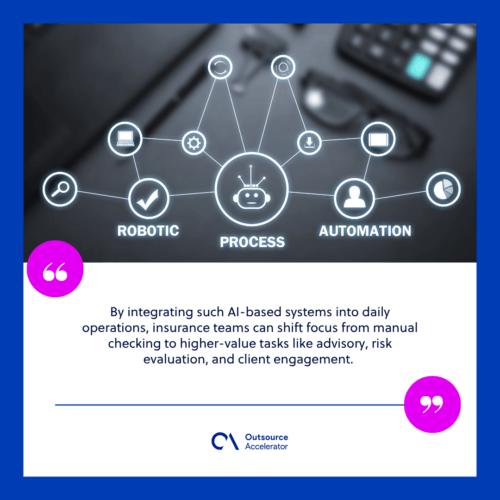
By integrating such AI-based systems into daily operations, insurance teams can shift focus from manual checking to higher-value tasks like advisory, risk evaluation, and client engagement. The result is a more efficient, scalable, and accurate workflow ecosystem.
Future of policy comparison: Human + AI collaboration
The future of AI in policy comparison is not about replacing human expertise but augmenting it. As AI models become more advanced, they will handle increasingly complex document structures, while humans will focus on interpretation, exceptions, and advisory roles.
We are moving toward a hybrid model where:
- AI handles data extraction and comparison
- Humans validate edge cases and complex interpretations
- Systems continuously learn from corrections and feedback
This collaboration will significantly improve accuracy while maintaining the contextual intelligence that only human reviewers can provide.
Striking the right balance: Where reliability truly lies
The debate between manual and AI-based policy comparison is ultimately about efficiency versus interpretation. Manual processes still hold value in complex, judgment-heavy scenarios, but they are no longer viable as the backbone of modern insurance operations.
AI-based systems bring unmatched speed, consistency, and scalability to policy comparison, making them significantly more reliable for structured and high-volume workflows.
However, the most effective approach is not replacement but integration. In this model, AI handles the heavy lifting, and humans ensure contextual accuracy.
As insurance continues to evolve, organizations that adopt intelligent automation early will gain a clear operational advantage in accuracy, turnaround time, and customer satisfaction.






 Independent





