
Hybrid AI-human customer support: When to escalate from bot to human agents


When should hybrid AI-human customer support escalate to a person?
Hybrid AI-human customer support should hand a chat to a human when the issue is complex, emotional, deeply technical, or stuck in a bot loop.
- AI handles fast, simple, high-volume tasks around the clock.
- Human agents step in for judgment, empathy, and hard problems.
- Clear escalation rules decide the exact moment to hand off.
AI has earned its place in customer support. Chatbots answer FAQs in seconds. Virtual agents work day and night. Automated workflows keep ticket queues moving. However, anyone who has dealt with a frustrated customer knows a hard truth: AI customer support cannot do everything.
The fix is hybrid AI-human customer support. This model blends both sides. So it uses AI for speed and scale, and people for judgment and empathy. The real challenge is not whether to use AI. Instead, it is knowing when to hand the chat to a human.
Understanding hybrid AI-human customer support
Hybrid AI-human customer support is just what it sounds like. In this model, AI and human agents work together. Each one plays to its strengths.
AI handles high-volume, repeat tasks. For example, it manages password resets, order tracking, and appointment reminders. Meanwhile, human agents step in when a chat needs nuance or critical thinking.
In this setup, AI does not replace people. Instead, it filters, ranks, and supports them. Bots gather context, sort issues, and even draft replies. As a result, when a human joins the chat, they already know the story and can focus on the fix.
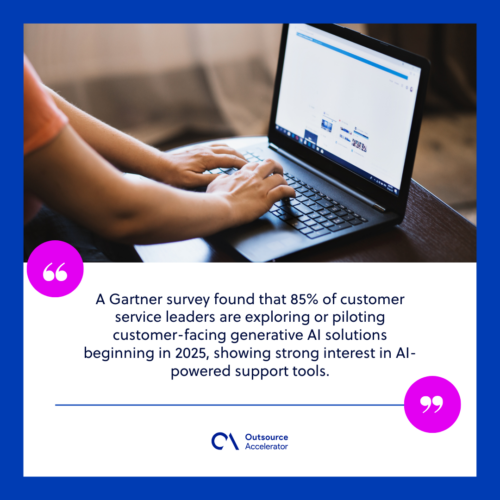
A Gartner survey found that 85% of customer service leaders were exploring or piloting customer-facing generative AI solutions. So interest in AI-powered support tools remains strong. For a wider view of the trend, see these customer experience statistics on AI.
For businesses, the wins are clear. These include faster replies, lower costs, and a steadier experience. For customers, hybrid support means fewer dead ends. In addition, they get real help faster when they truly need it.
What are scenarios that require escalation?
Not every chat should stay with a bot. In fact, knowing when to escalate is what sets good hybrid AI-human customer support apart from frustrating automation.
Research shows that most customers prefer human interaction over AI for service. They cite better understanding, care, and problem-solving. So here are the key triggers that should force a handoff to a person. Some firms even ask whether AI will one day take over, as this piece on AI and call center agents explores.
1. Complex or non-standard requests
AI is great at spotting patterns. However, it struggles when an issue breaks the rules. For example, billing disputes, custom requests, or policy exceptions all need human judgment. So a person should take these.
2. High emotional intensity
AI can detect anger, worry, or stress. However, it cannot offer real empathy. So when a customer is clearly upset, hand the chat to a person. As a result, you calm the tension and protect the long-term relationship.
3. Technical troubleshooting depth
AI can walk users through basic steps well. In fact, studies show that around 62% of customers prefer chatbots for simple queries like order tracking, because they reply at once.
However, deeper issues need human skill. For example, software bugs, integration failures, or outages call for diagnostic thinking. So a trained agent should take over. Strong chatbot best practices help keep the simple cases smooth.
4. Resolution stalls
Sometimes a bot loops or fails within a set time or number of tries. In that case, the system should pass control at once. After all, customers do not want dead-end automation. Instead, they want timely answers.
Best practices for hybrid AI-human customer support
Good hybrid support does not happen by chance. Instead, you must design it with care and run it with clear rules.
1. Establish clear escalation rules
One report found that 88.8% of consumers believe firms should always offer a human agent option. In addition, 93.4% prefer humans over AI even when AI is there.

So define exactly when AI must step aside. Base these rules on clear signals. For example, use negative sentiment, complexity scores, elapsed time, or a direct request. After all, vague rules are the top cause of poor support.
2. Ensure seamless handoffs
When a chat moves from AI to a person, the full context must move too. So customers never repeat themselves. The best systems give agents the whole chat history at once. In addition, they add a clear intent summary and suggested next steps.
3. Empower human agents with AI insights
Use AI insights to augment and empower human agents, not to micromanage them. For example, real-time prompts and sentiment cues help agents work faster. In this way, tools boost speed without stripping away the human touch.
4. Invest in comprehensive training
Training matters for both agents and the AI. Agents must know the AI system’s limits and how to step in with confidence. Meanwhile, the AI must keep learning from solved cases. As a result, it needs fewer handoffs over time.
5. Measure outcome-driven metrics
Track the metrics that matter to customers and the bottom line:
- Escalation rates
- Total resolution times
- Customer satisfaction (CSAT/NPS)
- First-contact resolution
These numbers show whether the hybrid model truly helps. In other words, they reveal if it improves outcomes or just shifts work. To see why this matters, read how customer satisfaction drives business success.
Scale your hybrid customer support with Sourcefit
Effective hybrid AI-human customer support needs more than software. It needs the right people, processes, and know-how. So partnering with Sourcefit makes a difference.
Through Sourcefit WorkingAI, firms can run support models that blend AI speed with skilled agents. These agents know exactly when and how to step in. Meanwhile, AI handles high-volume chats, gathers context, and flags escalation triggers. Then Sourcefit’s trained pros take over the complex, sensitive cases with ease.
This approach lets firms scale AI customer support without losing quality. Instead of overloading internal teams, you gain a flexible support operation. In this setup, humans amplify AI, and AI empowers humans.
Are you ready to move past bots-only or humans-only models? Then Sourcefit can help you build a hybrid AI-human customer support strategy. As a result, you deliver speed, empathy, and results right when customers need them most.
Frequently asked questions
What is hybrid AI-human customer support?
It is a model where AI and human agents work as a team. AI handles fast, simple tasks. Meanwhile, people handle complex or emotional ones.
When should a chatbot hand off to a human?
Hand off when the issue is complex, emotional, or deeply technical. In addition, escalate when a bot loops or stalls without a fix.
Does AI replace human agents in this model?
No. AI supports agents by gathering context and sorting issues. So people stay in charge of the hard, high-stakes conversations.
What metrics show hybrid support is working?
Track escalation rates, resolution times, CSAT or NPS, and first-contact resolution. Together, these show if outcomes truly improve.
Key takeaways
- Hybrid AI-human customer support pairs AI speed with human judgment.
- Escalate to a person for complex, emotional, or deeply technical issues.
- Clear rules and smooth handoffs prevent frustrating dead ends.
- Most consumers still want a human agent option available.
- Track outcome metrics to prove the model helps customers, not just shifts work.






 Independent





