
SWOT template

Definition
SWOT template
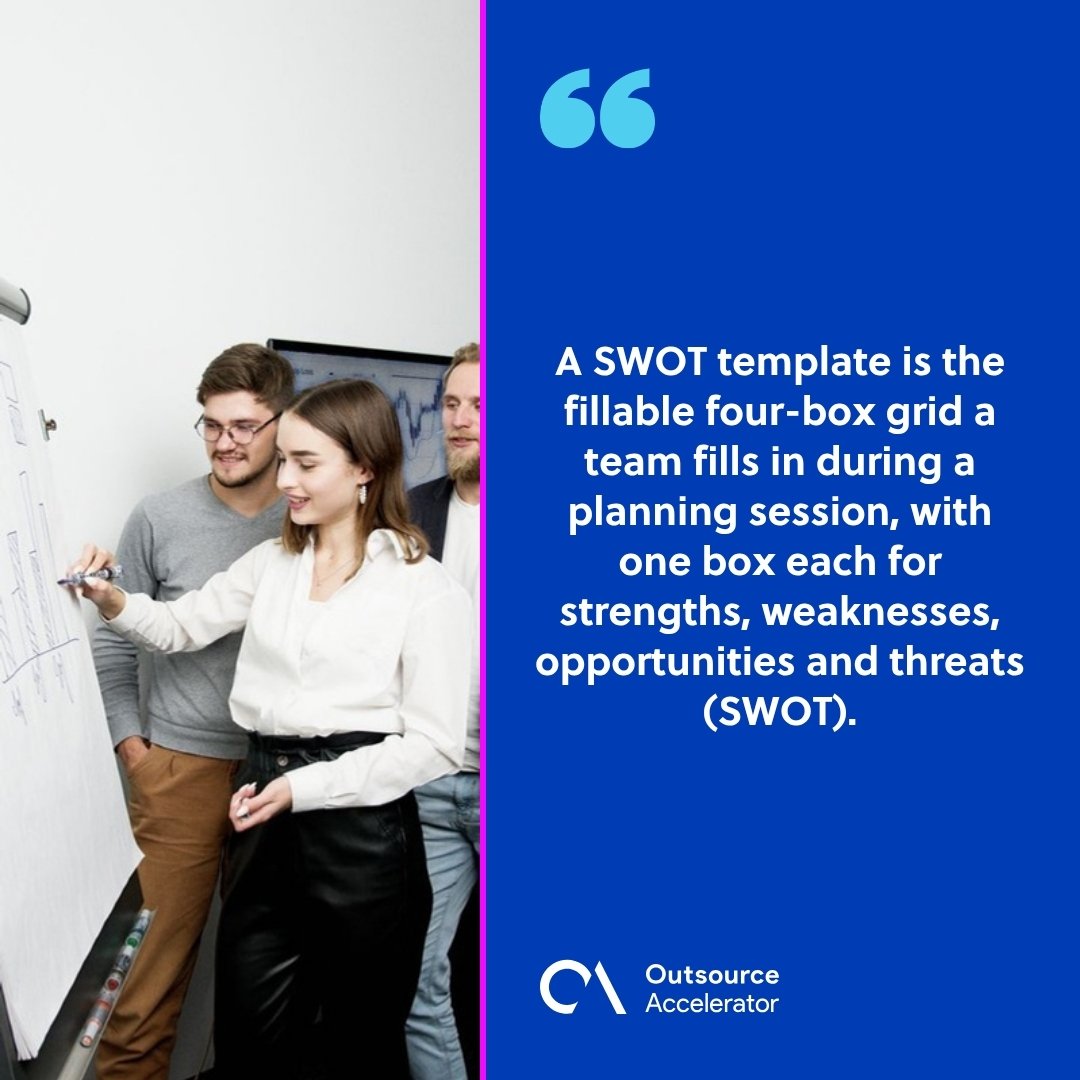
A SWOT template is the fillable four-box grid a team fills in during a planning session, with one box each for strengths, weaknesses, opportunities and threats (SWOT). The grid is the artifact; the thinking it forces out of the room is the real work.
The grid splits two ways. Strengths and weaknesses are internal and largely within your control, while opportunities and threats are external and mostly are not.
That split is the template’s whole value. It stops a team listing nine things it dislikes about itself and calling the result a strategy.
If you want the method’s origins and its critics, that belongs with SWOT analysis. This entry covers the sheet in front of you and how to run a session with it.
Key takeaways
- A SWOT template is a four-box grid: strengths, weaknesses, opportunities, threats.
- The horizontal split is internal versus external; the vertical split is helpful versus harmful.
- Better templates add a second layer that pairs boxes into strategies rather than stopping at lists.
- A template with no named owner or date per line produces a document nobody acts on.
How it works
You fill the four boxes against one stated objective, not against the business in general. Each line should be specific enough to argue with, the group then narrows the lists, and a second pass pairs boxes together to produce actions.
Defining the objective first is the step teams skip. A SWOT run against “the company” produces mush, while one run against “winning mid-market clients in 2027” produces decisions.
| Box | Nature | Prompt that works |
|---|---|---|
| Strengths | Internal, helpful | What do we do that a competitor cannot copy this year? |
| Weaknesses | Internal, harmful | Where do we lose deals or people, repeatedly? |
| Opportunities | External, helpful | What has changed outside that we could move on now? |
| Threats | External, harmful | What would hurt most if it happened next quarter? |
Session mechanics matter as much as the grid. University of Kansas Community Tool Box guidance suggests small breakout groups get 20 to 30 minutes to brainstorm, then narrow the list to roughly ten points or fewer.
Group size shapes the output. Three to ten people per breakout keeps everyone talking, while a single room of thirty hands the exercise to whoever speaks loudest.
The better templates do not stop at four lists. The University of Wisconsin-Madison Division of Extension worksheet uses outer boxes for the four lists and inner boxes for strategies, pairing strengths with opportunities and weaknesses with threats.

That pairing step is what converts a wall of sticky notes into something a manager can be held to. Without it you have a mood board — four tidy lists and no decision at all.
Add two columns most templates leave out — an owner and a date — because a line with neither will still be there, word for word, at next year’s session.
Treat the output as input, not as a plan. Feed it into a gap analysis template or an opportunity qualification framework so each line gets tested properly.
Examples
Three settings show the same grid doing different jobs, running from a published community worksheet through a business unit review to an outsourcing decision taken under real commercial pressure.
A public sector worksheet. The UW-Madison Extension matrix, dated October 2021, is a single landscape page with form fields, designed so a team can brainstorm in step one and write strategies in step two without changing documents.
A business unit review. A strategic business unit running its annual plan will usually complete one template per market rather than one for the unit, because threats differ sharply by geography.
The unit’s strategic intent sets the objective line at the top of each sheet, which keeps the four boxes pointed at the same question.
An outsourcing decision. A firm weighing strategic outsourcing of its finance back office might list in-house process knowledge as a strength and key-person dependency as a weakness.
Offshore talent availability goes in opportunities, transition risk in threats. The pairing step then asks the useful question — how does that strength cover that risk, and by when?
Related terms
- SWOT analysis: the method and its history, where this entry covers the fillable artifact.
- Gap analysis template: compares current state with target state once SWOT has set direction.
- Opportunity qualification framework: tests whether a listed opportunity is worth pursuing.
- Strategic intent: the longer-range ambition a SWOT session should be run against.
- Strategic business unit: the usual level at which a template is completed.
- Strategic outsourcing: a decision type SWOT templates are frequently used to frame.
FAQ
What goes in each box of a SWOT template?
Strengths and weaknesses are internal factors you control, such as skills, cost base and processes. Opportunities and threats are external factors you do not, such as regulation, competitors and demand shifts.
How long should a SWOT session take?
Allow 20 to 30 minutes for brainstorming per breakout group, then time to narrow and pair. A full session with discussion and strategy pairing usually needs two to three hours.
How many points should each box hold?
Fewer than people want to write. Narrowing each box to around ten points or fewer forces the group to argue about priority, which is where the value sits.
Should a SWOT template include scores or weights?
Optional, and useful when you must rank items. A simple high, medium or low impact column beats an elaborate numeric model that nobody can defend.
Who should be in the room?
A mix of functions, including people close to customers and delivery. A template filled in by the leadership team alone reliably misses the weaknesses everyone below them already discusses.
What makes a SWOT template fail?
Vague lines with no owner. “Improve communication” survives every review because nobody can prove it did not happen, whereas “cut quote turnaround to 48 hours by March” cannot hide.
Browse Outsource Accelerator for research and provider data to fill the external half of your grid.






 Independent






