
Subscription pricing

Definition
Subscription pricing
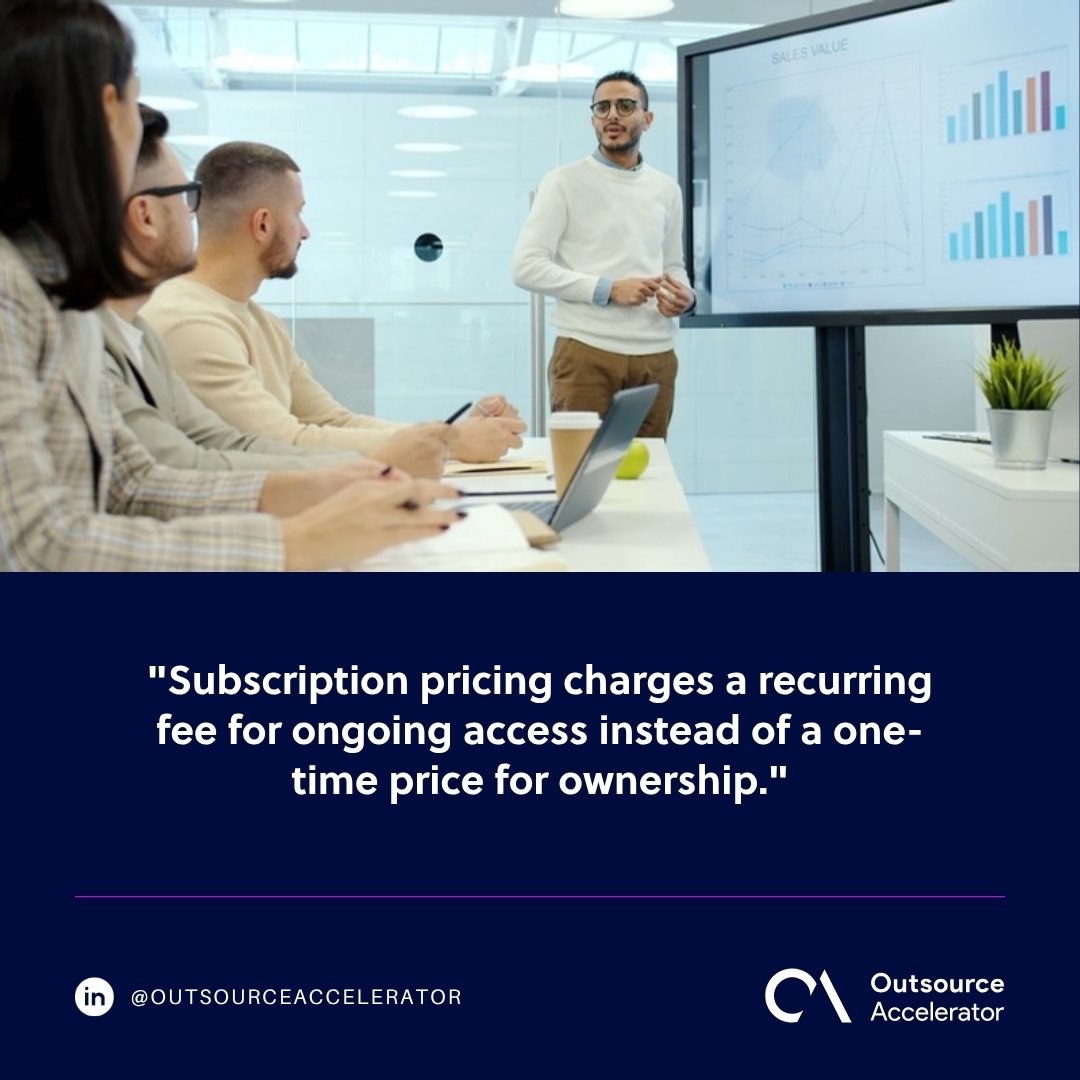
Subscription pricing charges a recurring fee for ongoing access instead of a one-time price for ownership. The seller sets a billing period, a unit of charge such as a seat or a usage tier, and the terms covering renewal, upgrade and cancellation.
Three decisions make the price. What you charge for, how often you charge, and what happens at renewal if nothing is said.
Get the unit wrong and everything downstream breaks. Charging per seat for a product used by one administrator caps your revenue; charging per transaction for a tool with unpredictable volume scares off the finance team.
The billing period carries the rest. Monthly plans lower the barrier to entry, annual plans cut cancellations and improve cash flow, and multi-year commitments buy a discount in exchange for certainty.
Price is also a positioning signal. The same software at $9 and at $900 a month attracts different buyers — and different support expectations, and a different sales motion.
Key takeaways
- The charging unit matters more than the headline number — it decides how revenue grows.
- Annual and multi-year terms trade price for predictability on both sides.
- Tiers work when each one is named after a customer type, not a feature count.
- Renewal, upgrade and cancellation terms are part of the price, not administrative detail.
How it works
Subscription pricing sets a recurring charge against a defined unit of value. The seller picks the unit, the period and the commitment length, then builds tiers or usage bands around them. Renewal and cancellation rules complete the structure.
| Model | Charging unit | Fits best when |
|---|---|---|
| Per seat | named user per month | usage scales with headcount |
| Usage-based | transactions or volume consumed | consumption varies widely by account |
| Tiered | a packaged bundle of limits | buyers sort into clear segments |
| Flat rate | one price, unlimited use | usage is predictable and support is light |
| Commitment | pre-purchased volume or spend | the buyer wants a discount for certainty |
Most mature sellers blend them. A platform fee plus usage-based billing covers fixed cost while letting revenue follow growth in the account.
Tier design is where margin leaks. A well-built tiered pricing ladder gives every tier an obvious buyer, while a badly built one pushes everyone to the cheapest option.
Packaging decides who upgrades. If the limit a growing customer hits first is the one you priced, expansion happens on its own — if it isn’t, you renegotiate the account every year.
Discounting is the quiet problem. Each concession made to close a deal shows up later in the pricing waterfall as the gap between list price and the cash you actually bank.
Set the policy before the deals start. A written pricing strategy playbook stops every sales rep inventing a private discount ladder under quarter-end pressure.
Grandfathering is the hidden cost of change. Every repricing leaves a tail of customers on old plans — and the longer that tail runs, the harder the billing system is to maintain.
Operations have to keep up. Proration, mid-term upgrades, failed cards and credits need a billing analyst and clean process, or the pricing model will outrun the finance team running it.
Examples
Cloud platforms, software vendors and regulated consumer subscriptions show the three pressures on subscription pricing: committing buyers to longer terms, packaging value into tiers, and treating renewal terms as a legal matter rather than a marketing one.
Cloud computing made commitment pricing standard. Amazon Web Services documents that Savings Plans let customers save up to 72% for a one- or three-year commitment to a set hourly spend.
Consumer subscription terms are now regulated. The United Kingdom’s Digital Markets, Competition and Consumers Act 2024 obliges traders to give pre-contract information and to send reminder notices before renewal payments, with most provisions phased into force.
Software vendors still lead on tiers. The familiar free, team, business and enterprise ladder exists so a buyer self-selects, and so a freemium business model can hand qualified users to a sales team.
Media and consumer apps price on access instead. A streaming service charging less for an ad-supported plan is selling one catalogue at two prices, to two different tolerances for interruption.
Outsourcing providers have adopted the shape as well. Managed services are increasingly sold as a monthly subscription per supported seat, with overage bands, rather than as a quoted project price.
Related terms
These terms cover the structures either side of subscription pricing: the model variants you pick between, the discipline that governs the choice, and the operational roles that keep recurring invoices accurate month after month.
- Tiered pricing: packages service levels into priced bands buyers self-select from.
- Usage-based billing: charges by consumption instead of a fixed periodic fee.
- Freemium business model: gives a free tier away to create paid upgrade demand.
- Pricing strategy playbook: documents how a company sets, tests and defends prices.
- Billing coordinator: keeps recurring invoices, credits and proration accurate.
FAQ
The practical questions are about choosing a unit, pricing annual terms against monthly ones, how often to raise prices, and what a buyer should read before signing a recurring contract.
How do I choose the charging unit?
Pick the thing that grows when the customer gets more value. If value tracks headcount, charge per seat; if it tracks volume, charge per transaction.
How big should the annual discount be?
Commonly the equivalent of one to two months free. The point is to cover the cancellation risk you avoid, not to win the deal on price.
How often can prices be raised?
Usually once a year, announced before renewal and applied to the next term. Mid-term increases on existing customers damage trust faster than any gain they produce.
What should a buyer check before signing?
Auto-renewal terms, notice periods, proration on upgrades and downgrades, and whether usage overage is capped. Those four clauses decide the real cost of the contract.
Does subscription pricing work for outsourced services?
Yes, for steady-state work with predictable volumes. Project-based or highly variable scopes are usually better priced hourly or per outcome.
Should prices be published on the website?
Publish them for self-serve products, where buyers compare before they ever speak to anyone. Enterprise deals with heavy configuration usually stay on request, though a visible starting figure still saves both sides a wasted call.
To compare how providers price managed services, browse costs and offers in the Outsource Accelerator directory.






 Independent






