
Stakeholder mapping

Definition
Stakeholder mapping
Stakeholder mapping is the practice of identifying everyone a project affects, then plotting each group by the power it holds and the interest it takes. The result shows who must be consulted and who only needs informing, so limited attention lands where it matters.
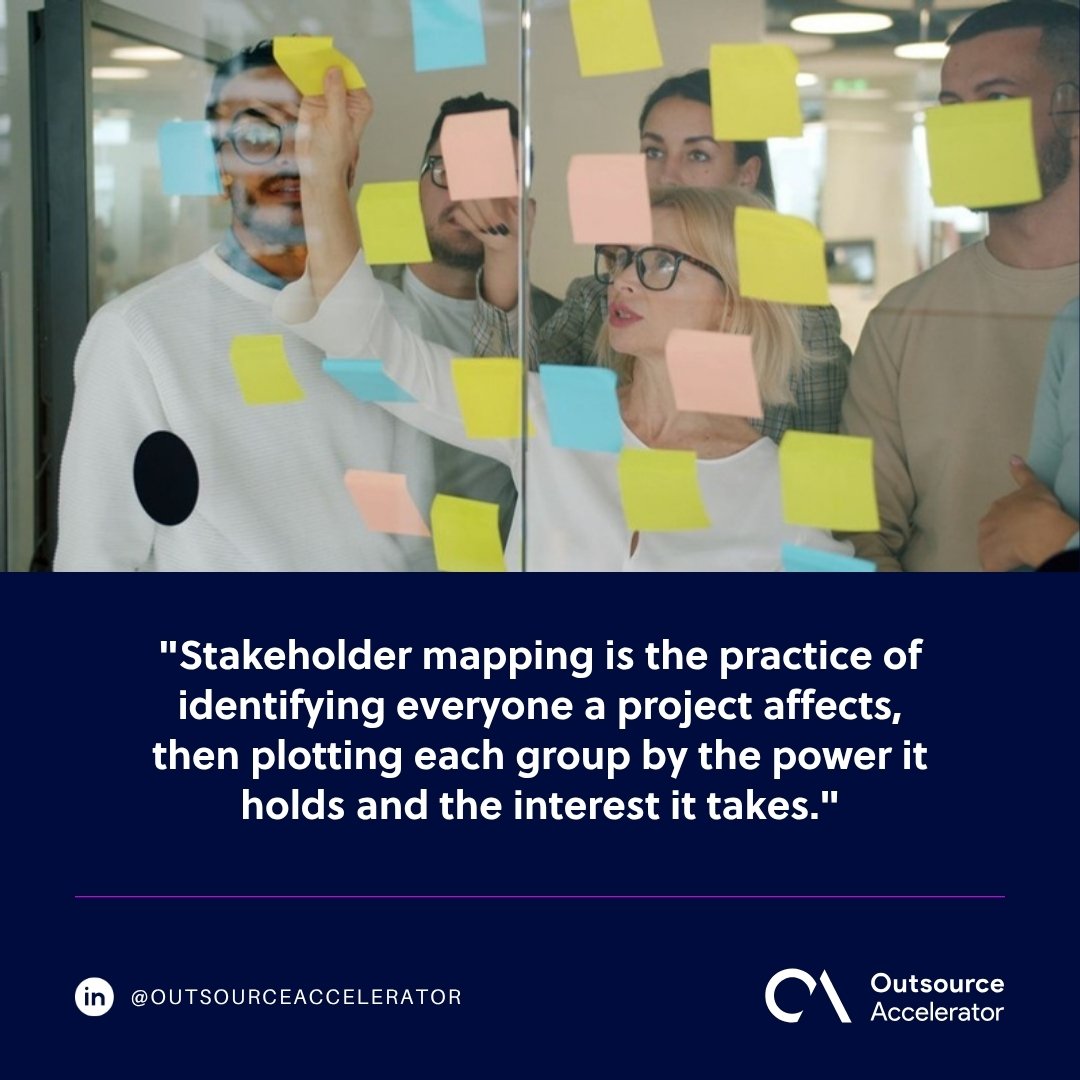
The map itself is simple. Two axes, four boxes, and a name in every box. What makes it useful is the argument behind it: someone has to say out loud whose opinion carries weight.
Outsourcing makes that harder than it sounds. One contract can touch finance, IT security, a works council, a client’s own customers, and a regulator in another country. Miss one group and the work stalls late, when fixing it costs most.
The cost of missing someone shows up late. Unmapped groups are a common source of change management fees, because a request that should have been scoped in week two lands in month six.
Mapping is also not a one-off exercise — people change jobs, budgets move, and a quiet sponsor turns loud. Good teams redraw the map at each phase gate and keep the previous version for comparison.
Key takeaways
- Stakeholder mapping sorts people by power and interest, never by job title.
- The map rations attention: high power plus high interest gets managed closely.
- Outsourced work widens the list to provider staff, subcontractors and regulators.
- Redraw the map at every phase gate, because influence moves faster than org charts.
How it works
Stakeholder mapping runs in four moves: list everyone the work touches, score each one on power and interest, place them on a two-by-two grid, then agree a contact plan per quadrant. The grid is the shortcut; the conversation behind it is the value.
Scoring is where teams argue, and the argument is the point. A land-use planning worksheet from the University of Wisconsin-Extension rates each group on power, influence, impact, interest and support before anyone picks a tactic.
Pick two of those dimensions for your axes and keep the rest as notes. Influence mapping handles the leftovers well, because it charts who listens to whom rather than where each name sits.
Keep the scoring crude. A one-to-five scale for power and the same for interest is enough, and a long argument over a three versus a four usually means you need better evidence about that group — not a finer scale.
| Power | Interest | Quadrant | Contact plan |
|---|---|---|---|
| High | High | Manage closely | Named sponsor, joint planning, weekly contact |
| High | Low | Keep satisfied | Short briefings, escalate only what they asked for |
| Low | High | Keep informed | Demos, newsletters, open office hours |
| Low | Low | Monitor | Light-touch updates, watch for a change of position |
The output then has to live somewhere useful. Park it in the project charter template beside the sponsor’s name, and feed it into the communication plan that sets who hears what, and how often.
Examples
Mapping shows up wherever a decision needs consent from people who do not report to you. Public programmes, community planning and offshore transitions all use the same grid, and the first two publish enough detail to learn from directly.
The UK’s Prosperity Fund evaluation team built one in February 2018. Ambassadors and heads of mission held strong formal power over the work; the UK media held almost none, yet shaped the politics around it.
The team’s reason for ranking anyone at all was blunt. Its evaluators recorded that management time is limited and cannot be spread evenly, so relationships had to be ranked.
The University of Wisconsin-Extension uses a four-box version in community land-use training published in 2020. Its quadrants are named for behaviour rather than rank: advocate, supporter, latent and indifferent.
A 300-seat contact centre transition usually maps three layers at once: the client’s operations lead, the provider’s site director, and the frontline supervisors who train their replacements. Skip that third layer — attrition will do the arguing for you.
Regulators deserve their own row. In cross-border outsourcing they rarely attend a meeting, yet they can stop a go-live, which puts them in the high-power box whatever their level of interest looks like.
The project coordinator is normally the person who keeps all these layers in contact once the map is agreed.
Related terms
Five neighbouring terms cover the work a map starts but cannot finish: the relationships behind the grid, the messages that follow it, the document that records the sponsor, the person who keeps the rhythm, and the cost of late surprises.
- Influence Mapping: charts the relationships between stakeholders rather than their position on a grid.
- Communication Plan: sets the message, channel and frequency each stakeholder group receives.
- Project Charter Template: records the sponsor, scope and authority your map helps confirm.
- Project Coordinator: keeps the contact rhythm the map prescribes actually happening.
- Change Management Fees: prices the scope changes that unmapped stakeholders tend to trigger.
FAQ
Six questions come up on nearly every first attempt at a map: what it is for, who belongs on it, how often it changes, whether stakeholders should see it, who owns it, and how it differs from influence mapping.
What is stakeholder mapping used for?
It decides where finite attention goes. The map tells you which groups get joint planning and which get a monthly email, before anyone wastes a meeting.
Who belongs on a stakeholder map?
Anyone who can approve, fund, block, deliver or feel the project. In outsourced work that includes the provider’s managers, its subcontractors and often a regulator.
How often should the map be redrawn?
At every phase gate, and any time a sponsor changes. Quarterly is the slowest safe rhythm on a live programme.
Should stakeholders see their own map?
Usually not in raw form. Share the contact plan it produces instead — few people enjoy reading that they sit in the “monitor” box.
Who owns the stakeholder map?
The project or programme manager owns it, usually with the sponsor’s sign-off. One named owner stops it becoming a shared document that nobody updates.
How does stakeholder mapping differ from influence mapping?
Stakeholder mapping places each group on a grid of power and interest. Influence mapping draws the lines between them, showing whose opinion travels through whom.
Start your research at Outsource Accelerator before your next transition reaches the table.






 Independent






