
Why remote companies need an employer of record


Why do remote companies need an employer of record?
Remote companies need an employer of record because it becomes the legal employer of their overseas staff, so it handles payroll, taxes, benefits, and local compliance while the company keeps control of the daily work.
- An employer of record (EOR) takes on the legal and administrative load of hiring across borders.
- It keeps a remote team compliant with local labor laws, so the risk of fines and disputes drops.
- It lets a growing company hire in new countries fast, without setting up a local entity.
Remote work has reshaped how businesses operate and how people work. Because of this shift, companies can now reach a global talent pool. As a result, they build diverse teams with strong skills. Still, managing a remote workforce brings its own challenges. Compliance, legal duties, and HR admin are the hardest of them.
In the 445th episode of the Outsource Accelerator podcast, Remotify.ph’s CEO Maria Sucgang explained why an employer of record matters to remote companies.
“One of the major caps we’ve identified is that most people working 100% remote are usually gig workers without employers on record. And that typically means they’re paid directly by foreign clients without social contributions or proper taxes filed.”
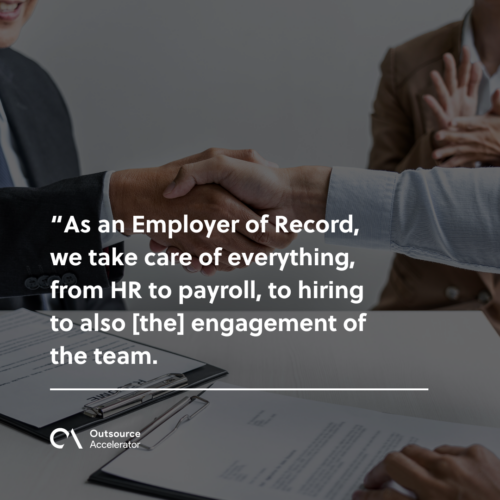
“As an Employer of Record, we take care of everything, from HR to payroll, to hiring to also [the] engagement of the team. We afford our clients control over their day-to-day operation, [and] make sure that there’s proper KPIs in place, there’s attendance, timekeeping, there’s all of these things.”
What is an employer of record?
An employer of record, often called an EOR, is a third party that acts as the legal employer for a group of workers. In this role, the EOR takes on payroll, benefits, tax compliance, and other employment tasks.
So by partnering with an employer of record, companies can offload the admin of hiring, onboarding, and managing staff. As a result, they can focus on their core business. The model also pairs well with wider HR outsourcing when a firm wants to lighten its back office.
In addition, an EOR brings peace of mind on compliance. Employment rules, tax laws, and HR duties keep changing. They are hard to track, especially for remote companies with workers across different jurisdictions. An employer of record stays current with these rules. In turn, it makes sure companies meet their legal duties, which cuts the risk of penalties, fines, or disputes.
EORs also know the unique challenges of remote work. For example, they handle remote onboarding, local labor-law compliance, and international payroll. This takes the pain out of managing a spread-out team. So companies can focus on building and growing their remote workforce. To see how it compares with other models, read the employer of record model explained.
Advantages of using an employer of record
Partnering with an employer of record offers clear advantages for modern businesses. By handing key employment duties to an EOR, companies gain on efficiency, compliance, and overall results. Here are the main benefits.
Compliance and risk mitigation
Employment rules, tax laws, and HR compliance can feel daunting. However, an EOR brings the know-how to keep every employment matter legal. As a result, the risk of penalties, fines, and disputes falls. That gives employers real peace of mind. Payroll is a big part of this, so it helps to weigh the pros and cons of payroll outsourcing too.
Efficient workforce management
An EOR handles admin tasks like payroll, benefits, and tax filings. Because of this, companies can streamline how they manage staff. The employer of record also oversees onboarding, exits, and other HR work. So businesses are free to focus on strategy and core strengths.
Easier global expansion
For firms that want to grow abroad, an EOR can be a valuable partner. EORs know local labor laws and regulations, so they make a compliant presence in new markets easier. In practice, they handle visa processing, local payroll, and benefits. This smooths the move into new territories. Many pair the EOR with an international payroll setup to keep cross-border pay clean.
Are the services of an employer of record right for you?
An employer of record offers many benefits. Even so, it helps to check whether it fits your goals. Consider the factors below to decide if an EOR is right for you.
Business scale and growth plans
In general, EORs suit companies that are growing fast or plan to expand. Is your firm scaling quickly or aiming for new hires abroad? If so, an employer of record can give you the support to manage a growing team well. A PEO partnership is a close option worth comparing here.
Geographic expansion
Are you entering new markets or operating across many jurisdictions? Then an EOR can simplify compliance, local labor laws, and admin. Its skill with diverse legal frameworks and local culture can speed up your expansion.
Resource optimization
To decide, look at your internal HR capacity and the time spent on admin. Do these tasks pull your HR team away from strategy? If they do, an EOR can help optimize your HR resources. By outsourcing time-heavy admin, your HR team can focus on work that drives the business forward.
Frequently asked questions about employers of record
Here are common questions remote companies ask about using an employer of record.
What is the difference between an EOR and a PEO?
An EOR becomes the legal employer of your workers, so it can hire in a country where you have no entity. A PEO co-employs staff alongside your own legal entity. In short, an EOR removes the need to set up a local company, while a PEO shares duties with one you already have.
Does an employer of record control my employees?
No. The EOR is the legal employer on paper only. You still set the tasks, priorities, and daily direction. Meanwhile, the EOR handles payroll, benefits, and compliance in the background.
How fast can an EOR help me hire abroad?
Often within days or a few weeks. Because the EOR already has a local entity in place, you skip the months it takes to register your own. As a result, you can onboard a new hire quickly.
Is an employer of record worth the cost for a small team?
For many small firms, yes. A single wrong tax filing abroad can cost far more than EOR fees. So even a one or two-person remote team can gain from the compliance cover.
Which companies benefit most from an EOR?
Fast-growing firms, remote-first startups, and any business hiring across borders benefit most. In each case, the EOR removes legal risk and admin so leaders can focus on growth.






 Independent






