
The best remote certifications to have in 2026


What are the best remote work certifications to have?
The best remote work certifications are online credentials in marketing, HR, sales, project management, and cloud tech that prove your skills to employers anywhere.
- You can earn them fully online, from any location.
- They help you stand out, win raises, and land better roles.
- Top options come from Microsoft, Google, Cisco, PMI, and HubSpot.
Many jobs today run from anywhere with an internet link. So now is a great time to look at remote work certifications. As a remote worker, the right credential can set you apart from the crowd.
What is a remote certification?
A remote certification is an official credential earned online. In short, it proves your skill or status in a field.
You complete the training and tests virtually. As a result, you can study and pass exams from anywhere.
These programs grew fast with the rise of remote work. Because of this, workers can grow their careers without visiting a test center.
Platforms like LinkedIn now offer many programs, including data science. For example, a data science credential can boost your job prospects. In fact, employers value candidates with current, relevant skills.
Examples of remote work certifications
Certifications help you stand out in a crowded market. In addition, some employers require them for a raise or promotion. Here are a few of the best remote work certifications to consider.
Marketing certifications
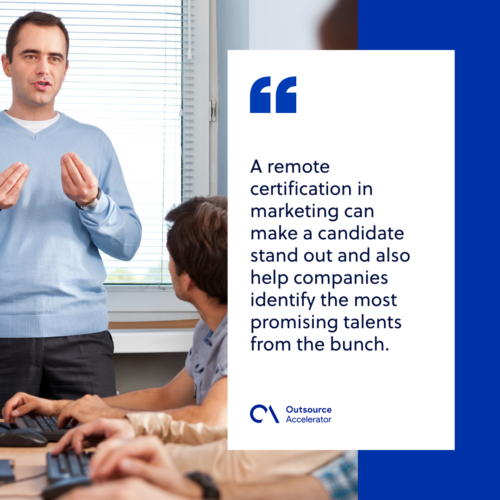
Marketing roles are in high demand, especially digital ones. As a result, a digital marketing credential can help you stand out.
It also helps firms spot strong talent fast. For example, badges from Facebook Blueprint or Hootsuite show real skill. In addition, Coursera and LinkedIn Learning offer hands-on programs.
Business analyst certifications
Business analysts study processes, products, and systems. As a result, they help firms boost efficiency and profit. They also use data and IT to guide big decisions.
The International Institute of Business Analysis (IIBA) offers remote credentials. In fact, its levels run from entry to senior.
Human resource certifications
A credential in human resources (HR) shows real drive. It also signals your leadership skills to employers.
The HR Certification Institute (HRCI) is a well-known body here. For example, it offers the PHR and SPHR designations.
Sales certifications
Salespeople often invest in more training. So a sales credential can keep you ahead of rivals. It also sharpens the knowledge you already have.
Platforms such as HubSpot Academy offer sales credentials. In addition, you can display them on LinkedIn.
Project Management Professional (PMP) certification
The PMP is a global credential for project managers. The Project Management Institute (PMI) runs it. As a result, many view it as one of the most respected badges in the field.
Which remote work certifications are most in demand?
Certifications prove you can do the job. Here are some of the most sought-after remote work certifications today.
Microsoft certifications
Remote credentials from Microsoft suit IT and cloud pros. They range from basic to role-based. However, each path requires a set of exams.
Google Cloud certifications
Demand for data and cloud skills stays strong. As a result, a Google Cloud certification can lift your pay. Options include Cloud Digital Leader, Data Engineer, and Cloud Security Engineer.
Cisco certifications
Leading IT and networking company, Cisco offers well-known credentials. In fact, they span entry, professional, and expert levels. Network engineers and admins gain the most from them.
Google digital marketing certification
Google runs marketing courses through Google Skillshop. As a result, you can prove your skill with Google tools. In addition, these badges look strong on any resume.
How to get remote work certifications
Each certification has its own rules. Some need years of experience or several exams. However, many programs stay simple as long as you finish the courses online. Here are the basic steps.
Step 1: Choose the credential you need
First, pick the certification that fits your goals. Your employer may suggest a set for remote roles. Next, tune your resume for applicant tracking systems. As a result, more recruiters will see your profile.
Step 2: Apply and get approved
Then fill in the application form with your experience. After that, the provider reviews and approves your request.
Step 3: Complete your course or training
Most courses include guides, videos, and exams. Once you finish, the provider emails your certificate. Finally, add it to your resume or send it to your employer.
Frequently asked questions
What are remote work certifications?
They are online credentials that prove your skills. In short, you earn them fully online, from anywhere. As a result, they help you compete for remote roles.
Are remote certifications worth it?
Yes, for most workers. They can help you win raises, promotions, and new roles. In fact, many employers now expect current, proven skills.
Which remote certifications pay the most?
Cloud and IT credentials often lead on pay. For example, Microsoft, Google Cloud, and Cisco badges rank high. Still, results depend on your role and market.
How long does it take to get a remote certification?
It varies by program. Some take a few weeks, while others take months. So check the course length before you enroll.
Do I need experience to earn one?
Not always. Many entry-level programs need no prior experience. However, senior credentials often require years in the field.
Key takeaways
- Remote work certifications prove your skills to employers anywhere.
- Strong fields include marketing, HR, sales, project management, and cloud tech.
- Top providers include Microsoft, Google, Cisco, PMI, and HubSpot.
- Most badges take weeks to months and can be earned fully online.
- First choose the right credential, then apply, study, and pass.






 Independent





