
Revolutionize your workforce with flexible staffing solutions

What are flexible staffing solutions and how do they help?
Flexible staffing solutions let you scale your workforce up or down as demand shifts, so you pay for talent only when you need it.
- They give fast access to temporary workers, freelancers, and specialists.
- They cut fixed payroll costs during slow periods.
- They help teams stay agile without long-term hiring risk.
The old idea of a fixed workforce is changing. Today, businesses use flexible staffing solutions to adapt fast, lift productivity, and grow talent. So this model has become a real game-changer. But what are flexible staffing solutions, and how can they reshape your business?
In the 466th episode of the Outsource Accelerator podcast, Catherine vanVonno of 20Four7VA explained how her company runs flexible staffing.
What are flexible staffing solutions?
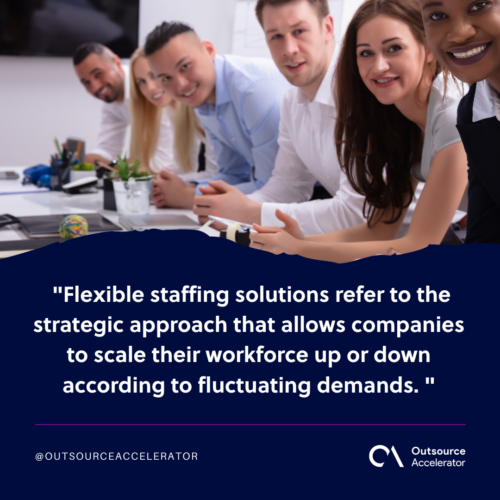
Flexible staffing solutions are a strategy that lets companies scale their workforce up or down with demand. Unlike permanent hires, they let you onboard temporary workers and freelancers for set projects or timeframes. As a result, you match staffing to real need.
This model overlaps with other agile hiring approaches. For example, many firms blend it with staff leasing or seasonal hires to cover demand spikes.
Benefits of flexible staffing solutions
Flexible staffing solutions offer clear benefits for both employers and workers. Here are the main ones.
Cost efficiency
Flexible staffing brings real cost advantages. It removes the burden of permanent hires during slow periods. So you pay only for the talent you need, which lowers overhead.
Specialized skills
Need a niche skill for a short project? Flexible staffing gives you access to a diverse pool of specialized professionals. As a result, you get the right expertise at the right time without a long-term tie.
Improved productivity
Flexible staffing prevents both shortages and overload. It adapts quickly to workload swings. So teams keep a balanced load, which lifts overall productivity.
Diverse perspectives
Embracing diversity in staffing brings fresh ideas. Different backgrounds enrich problem-solving and creativity at work. Over time, this variety can spark real innovation.
Implementing flexible staffing solutions
Putting flexible staffing to work takes a few key steps.
Assessment of needs
First, review your demand and find gaps that temporary staff could fill. Then look at project scope and timelines to gauge the workforce swings you expect.
Develop a strategy
Next, build a flexible staffing strategy that fits your goals.
- Determine the roles suitable for flexible staffing
- Outline recruitment processes
- Establish criteria for hiring temporary staff.
Seasonal demand often shapes this plan. For instance, retail and logistics firms lean on seasonal employment to cover peak months.
Training and onboarding
Then streamline onboarding so temporary staff settle in fast. Provide training, share your culture, and explain project goals clearly.
Legal and compliance considerations
Finally, handle the legal and compliance side of a mixed workforce. Make sure you follow labor laws and local rules.
BPOs’ flexible staffing processes
Outsourcing firms like 20Four7VA use flexible staffing because of how they work and what clients need. Here is how 20Four7VA usually runs it. Many gig economy platforms follow a similar on-demand model.
Candidate selection and facilitation
In the podcast, Catherine shared how 20Four7VA gives businesses a range of remote skill sets. “We match client job descriptions to our talent pool, and hopefully, the client finds someone interesting.” She added, “We facilitate the interviews. If the client hires that worker, that worker reports directly to them. Our role involves conducting background checks.” In this way, 20Four7VA supports staffing and recruitment without taking over the client’s team.
Support and monitoring
Catherine also described the support they give clients who hire remote workers. “We monitor the attendance, we have a time-tracking app, we do the payroll processing,” she said. The CEO added that some clients choose temporary, seasonal hires, while others aim for permanent roles. For long-term clients, an HR unit guides them through annual performance reviews.
Transparent fee structure and client support
The company’s rule for employees who meet client expectations is that they “get the cost of living increase or any type of bonuses.” Any bonuses or rate increases to the worker are all direct pass-throughs. 20Four7 “doesn’t take any additional percentage like Upwork does.” The CEO added, “We do all the heavy lifting for the clients. And we help them onboard and give them a road map for success.”
Extending HR support beyond borders
Catherine shared how team structure changes as a company grows. “They’re all departmentalized, they’re considered staff, they’re not VAs,” she said. She then explored the complexity of HR compliance across a distributed team. “We have HR compliance measures in place. We have partnered with a third-party HR compliance company that assists us in managing employer records and contracts for localized contract workers. This support extends beyond the Philippines, where we operate.” As a result, clients gain reach without building their own global HR.
Embrace innovation through flexible staffing solutions
Flexible staffing solutions help firms stay agile and competitive. By using smart staffing practices, businesses gain adaptability, efficiency, and better talent use. Done well, this approach also supports broader offshore staffing benefits like access to a wider talent pool.
Here are key ways to drive innovation through flexible staffing solutions:
- Agile talent acquisition. Use technology and data to speed up hiring and find candidates with the right skills and culture fit.
- Gig economy integration. Tap online platforms that connect you with on-demand talent for fast access to niche skills.
- Cross-functional teams. Form teams with mixed skill sets to boost collaboration and fresh problem-solving.
- Remote work enablement. Offer remote options to reach a global talent pool and give staff more flexibility.
In short, flexible staffing means rethinking old employment models. It builds a culture of adaptability, learning, and creativity. By doing so, firms can thrive.
Frequently asked questions
What is the difference between flexible staffing and permanent hiring?
Permanent hiring adds fixed, long-term roles. Flexible staffing, by contrast, brings in temporary workers or freelancers for set needs. So you can scale the team without carrying fixed payroll in slow periods.
Which roles work best for flexible staffing?
Project work, seasonal demand, and niche skills fit this model well. For example, design, customer support, and admin tasks are common. Still, review each role to confirm it suits short-term staffing.
How do flexible staffing solutions save money?
You pay only for the talent you use. As a result, you avoid idle payroll during quiet spells and cut overhead tied to permanent hires.
Do flexible staffing solutions affect quality?
No, not when managed well. Clear onboarding, training, and monitoring keep standards high. In addition, specialists often bring expertise that lifts output.
How can a BPO support flexible staffing?
A BPO matches talent, runs interviews, and handles background checks. It can also manage attendance, time tracking, and payroll. So you gain a flexible team without the admin load.






 Independent






